Best Spice Organizers and Racks (Tested in Real Kitchens)
In brief: The best spice organizer is the one that fits where your spices already live. With a drawer at least 3 inches deep, the SpaceAid bamboo insert has the biggest daily payoff. Working out of a cabinet, a 3-tier expandable bamboo shelf costs far less and solves the same problem. This guide is organized by place first, product second.
As an Amazon Associate, I earn from qualifying purchases. This costs you nothing extra and helps fund the research behind these reviews.
I have counted my spice jars exactly once, and I regretted it: thirty-four. That number is why the usual advice — “buy a spice rack” — fails most kitchens. A rack holds twelve. The real question is where thirty-odd jars should go in your kitchen, and only then which product fits that spot. Across the picks below, the same pattern shows up again and again in verified buyer reviews: people who choose the location first stay organized; people who buy a pretty rack first are back to a jumbled cabinet by spring.
Where should your spices actually live?
There are six realistic homes for a spice collection, and each has a different failure mode. A drawer gives the best label visibility because you look down at the lids, but it costs you a whole drawer. A cabinet shelf is free real estate you already own, though anything past the second row disappears — a pull-out rack fixes that, at the price of an installation afternoon. Wall and door racks claim dead space but hold the fewest jars.
| If your kitchen has… | Put spices here | The trade-off |
|---|---|---|
| A spare drawer 3″+ deep | In-drawer tiered insert | Best visibility; costs you a drawer |
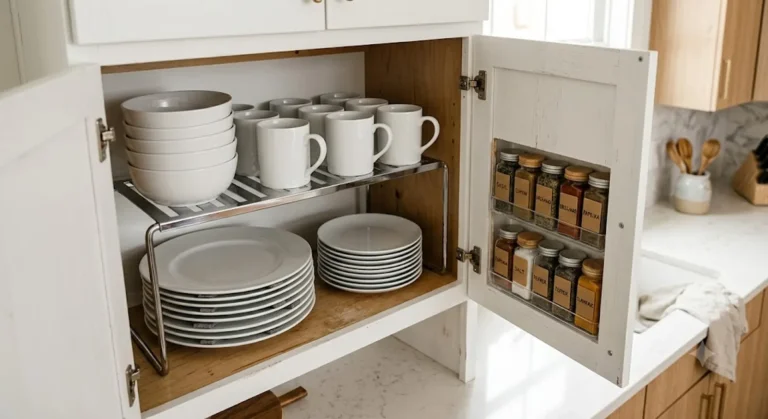
| Cabinet space but no spare drawer | Tiered shelf riser | Cheapest fix; back row still shallow |
| A deep, dark cabinet | Slide-out pull-out rack | Reaches the back; needs installing |
| Wall or cabinet-door space | Wall-mounted rack | Uses dead space; holds the least |
| Steel fridge, tiny kitchen | Magnetic fridge rack | Free space; only fits small tins |
| Counter to spare, starting from zero | Revolving carousel | Most convenient; eats counter |
Most kitchens end up using two of these, not one — mine runs a drawer insert for the daily jars and a wall rack for the long tail. If you’re rethinking the whole room, I cover the rest in my guide to kitchen organization ideas that actually work.
Measure before you buy: the three numbers that decide everything
Nearly every one-star review on these products is a fit problem, not a quality problem. Three measurements prevent almost all of them.
| Measure | What to check | Why it matters |
|---|---|---|
| Drawer interior depth | At least 3″, measured inside | Tiered inserts angle jars upward; under 3″ the back row won’t clear the drawer front |
| Your tallest jar | Typically 3.5″–4.5″ | Risers and wall racks are built around standard supermarket jars; club-store jars often won’t fit |
| Cabinet shelf clearance | Height between shelves | A 3-tier riser needs roughly 8″–10″ of vertical room to be usable |
How I chose these spice organizers
For each pick, I cross-referenced hundreds of verified-purchase reviews looking for the complaints and praise that repeat across dozens of different buyers, not just a single loud opinion. That means checking whether an organizer holds up with mismatched, real-world jars rather than a tidy matched set, whether labels stay readable once it’s loaded, whether pieces shift or slide with everyday use, and how easily grease and spice residue wipe off. I also compared specs, capacity, and price against the alternatives in each category, so a pick only makes this list if it holds up across a large sample of owners — not just a nice photo.
The best spice organizers and racks I recommend
SpaceAid Bamboo Spice Drawer Organizer — best for drawers

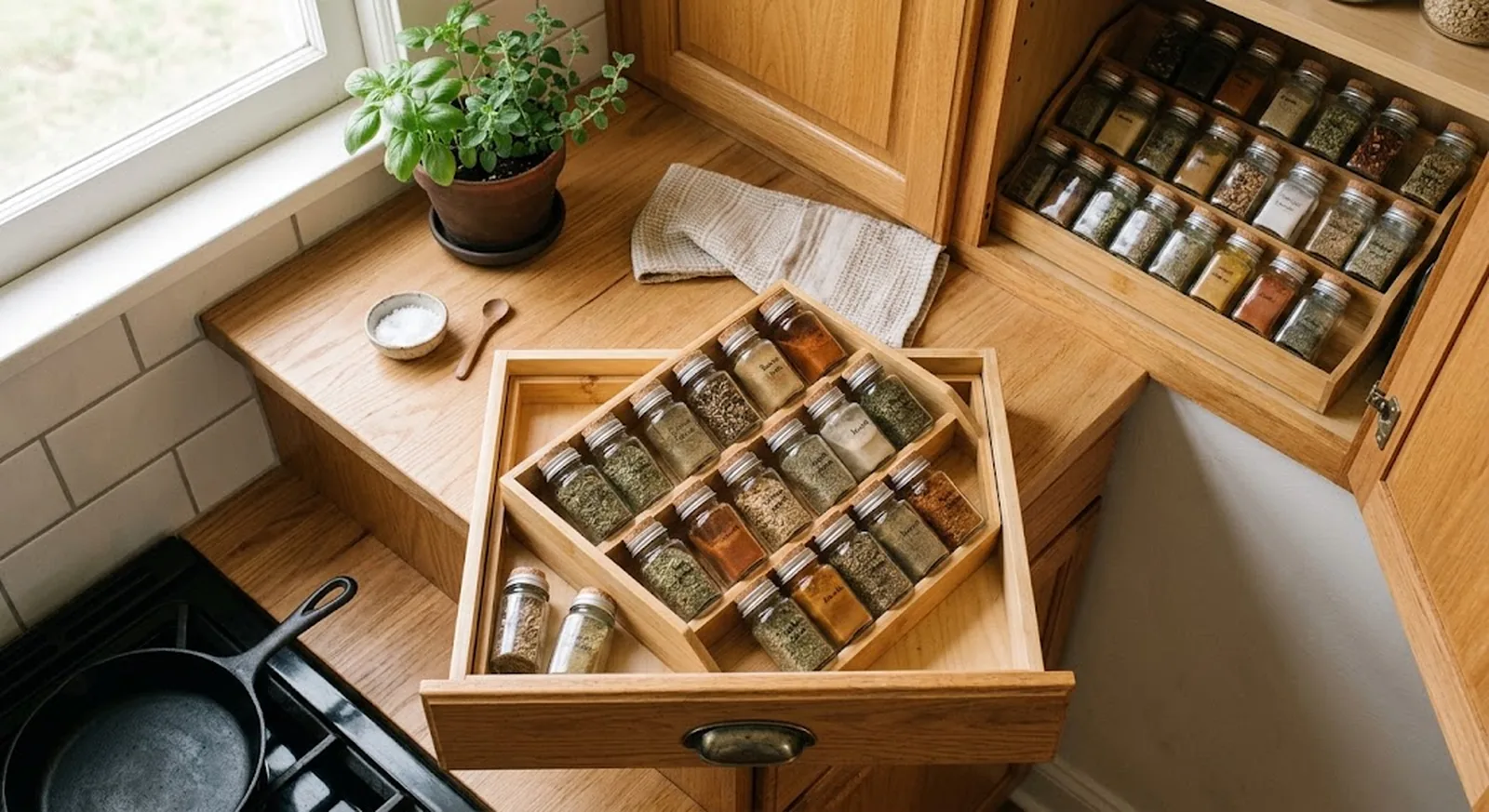
This is the one that changed how I cook. Four tiers angle every jar back so the lid faces you, and because it expands from roughly 12 to 23 inches it adapts to the drawer instead of the other way round. With 4.7 stars across more than a thousand ratings, the consensus matches mine: you stop hunting. My honest gripe is that it demands a genuinely 3-inch-deep drawer — buyers with drawers under 3 inches report the back tier fouling the drawer front when it closes — and jars aren’t included.
3-Tier Bamboo Expandable Spice Shelf — best budget pick for cabinets

If you’re not ready to surrender a drawer, this is the highest-value fix in the guide and the one I recommend most often. It’s a stepped riser that widens to span an awkward cabinet, so the second and third rows sit high enough to read without lifting anything out. More than 8,000 ratings at 4.7 stars tell you it fits a lot of cabinets. The catch is that it’s a shelf, not a container — nothing holds the jars in place, so the front row can shuffle. It also needs real vertical clearance. Same principle as the shelf organizers I use elsewhere in my cabinets.
Pull-Out Slide-Out Spice Rack Organizer — best for deep cabinets

Deep cabinets are where spices go to be forgotten, and a slide-out tray is the only thing that genuinely fixes it — you pull the whole population forward instead of excavating for the cumin. This one runs smoothly loaded and the rails feel solid rather than springy. It carries 4.7 stars on a much smaller review base than the others here, so treat that as promising rather than proven. It’s also the priciest approach here and the only one that asks you to mount hardware inside a cabinet. If you rent, choose almost anything else on this list.
Deco Brothers 3-Tier Wall Mounted Spice Rack — best for walls and cabinet doors

This design has sold quietly for years — over 9,000 ratings at 4.6 stars — because it turns a strip of wall or the inside of a cabinet door into storage you weren’t using. Everything sits on one plane, so you read every label at once, and mine lives inside a pantry door. Two honest downsides: capacity is modest, so this supplements rather than replaces a drawer system, and on an open wall your spices sit in daylight, which dulls dried herbs faster.
HuggieGems Magnetic Spice Rack for Refrigerator — best for renters and tiny kitchens

The side of your fridge is the most underused vertical surface in a small kitchen, and these magnetic shelves are the cheapest way to claim it — no drilling, no landlord conversation, and they come off in seconds when you move. At 4.8 stars across more than 15,000 ratings, they’re the highest-rated pick here. The limitation is physical: the magnets suit lightweight tins and small bottles, and loading them with tall glass jars makes them creep downward. Check that your fridge side is actually magnetic first — plenty of stainless finishes aren’t. For more in this vein, see my small kitchen storage ideas that don’t require a renovation.
Kamenstein 16-Jar Ellington Revolving Spice Rack — best if you’re starting from zero

Everything else here organizes spices you already own. This one arrives filled, which makes it the sensible pick for a first apartment or a gift — sixteen matching jars, lift-and-pour caps, and a carousel you spin with one hand while the other stirs. The trade-offs are real: it permanently occupies a circle of counter, the included spices are ordinary supermarket quality, and sixteen jars is a starting point a keen cook outgrows within a year. I make a similar case in my kitchen essentials guide for a first apartment.
Should you decant your spices into matching jars?
The photogenic kitchens all do it, and there’s a practical case: uniform jars stack predictably, so an insert or riser holds more of them. But the cost is ongoing. You inherit a refill chore and you lose the manufacturer’s best-by date the moment you pour — which matters, because ground spices fade in six months to a year while whole ones hold for years. If you decant, write the purchase month on the bottom of every jar. My compromise: decant only the eight I use constantly. If you like the look, my picks for storage jars and canisters apply here too.
Organize by frequency, not alphabet
Alphabetizing is the advice everyone gives and almost nobody maintains, because you only stay alphabetical if you re-file perfectly every time. Frequency sorting is self-correcting: put the eight jars you reach for daily in the best position — front row, nearest the stove — and let the rest live in a second, less convenient zone. When a jar from the back starts getting used weekly, it graduates. This is the same logic behind the one-zone counter method I use for everything else on the countertop.
Frequently asked questions
How deep does a drawer need to be for a spice drawer organizer?
Three inches of interior depth is the working minimum for a tiered insert, measured inside the drawer. Below that, the raised back row hits the drawer front when you close it. Flat inserts fit shallower drawers but lose the angled-label visibility.
Where is the worst place to store spices?
Directly above the stove, which is exactly where most kitchens put them. Heat and steam dull dried herbs fastest; a wall rack in full daylight is a close second. Cool, dark and dry beats convenient — near the stove, not over it.
How many spice jars does the average kitchen need?
Most home cooks genuinely use eight to twelve and own two to three times that. Before buying any organizer, pull everything out and bin what’s older than you can remember. Size storage to the collection you cook with, not the one you’ve accumulated.
Do magnetic spice racks damage a refrigerator?
They don’t damage the panel, but grit trapped under a magnet can scuff a finish, so lift rather than drag when you reposition. The bigger catch is compatibility — many stainless fronts aren’t magnetic, though side panels often are. Test with a fridge magnet before ordering.
Are expandable spice racks sturdy enough?
Bamboo expandable models generally hold full glass jars without sagging, based on the buyer reviews across these picks; the weak point is lateral movement, not load. Set the width snug against both sides of the drawer and it stops sliding.
Key takeaways
- Pick the location first — drawer, shelf, deep cabinet, wall, fridge or counter — then buy the organizer built for it.
- Measure three things: interior drawer depth (3″ minimum), your tallest jar, and cabinet shelf clearance.
- A drawer insert gives the best visibility; a tiered bamboo riser gives the best result per dollar.
- Sort by frequency, not alphabetically — frequency order maintains itself.
- Store cool and dark, never above the stove.