Best Stockpots for Soup, Stock, and Pasta Lovers (2026 Tested Picks)
A stockpot is the least glamorous thing in most kitchens and probably the pot people reach for most. It makes the Sunday soup, the chicken stock that turns Monday’s leftovers into something worth eating, and the rolling boil that a pound of pasta actually needs. It is also the piece of cookware people most often buy wrong — too small, too thin, or too heavy to lift once it is full.
Disclosure: Kitchaneers is reader-supported. I earn a commission on qualifying purchases made through links on this page, at no extra cost to you. Every recommendation here is built from verified-purchase buyer reviews, recurring complaint and praise patterns, and spec and price comparisons across alternatives — and I say when something has a real pattern of disappointing owners.
I compared seven stockpots against each other by digging through verified-purchase buyer reviews for the jobs people actually buy a stockpot to do: a big pot of soup, a whole-carcass chicken stock simmered for hours, and a pound of dried pasta dropped into a full boil. Cross-referencing recurring complaints and praise across hundreds of owner reviews surfaces the differences fast. Below are the picks that held up, the honest downside of each one, and — first — the size and construction math that decides which pot is right before any brand name enters the conversation.
What Size Stockpot Do You Actually Need?
This is the question that decides everything else, and it is the one most buying guides skip. The trap is that a stockpot’s stated capacity is not its usable capacity. You cannot fill a pot to the rim and expect a rolling boil to stay inside it. Plan on filling to roughly two-thirds for anything that boils hard, and three-quarters at most for a gentle simmer. An 8-quart pot is realistically a 5-to-6-quart pot.
Here is how that translates to the jobs people actually buy a stockpot for:
| What you’re making | Pot size that works | Why |
|---|---|---|
| Soup for 2–4, one meal | 6 quart | Fits a full head of vegetables plus broth with headroom to stir |
| Soup or chili for a week of leftovers | 8 quart | Doubles a standard recipe without boiling over |
| Stock from one whole chicken carcass | 8 quart | Carcass must sit below the water line; 6 qt is a squeeze |
| 1 lb of dried pasta | 8 quart | Pasta needs roughly 4 quarts of water per pound to move freely |
| Stock from two carcasses, or a big batch to freeze | 12 quart | Room for bones, mirepoix, and enough water to cover both |
| Seafood boil, corn for a crowd, canning | 16 quart | Volume plus the height a jar rack or a lot of shellfish demands |
If you are buying one pot and only one pot, 8 quarts is the answer for most households. It is the smallest size that handles a chicken carcass and a pound of pasta without drama, and it still fits on a standard burner and in a standard cabinet. Go to 12 or 16 quarts only if you genuinely batch-cook — a 16-quart pot holds about 33 pounds of water alone before you add a single ingredient, and lifting that to a sink is a real consideration, not a theoretical one.
Shape matters too, and it barely gets discussed. A tall, narrow pot loses less liquid to evaporation over a long simmer, which is what you want for stock. A wider, shorter pot comes to a boil faster and is easier to reach into, which is what you want for pasta and for soups you stir often. Most 8-quart pots split the difference sensibly. If you already have a wide, heavy pot for braising — see my tested Dutch ovens under $100 — lean taller with the stockpot so the two are not doing the same job.
Tri-Ply vs. Disc-Bottom: Where the Money Actually Matters
Cookware marketing has trained everyone to want fully clad tri-ply construction, where a layer of aluminum runs through the base and up the walls. In a sauté pan, that is worth paying for: you are searing, the sides get hot, and even heat across the whole surface changes the result. I wrote about the physics of it in why tri-ply cookware heats more evenly.
A stockpot is a different machine. Ninety percent of what it does is heat a large volume of liquid, and liquid convects — it moves the heat around for you. The walls of a stockpot spend their life in contact with water that is already at the same temperature. So the clad sidewalls that justify a premium price on a skillet do comparatively little here.
What does matter is the base. A thick, aluminum-encapsulated disc bottom — the construction on most mid-priced stockpots — spreads heat well enough that a bean soup will not scorch in a ring where the burner flame hits. A thin, single-ply base will scorch, and once you have burnt lentils welded to the bottom of a pot, you learn this lesson permanently. That is the actual dividing line: base thickness, not wall cladding.
My honest position after weighing owner reviews and price comparisons across tiers: buy a well-made disc-bottom pot and put the savings toward a better skillet. Fully clad stockpots are lovely and they do brown a mirepoix slightly more evenly at the start of a soup, but the gap is small, and it is the smallest gap you will find anywhere in cookware. If you are assembling a first kitchen from scratch, my first-apartment essentials guide puts the priorities in order.
How These Picks Were Chosen
For each pot, I cross-referenced verified-purchase reviews against three recurring themes buyers actually report on: how fast the pot brings a full load of water to a boil, whether a thick soup scorches during a long, infrequently stirred simmer, and how much liquid a long, bare simmer loses to evaporation. Spec sheets and price-tier comparisons filled in the rest — base construction and thickness, wall cladding, and handle geometry.
Alongside that, owner reviews are where the things you only learn from living with a pot show up: whether the handles stay cool near a flame, whether they give enough leverage to pour without a second pair of hands, whether the lid seats without rattling, and how the interior holds up after repeated dishwasher cycles. Every pot below was checked against all of it.
The Best Stockpots of 2026
Best Overall: Tramontina Signature Tri-Ply Clad Stainless Steel 8-Quart Stock Pot

This is the pot I would hand someone who asked for one recommendation and no follow-up questions. It is genuinely fully clad — aluminum through the base and up the walls — at a price that usually sits far closer to disc-bottom pots than to the premium clad brands. Across owner reviews, it’s the pot under the top tier that comes up again and again with no scorching complaints even after a long, infrequently stirred simmer. Boil-time feedback puts it mid-pack, not fast, which is what you expect from a heavier pot; heavier metal takes longer to heat and then holds temperature better once it gets there. It is oven-safe to 500°F, induction-ready, dishwasher-safe, NSF-certified, and carries a lifetime warranty.
The honest downside: a recurring complaint in owner reviews is that the loop handles sit close to the body. With an oven mitt on and eight quarts of stock inside, that gap disappears fast and knuckles brush the hot wall. It is a real ergonomic annoyance, not a dealbreaker, but it is the reason this pot is not also my pick for the largest sizes.
Best for: the person buying one stockpot for the next decade who wants clad construction without the clad-brand markup.
Buy It For Life: All-Clad D3 Stainless Steel 8-Quart Stockpot

The D3 is the reference point everything else in this category gets measured against, and it earns that in the details rather than in any single dramatic advantage. Owner reviews consistently point to the most even browning of onions and celery at the start of a soup — no hot ring over the burner, no pale edges. The flared rim pours without dribbling down the side, which sounds trivial until you’ve strained a full pot of stock through it. The riveted handle is designed for an underhand grip and gives real leverage. It is made in Pennsylvania and it will outlive most of the kitchen around it.
The honest downside: the performance gap over the Tramontina above is small, and in a pot that mostly boils water it is smaller still, while the price gap is not small at all. Reviewers also note the exposed rivets on the interior collect a film of stock protein that needs a deliberate scrub. Buy this because you want it to be the last stockpot you buy, not because you expect a different soup.
Best for: cooks upgrading one piece at a time who want the heirloom version and will use it weekly.
Best Starter Pot: Amazon Basics Stainless Steel 8-Quart Stock Pot with Glass Lid
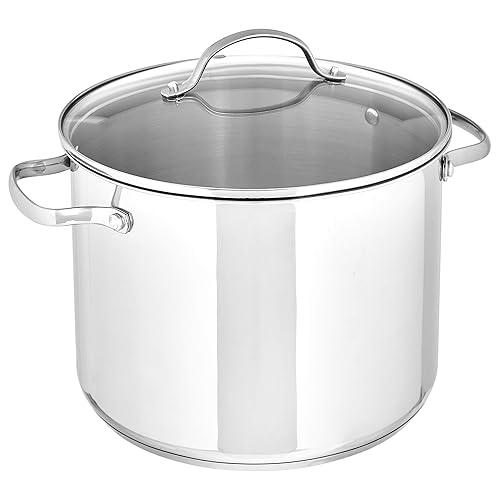
If a stockpot is the thing standing between you and cooking more often, this is the one to buy today and stop deliberating. Heavy-gauge stainless with an aluminum-encapsulated base, riveted side handles, a vented tempered-glass lid, induction-compatible, oven-safe to 500°F without the lid. Owner reviews at this price point consistently describe no burnt ring even after simmering thick soups — just a faint discoloration over the burner — which is the main thing worth checking for at this price. Boil-time feedback is quick, because the pot is lighter than the clad options and there is less metal to heat.
The honest downside: the lighter body is exactly why the long simmer needs more attention. Reviewers note that on a low burner setting it tends to creep up toward a gentle boil rather than hold a bare simmer, so a long stock session means checking on it more than the heavier pots need. The glass lid is also the first thing that will break in this pot’s life.
Best for: first kitchens, rentals, and anyone who wants a capable pot without thinking about cookware for one more minute. I make the broader case for spending carefully at this tier in budget cookware sets under $100.
Best for Pasta: Cuisinart Chef’s Classic Stainless 12-Quart Pasta/Steamer Set (77-412P1)

Four pieces: a 12-quart stockpot, a perforated pasta insert, a steamer insert, and a lid. The insert is what earns this a slot. Lifting a basket of spaghetti straight out of the water — instead of hauling a full pot of boiling liquid across the kitchen to a colander — is the single biggest safety and convenience upgrade available in pasta cooking, and it matters more the older or smaller you are. Twelve quarts also means you can salt the water properly and still have room for two pounds of pasta at a holiday dinner. Mirror-finish stainless over an aluminum-encapsulated base, cool-grip riveted handles, helper handle for pouring.
The honest downside: the insert is a storage problem. It is a 12-quart pot plus two large baskets, and in a small kitchen that stack has to live somewhere. It also nests less compactly than the photos suggest. If cabinet space is your constraint, buy a plain pot and a spider strainer instead.
Best for: households where pasta night is a fixed institution, and anyone who steams vegetables often enough to want the second insert.
Best Budget Multi-Tasker: Cook N Home 12-Quart Stainless Steel Pasta Pot with Strainer Insert 3-in-1

The same three-in-one idea as the Cuisinart set — 12-quart pot, strainer insert, steamer insert, glass lid — at a noticeably lower tier. Mirror-polished 18/10 stainless with an aluminum disc sandwiched in the base, induction-compatible, dishwasher and oven safe. It came to a boil quickly and the strainer insert does exactly what the expensive one does. For a household that boils a lot of pasta, steams a lot of vegetables, and does not want to spend much, this is a lot of function for the money.
The honest downside: the build tells you where the savings came from. The pot walls are thinner than every other pick here, the lid knob is the flimsiest of the group, and it’s the one pot in this lineup where multiple reviewers report the beginnings of a scorch ring during a long, infrequently stirred simmer. Treat it as a boiling and steaming pot, and use something heavier for anything thick that sits on low heat. I have written before about how thin cookware quietly costs more over time in the real cost of cheap cookware.
Best for: pasta-and-steam households on a budget, second pots, and college kitchens.
Best for Big Batches: Tramontina Gourmet Stainless Steel 16-Quart Stock Pot with Lid

Sixteen quarts is a specialist size, and this is the specialist I would buy. Eighteen-ten stainless with an impact-bonded tri-ply base, a proper stainless lid rather than glass, cast riveted handles, oven-safe to 500°F, induction-compatible. Two carcasses’ worth of stock with surplus to freeze is exactly the scenario this size exists for. The tall profile also means noticeably lower evaporation loss over a long simmer than the wider pots — precisely what you want when you are trying to concentrate flavor rather than replace water.
The honest downside: weight, and it is not a small caveat. Filled, this pot is beyond what many people can safely lift to a sink, and the loop handles do not give you a great angle for it. Plan to ladle it down before you move it. It is also tall enough that on some ranges the lid clears the underside of a microwave hood by very little — measure before you buy.
Best for: batch cooks, canners, seafood boils, and anyone who freezes stock by the quart.
Best for Small Kitchens: Cuisinart Chef’s Classic Stainless 6-Quart Stockpot with Cover
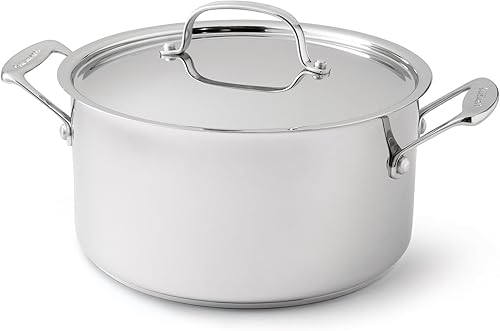
Not every kitchen has room for an 8-quart pot, and not every cook needs one. Six quarts is the honest size for one or two people who make soup for the week rather than for a crowd. The Chef’s Classic formula is well proven: mirror-finish stainless, aluminum-encapsulated base, cool-grip riveted handles, a tapered rim that pours cleanly, and a solid stainless lid that seals in moisture. Review patterns show it holding a low simmer more steadily than the lighter budget pots, with no scorch complaints. It also stores where a bigger pot will not, which is the entire point.
The honest downside: six quarts is genuinely tight for stock. A whole chicken carcass fits only if you break it down first, and a pound of pasta boils in it but with less water than I would like, which means a slightly gummier result. Buy this knowing you are choosing storage space over versatility.
Best for: apartments, one- and two-person households, and as a second pot alongside a larger one.
Quick Comparison
| Pot | Size | Base | Strainer insert | Best for |
|---|---|---|---|---|
| Tramontina Signature Tri-Ply Clad | 8 qt | Fully clad | No | Best overall |
| All-Clad D3 | 8 qt | Fully clad | No | Buy it for life |
| Amazon Basics | 8 qt | Encapsulated disc | No | Starter pot |
| Cuisinart Chef’s Classic Pasta/Steamer | 12 qt | Encapsulated disc | Yes, plus steamer | Pasta |
| Cook N Home 3-in-1 | 12 qt | Disc | Yes, plus steamer | Budget multi-tasker |
| Tramontina Gourmet | 16 qt | Tri-ply base | No | Big batches |
| Cuisinart Chef’s Classic | 6 qt | Encapsulated disc | No | Small kitchens |
Stockpot Features That Matter (And Three That Don’t)
Base thickness matters most. Every recurring complaint about the weakest-reviewed pot in this group traced back to a thin base. If you can only evaluate one specification, evaluate that.
Handle geometry matters second. Loop handles are standard and fine, but the gap between handle and pot wall decides whether an oven mitt fits. Check it in the photos. A helper handle on the opposite side of a large pot is worth more than any finish.
A stainless lid beats a glass one on a pot this size. Glass lids let you watch, which is pleasant, but they are heavier, they crack, and condensation makes them useless for watching within about four minutes anyway.
Three things I would not pay extra for. Nonstick interiors: you are boiling, not searing, so the coating gives you nothing while adding a wear item and a temperature ceiling. Measurement markings inside the pot: they etch, they blur, and they are consistently optimistic. Steamer inserts sold separately as an upgrade: a folding steamer basket costs a fraction and fits several pots. Several of these ideas overlap with the assumptions I take apart in five kitchen myths that are ruining your cookware.
Keeping a Stockpot From Looking Ten Years Old
Stainless stockpots pick up two marks that people mistake for damage. The first is a rainbow sheen, which is a harmless heat tint from an empty pot on a hot burner. The second is chalky white spotting, which is mineral deposit from hard water. Both come off the same way: fill the pot with a few inches of water, add a generous splash of white vinegar, bring it to a simmer for a few minutes, cool, and wipe. No abrasive required.
For a genuinely scorched base, cover the burn with water, add a spoonful of baking soda, simmer for fifteen minutes, then leave it to cool completely before scraping with a wooden spoon. Patience does the work; a metal scourer just leaves you with a scratched pot and a burnt one.
Two habits extend a stockpot’s life more than anything else. Salt pasta water only after it boils — salt dropped into cold water sinks and sits, and over years that causes the small pits you sometimes see in the base of an old pot. And never put a large empty pot over a high flame to “preheat” it; there is nothing to absorb the energy. My full routine for every material lives in the complete kitchen tool care guide.
Frequently Asked Questions
What size stockpot is best for one person?
Six quarts covers soup for the week, a pound of pasta, and a small batch of stock from a broken-down carcass. Eight quarts is more versatile if you have the cabinet space, and I would default to it unless storage is genuinely tight.
Can I use a stockpot instead of a Dutch oven?
For soup and boiling, yes, and happily. For braising, no. A stockpot has thin walls and a light lid, so it will not hold the low, steady, even heat that a braise wants, and most are not built for hours in the oven. The two pots are complements, not substitutes.
Is a pasta pot with a strainer insert worth it?
It is worth it if you cook pasta at least weekly, or if lifting a full pot of boiling water to the sink is something you would rather not do. If you already own a colander and a spider and you are comfortable draining at the sink, the insert mostly costs you cabinet space.
Do I need an induction-compatible stockpot?
If you have an induction cooktop, yes, and every pot on this list qualifies. If you do not, buy one anyway — induction compatibility means a magnetic stainless base, which is a reasonable proxy for a properly built one, and it protects you if you move or replace the range.
Why does my soup scorch on the bottom of the pot?
Almost always a thin base concentrating the burner’s heat into a ring rather than spreading it. Thick purées, beans, tomato, and anything with dairy or starch are the usual victims. A heavier base fixes it; failing that, drop the heat further than feels necessary and stir the bottom every few minutes.
The Bottom Line
For most people, an 8-quart pot with a thick base is the whole answer, and the Tramontina Signature Tri-Ply Clad is the version I would buy with my own money. If pasta night is the reason you are shopping, the Cuisinart pasta and steamer set earns its cabinet space. If you batch-cook stock, go straight to sixteen quarts and accept that you will ladle it down before you move it.
What I would not do is buy a stockpot as part of a set you do not otherwise need. Sets tend to include a stockpot that is smaller and thinner than the one you would have chosen alone — a point I get into in more detail in my guide to the best cookware sets of 2026. Buy the pot for the pot’s job. It will be doing that job long after the rest of the set is gone.