
Is the KitchenAid Stand Mixer Worth It? An Honest Answer for Home Bakers
Disclosure: This post contains Amazon affiliate links. If you purchase through them, I earn a small commission at no extra cost to you. All recommendations are based on analysis of verified-purchase buyer reviews, spec comparisons, and price research.
If you’ve been staring at a $450 KitchenAid and wondering whether it’s actually worth it, that hesitation is common among home bakers weighing it against a cheaper hand mixer. Based on a close look at verified-purchase reviews, spec comparisons, and pricing for the KitchenAid Artisan, here’s a clear answer: yes, it is worth it — but only if you’re using it for the right things. If you bake bread more than twice a week, read section four before you spend a dollar. And if you’re still comparing stand mixers broadly rather than just the KitchenAid, the alternatives further down cover budget and bread-focused picks too.
Is the KitchenAid Stand Mixer Worth It? The Short Answer
For most home bakers: yes. The KitchenAid Artisan is genuinely excellent for cookies, cakes, frosting, meringues, whipped cream, and light doughs. It frees your hands, it lasts decades, and the attachment ecosystem makes it the most versatile appliance you can put on a counter. At $329–$449 (depending on sale timing), it works out to roughly $20–25 per year over a 20-year lifespan — cheaper than most kitchen gadgets people buy without thinking twice.
For frequent bread bakers: probably not. The Artisan’s 325-watt motor is the honest limitation nobody talks about. KitchenAid updated its official guidelines in 2023: max speed 2, no more than 2 minutes of kneading at a time, 4–6 minutes total. Exceed that regularly, and you risk burning out the motor — a problem that typically falls outside the warranty. I’ll walk through all of this below.
What the KitchenAid Artisan Actually Is
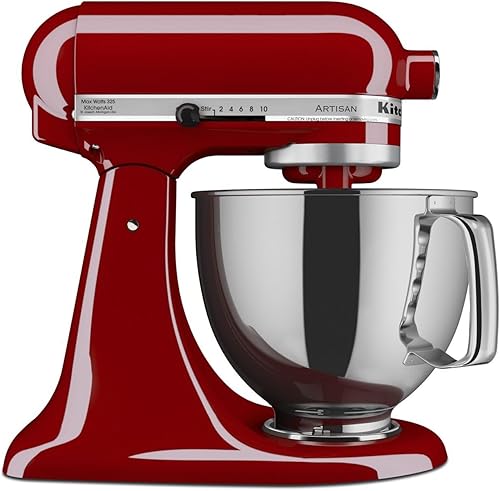
The model most people consider is the KitchenAid Artisan Series 5-Quart Tilt-Head Stand Mixer (KSM150PS). Here’s what you’re getting:
- Motor: 325 watts
- Bowl capacity: 5 quarts (holds roughly 9 dozen cookies or 4 loaves of bread — in theory)
- Speed settings: 10
- Design: Tilt-head (lift the head to access the bowl), die-cast metal body
- Included attachments: flat beater, dough hook, wire whip, pouring shield
- Colors: 70+ options — Empire Red, Onyx Black, Ice, Pistachio, and dozens more
- Price: $329–$449 (Black Friday and Amazon sales regularly hit the lower end)
The die-cast metal body is one reason these mixers last so long. I’ve heard from readers whose parents have used the same KitchenAid for 30+ years. That’s the build quality you’re paying for.
Where the KitchenAid Excels (The Tasks It Was Built For)
It’s a longtime favorite among home bakers for good reason. Here’s where the KitchenAid is genuinely unmatched at its price point:
Cookies and cakes
Creaming butter and sugar for 5 minutes produces noticeably lighter cookies than a hand mixer. Reviewers describe starting the mixer, walking away, and coming back to a perfectly pale, fluffy base. The flat beater attachment covers the full bowl diameter with what KitchenAid calls “planetary mixing action” — it rotates around the bowl while spinning, which means virtually no unmixed pockets. For chocolate chip cookies, pound cake, or anything that needs a long cream-and-beat cycle, this mixer is exceptional.
Frosting and whipped cream
This is the use case that will make you wonder why you waited. Swiss meringue buttercream — the kind that requires 10+ minutes of beating egg whites to stiff peaks — is completely effortless. Buyers report making whipped cream in under 4 minutes without needing to stand over it, and cream cheese frosting going from lumpy to silky while the mixer handles it unattended. If you bake celebration cakes or layer cakes regularly, this alone justifies the cost.
Meringues and delicate tasks
The 10-speed range gives real precision. Starting at speed 1 for gentle incorporation, moving up to 8 or 10 for stiff peaks — the control is there. Reviewers who make French macarons (notoriously picky about over-beaten whites) report doing so without issue. A hand mixer technically can do this, but the KitchenAid does it without requiring your full attention.
Pasta dough and short-knead doughs
Pizza dough, focaccia, and fresh pasta dough — done in 4–5 minutes of kneading, staying within KitchenAid’s recommended window. The dough hook handles these tasks cleanly. The key is not going over the time limit, which I’ll explain in the next section.
The One Thing KitchenAid Struggles With: Regular Bread Baking
This is the honest part that most reviews skim past or skip entirely. If you bake bread more than once or twice a week — especially enriched doughs like brioche, sourdough, or sandwich bread — the KitchenAid Artisan is likely the wrong tool.
Here’s the specific issue: the Artisan’s 325-watt motor is not designed for sustained heavy kneading. In 2023, KitchenAid updated its official guidelines to state:
“Do not exceed speed 2 when kneading dough with the dough hook. Do not knead for more than 2 minutes at a time. Total mixing and kneading time should not exceed 4 to 6 minutes.”
Most bread recipes call for 8–10 minutes of kneading. That’s double what KitchenAid officially supports. Exceed these limits regularly, and you risk burning out the motor — and the warranty specifically doesn’t cover damage from exceeding recommended usage.
Bakers who knead bread regularly report the motor straining, the mixer “walking” across the counter, and in some cases, burning out entirely. This isn’t a manufacturing defect — it’s using the machine outside its intended load. The KitchenAid Artisan was designed for batters and light doughs, not the sustained resistance of high-hydration bread dough.
The bottom line: if bread baking is your main use case, skip to the alternatives section. If you bake an occasional loaf of simple white bread and mostly do cakes and cookies, you’ll be fine staying within the guidelines.
Tilt-Head vs. Bowl-Lift: Which KitchenAid Should You Get?
If you decide the KitchenAid is right for you, you’ll face one more choice: tilt-head or bowl-lift.
Tilt-Head (Artisan, ~$349–$449): The head tilts back for bowl access. Great for everyday baking — cakes, cookies, frosting. The 5-qt bowl handles most home baking needs. This is what most home bakers should get.
Bowl-Lift (~$600+): The head stays fixed and the bowl lifts up on a lever. Sturdier frame, more powerful motor, better for larger batches and dough. If you bake bread occasionally alongside cakes and cookies, the bowl-lift is the better investment — the motor handles stress better than the tilt-head. Still not a Bosch-level bread machine, but meaningfully more capable.
For most home bakers who primarily bake cakes, cookies, and occasional bread: the Artisan tilt-head is the right call. It’s more affordable, more widely available, and perfectly capable for its intended use.
Is the KitchenAid Stand Mixer Worth It? The Cost-Per-Use Math
Let’s do the math that most reviews skip.
| Scenario | Cost | Lifespan | Cost/year |
|---|---|---|---|
| KitchenAid Artisan (sale price) | $329 | 20+ years | ~$16/year |
| KitchenAid Artisan (full price) | $449 | 20+ years | ~$22/year |
| Mid-range hand mixer | $50–$80 | 5–8 years | $8–$10/year |
| Cuisinart SM-50 stand mixer | $250 | 10–15 years | ~$17–$25/year |
At $22/year over 20 years, the KitchenAid is not the luxury purchase it feels like at the register. The real question isn’t whether you can afford it — it’s whether you’ll use it enough to justify the upfront cost over a hand mixer that works fine for light tasks.
My threshold: if you bake at least once a week and regularly make recipes that require prolonged beating (frosting, meringues, creaming butter and sugar), the KitchenAid will earn its counter space within a year. If you bake once a month or mostly do simple quick breads and muffins, a good hand mixer will serve you just as well at a fraction of the price.
Best KitchenAid Alternatives If It’s Not the Right Fit
If the KitchenAid isn’t the right match, here are the three alternatives I’d point you toward depending on your use case:
Budget alternative: Cuisinart SM-50 Stand Mixer (~$200–$250)
The Cuisinart SM-50 is the sensible choice if you want a stand mixer but can’t justify the KitchenAid price. It’s 500 watts (more than the KitchenAid Artisan), 5.5-quart bowl, and includes the same core attachments. It doesn’t have KitchenAid’s attachment ecosystem or the same lifetime longevity, but it handles everyday baking well. Good option for beginners who aren’t sure how much they’ll use it. It’s also my top value pick in my roundup of the best stand mixers under $300, if you want to compare it against the competition.

Bread baker’s choice: Bosch Universal Plus (~$500)
If bread is your primary use case, the Bosch Universal Plus is the answer. It’s 500 watts with a center-column design that handles heavy doughs effortlessly — multiple bakers report using it weekly for years with zero motor issues. The 6.5-quart bowl handles large batches. It’s not as versatile as KitchenAid for light tasks like frosting, and the learning curve is steeper, but for sourdough, brioche, and enriched doughs, it’s the right tool. Bakers who switched from KitchenAid to Bosch after motor failures consistently say they wish they’d made the switch sooner.

Premium option: Ankarsrum (~$800)
The Ankarsrum is the choice for bakers who want the best of everything and are willing to pay for it. Swedish-made, quiet, handles high-hydration sourdough effortlessly, and built to last a lifetime. The bowl rotates from below rather than the attachments rotating inside — it’s a fundamentally different mechanical approach. Steep learning curve, and at $800 it’s a serious commitment. But if you bake bread several times a week and want a machine that will outlast everything else in your kitchen, it’s worth considering.
The Attachments Question: Do They Make It More Worth It?
The KitchenAid attachment ecosystem is one of its biggest selling points — and one of its biggest marketing traps.
Attachments that are genuinely worth buying:
- Pasta roller and cutter (~$180): If you make fresh pasta more than a couple of times a year, this attachment pays for itself versus buying a standalone pasta machine. Genuinely excellent. See our manual vs. attachment pasta maker comparison if you’re not sure this is worth buying a mixer for.
- Meat grinder (~$60–$80): Grinds meat well for burgers, sausages, and meatballs. Solid value if you do this regularly.
- Ice cream maker bowl (~$80): Works well, especially given you already own the machine.
Attachments that are mostly marketing:
- Spiralizer (~$100): Slow, awkward, and outclassed by a $25 handheld spiralizer for most tasks.
- Juicer attachment (~$75): Works, but you’ll only use it if you juice regularly — and then a dedicated juicer is probably better.
- Sifter and scale (~$100): The scale accuracy gets inconsistent reviews. I’d skip it.
The honest calculation: buy the attachments you know you’ll use, not the ones you might use someday. Two real attachments that get regular use make the KitchenAid more worth it. A drawer full of attachments you bought optimistically does not. For a full breakdown of which ones earn their place, see my guide to the best stand mixer attachments you’ll actually use.
If you’re building out your kitchen from scratch, I’d start with my guide to kitchen essentials for your first apartment before diving into accessories — it’ll help you prioritize what actually earns its space.
Who Should Buy the KitchenAid (And Who Should Skip It)
| Your situation | Verdict |
|---|---|
| You bake cookies, cakes, and frosting regularly | ✅ Buy it — this is exactly what it’s built for |
| You make celebration cakes or layer cakes | ✅ Buy it — frosting and meringue tasks are effortless |
| You want to make fresh pasta occasionally | ✅ Buy it — and get the pasta attachment |
| You bake bread 1–2 times per week (simple loaves) | ⚠️ Maybe — stay within KitchenAid’s 4–6 min guideline |
| You bake sourdough, brioche, or enriched doughs regularly | ❌ Skip it — get the Bosch Universal Plus instead |
| You bake only occasionally (once a month or less) | ❌ Skip it — a $60 hand mixer will do the job |
| You’re in a tiny kitchen with no counter space | ❌ Skip it — the KitchenAid needs a permanent home to be worth it |
| You’re a beginner who bakes weekly and wants to improve | ✅ Buy it — the quality improvement is real and motivating |
When to Buy: The Best Time to Get a Good Deal
The KitchenAid Artisan goes on sale reliably. The best windows are Black Friday (November) and Amazon Prime Day (July), when prices regularly drop to $299–$349. Mother’s Day and holiday season (December) also see deals, though less reliable than Black Friday. If you’re not in a rush, waiting for a sale is the easiest way to save $100.
The color selection is widest at full price. Sale versions are often limited to classic colors like Empire Red, White, and Black — still great options, but if you want Pistachio or Mineral Water Blue, you may pay a premium.
It’s also worth checking Amazon’s refurbished or “used — like new” listings. KitchenAid offers a certified refurbished program, and because these machines last decades, a refurbished unit from five years ago is likely still in excellent condition.
My Verdict: Is the KitchenAid Stand Mixer Worth It?
After reviewing verified buyer feedback and comparing specs closely, my answer is yes — with the caveat that’s worth repeating one more time: it’s worth it for the right baker, doing the right tasks.
If you bake cakes, cookies, frosting, and occasional light doughs, the KitchenAid Artisan is one of the best investments you can make in your kitchen. The build quality is real, the results are better than a hand mixer, and at $22/year over its lifespan, it’s genuinely affordable.
If bread is your primary passion, spend the same money on a Bosch Universal Plus and thank yourself later. The KitchenAid Artisan will frustrate you, and motor replacement is expensive.
And if you’re still figuring out your kitchen setup, I’d recommend reading through my picks for the best small kitchen appliances — it puts the stand mixer decision in context of the other equipment worth prioritizing first. Once you’ve got your kitchen basics dialed in, the KitchenAid is a genuinely rewarding upgrade.
Frequently Asked Questions
Is the KitchenAid stand mixer worth it for bread?
For occasional bread baking (1–2 simple loaves per week, staying within the 4–6 minute kneading guideline), yes. For regular bread baking — especially sourdough, brioche, or high-hydration doughs — no. The 325-watt motor is not built for sustained heavy kneading, and KitchenAid’s own guidelines confirm this. Consider the Bosch Universal Plus instead.
How long does a KitchenAid stand mixer last?
Used within its intended tasks, a KitchenAid Artisan typically lasts 20–30+ years. The die-cast metal body and quality motor components are built for longevity. Readers regularly report using machines their parents bought decades ago. Motor lifespan shortens significantly if used regularly outside recommended parameters (overloaded with bread dough).
Is the KitchenAid Artisan or Pro the better buy?
For most home bakers, the Artisan tilt-head is the better buy. It’s $100–$150 cheaper than the Pro bowl-lift, handles all standard baking tasks equally well, and is easier to use for smaller batches. The Pro (bowl-lift) is worth the upgrade if you regularly make large batches or plan to use the machine heavily for dough — its frame handles stress better.
What’s the best KitchenAid stand mixer alternative?
Depends on your use case. For a budget alternative with solid everyday performance: the Cuisinart SM-50 at around $200–$250. For bread baking: the Bosch Universal Plus at around $500. For bakers who want the absolute best machine regardless of cost: the Ankarsrum at around $800.
Does the KitchenAid stand mixer come with a warranty?
Yes — the Artisan comes with a 1-year full warranty. One important note: KitchenAid’s warranty specifically doesn’t cover damage caused by exceeding the recommended kneading speed and duration. If you burn out the motor from heavy bread dough use, you’re likely paying for repairs out of pocket.
Are KitchenAid mixers worth it?
For most home bakers, yes. Across verified-purchase reviews, owners consistently point to the die-cast metal body, the planetary mixing action, and a lifespan that often stretches past 20 years as the reasons it earns its price. The exception is frequent, heavy bread baking, where the motor’s official kneading limits make a machine like the Bosch Universal Plus the better fit — see the cost-per-use math above for the full picture.
Is a KitchenAid worth it?
It depends on what you bake and how often. If cookies, cakes, frosting, and the occasional light dough make up most of your baking, a KitchenAid earns its keep quickly and lasts for decades. If you knead bread several times a week, a different machine will serve you better — see the alternatives above. If you’re still cross-shopping the field, my roundup of the best stand mixers under $300 compares KitchenAid against the strongest budget and mid-range options.
Is KitchenAid Mixer Worth It for Occasional Bakers?
Probably not. If you bake once a month or less, a $60 hand mixer covers the same jobs at a fraction of the cost and counter space. The KitchenAid earns its keep for bakers who use it weekly, not occasionally.