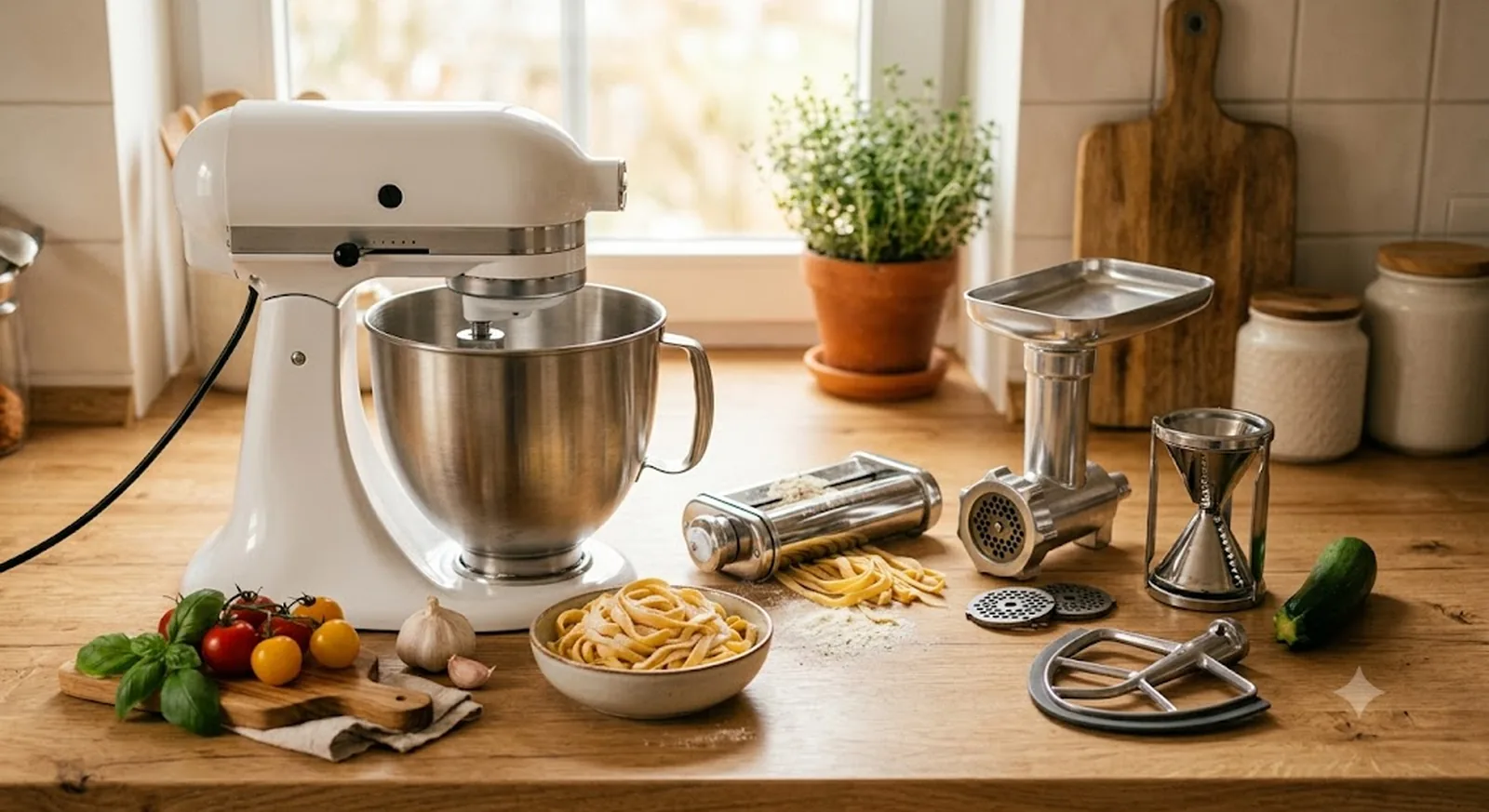
Best Stand Mixer Attachments You’ll Actually Use
KitchenAid pitches every stand mixer attachment as a must-have, but they are not remotely equal once you look past the marketing. This guide is built from digging through verified-purchase reviews, the complaints and praise that keep repeating, and how the specs and price tiers stack up across every attachment the power hub will accept. This is my honest take on which stand mixer attachments you’ll actually reach for versus the ones that mostly look impressive in the box. Heads up: this post contains Amazon affiliate links. If you buy through them I may earn a small commission, at no extra cost to you — it never changes which products I recommend.
Here’s the thing nobody tells you when you unbox that mixer: the power hub on the front is the real story. That little chrome collar turns a cake machine into a pasta shop, a butcher counter, and a small-batch ice cream parlor. But the marketing pushes every accessory equally, and they are absolutely not equal. After working through hundreds of verified buyer reviews for each attachment — what keeps coming up as praise, what keeps coming up as a complaint, and how the specs and price tiers compare — I can tell you exactly where the money is well spent and where it quietly disappears.
How I decide what earns a spot on the hub
I judge attachments by patterns that show up over and over in verified owner feedback, not the way a catalog does. Three questions decide it. First, does it do a job better than a tool you already own? Second, do most owners actually pull it out more than twice a year, or does it become a novelty? Third, is it built to survive a dishwasher, a dropped part, and years of use? Reviewers who regret a purchase say so, loudly and repeatedly — and that pattern is exactly why my recommended shortlist is shorter than the brand would like.
One more filter: compatibility. Most of these fit the universal power hub, so they work across tilt-head and bowl-lift models. A couple of the bowl-and-beater style attachments are sized for specific tilt-head bowls, so I’ll flag that where it matters. If you’re still choosing the mixer itself, my guide to the best stand mixers under $300 and my honest take on whether the KitchenAid is worth it will save you from buying the wrong base.
Stand mixer attachments at a glance
| Attachment | Best for | How often owners use it | Price tier |
|---|---|---|---|
| Flex Edge Beater (KFE5T) | Everyone — replaces the standard paddle | Weekly | $ |
| Pasta Roller & Cutter Set (KSMPRA) | Home pasta makers | Monthly | $$$ |
| Food Grinder (KSMMGA) | Burgers, sausage, fresh grinds | Monthly | $$ |
| 7-Blade Spiralizer (KSM2APC) | Veggie noodles, apple prep | Occasionally | $$$ |
| Ice Cream Maker (KAICA) | Frozen desserts — if you plan ahead | Seasonal | $$ |
KitchenAid KFE5T Flex Edge Beater — the one attachment everyone should own

If you buy exactly one attachment, make it this one. The Flex Edge Beater is a flat beater with a flexible silicone strip along one side, so it scrapes the bowl while it mixes. That sounds minor until you make frosting, cookie dough, or cake batter and realize you’re no longer stopping the machine every ninety seconds to drag a spatula down the sides. It quietly fixes the single most annoying part of using a stand mixer.
Across verified reviews, it’s consistently described as basically replacing the standard paddle. Owners report creaming butter and sugar comes out more even, with noticeably less unmixed flour clinging to the bowl. It’s one of the most affordable things on this list, it fits standard 4.5 and 5-quart tilt-head bowls, and the whole thing is dishwasher-safe. The recurring complaint: the silicone edge can wear or discolor over years of heavy use, and it’s not the tool for very stiff bread dough — that’s still a job for the dough hook. For everything else, it’s the attachment I’d recommend to a new owner first.
KitchenAid KSMPRA 3-Piece Pasta Roller & Cutter Set — best if you’ll actually make pasta

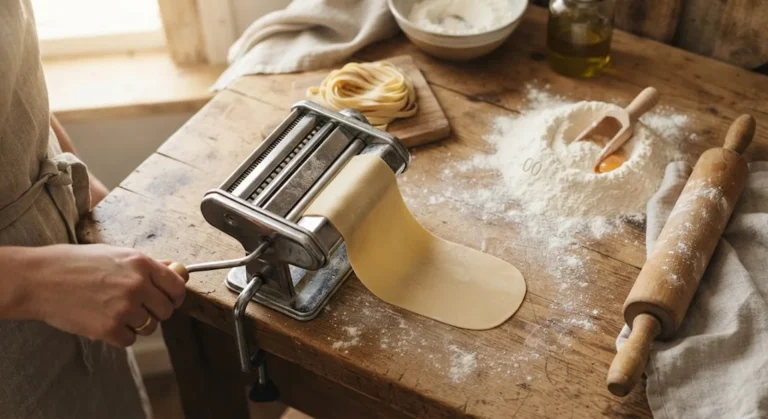
This is the attachment that owners say turns a stand mixer into something genuinely different. The set includes a sheet roller plus fettuccine and spaghetti cutters, all stainless steel. Because the mixer drives the rollers, both your hands are free to feed and catch the dough — which is the real advantage over a hand-crank machine you have to clamp to the counter. Reviewers consistently report fresh pasta from flour and eggs comes together in under an hour, cooks in about two minutes, and tastes like a different food from the dried box.
It’s the priciest pick on this list, and that’s the honest catch: it only makes sense if you’ll use it. If “homemade pasta night” is a fantasy rather than a habit, the money is better spent elsewhere. The rollers also shouldn’t go in the dishwasher — you clean them by letting dough dry and brushing it out, which takes a little discipline. But for people who genuinely love cooking, this is the attachment that pays for itself in dinners you’ll be proud of. Pair it with a good small-appliance setup and you’ve got a real pasta station. Still weighing this against a hand-crank machine? Our manual vs. attachment pasta maker breakdown walks through the full cost-of-ownership math.
KitchenAid KSMMGA Food Grinder Attachment — best for burgers, sausage, and fresh grinds

This is the one that quietly wins over anyone who cares about what’s in their meat. Grinding your own chuck for burgers is a real upgrade — you control the fat ratio, the freshness, and the grind size, and the difference in a home burger is not subtle. The KSMMGA is the metal-geared version, which handles chilled meat far better than the older plastic grinders. It comes with multiple grinding plates and sausage-stuffer tubes, so you can move from coarse chili grind to fine sausage without buying anything extra.
My insider tip, borrowed from restaurant prep: freeze the metal parts and the meat cubes for fifteen minutes before grinding. Cold fat stays firm and cuts cleanly instead of smearing, which keeps the texture loose and the grinder from clogging. The genuine con is cleanup — there are several parts to wash and dry immediately so they don’t spot, and it’s more effort than tossing a bowl in the sink. It also overlaps in spirit with a food processor, though a processor chops rather than truly grinds. If you eat a lot of ground meat, this earns its place fast.
KitchenAid KSM2APC 7-Blade Spiralizer — useful, but be honest with yourself

The spiralizer is where I have to check my own enthusiasm. It’s genuinely well made — seven blades that peel, core, and slice, plus spiral and ribbon cuts — and it clamps to the hub so the mixer does the turning. For zucchini noodles, curly apple slices for a pie, or a big batch of slaw, it’s fast and consistent in a way a handheld spiralizer isn’t. Owners who do a lot of vegetable prep consistently call it a real time-saver.
Here’s the honest part. It’s one of the pricier attachments, and for most home cooks it lands in “nice to have” rather than “need.” If you already own a handheld spiralizer or a mandoline, the upgrade is convenience, not capability. The blades and small parts also need careful storage or they wander off into a drawer. Buy it if you spiralize weekly; skip it if this would be your third gadget doing roughly the same job. That’s the whole test.
KitchenAid KAICA Ice Cream Maker Attachment — the one people regret most often

I’m including the ice cream maker precisely because it’s the attachment that shows up with the most buyer’s remorse in the reviews — and I want to be fair to it. When it works, it works well: the frozen bowl and dasher churn out a genuinely creamy two-quart batch of ice cream, sorbet, or gelato, and doing it in your own mixer is genuinely satisfying the first time. Homemade frozen dessert is a real pleasure, and this makes a good one.
The catch is the freezer bowl. You have to pre-freeze it solid for a full day before you can churn, so spontaneous ice cream isn’t happening, and the bowl takes up serious freezer real estate the rest of the time. For a lot of people that friction means it gets used twice and then lives in a cabinet. My honest verdict: buy it only if you’re a committed dessert person who will plan ahead, and clear the freezer space first. If you make frozen desserts constantly, a dedicated compressor machine — like the standalone models in my small kitchen appliance guide — will serve you better. Otherwise, this is the easiest attachment on the list to skip.
Attachments I’d think twice about
A few accessories look tempting in the lineup but rarely earn their keep. The grain mill is wonderful if you bake with fresh-milled flour every week, and pointless if you don’t — it’s a specialist’s tool, not a starter one. The citrus juicer and the sifter-plus-scale attachment both solve problems you can already handle with a five-dollar tool and a cheap kitchen scale. And the fruit-and-vegetable strainer overlaps heavily with the food grinder for most people. None of these are bad; they’re just narrow. The pattern is always the same: if it duplicates something you own or serves a habit you don’t actually have, it becomes drawer clutter.
Attachment vs. buying a separate tool
A fair question with every one of these: why not just buy the standalone version? The answer comes down to counter space, storage, and how the mixer’s motor changes the job. The pasta rollers are the clearest win — a dedicated hand-crank machine has to be clamped down and turned with one hand, while the mixer frees both of yours and gives an even, hands-off feed. The grinder is similar: the mixer’s motor pushes chilled meat through steadily, where a manual grinder fights you and warms the meat as you crank.
The trade runs the other way for a couple of them. A dedicated ice cream machine with a built-in compressor churns on demand with no pre-freezing and holds a firmer set, so heavy dessert makers are better served by a standalone unit. And a good handheld spiralizer or mandoline costs a fraction of the attachment and stores in a drawer. My rule: let the mixer take over the jobs where its motor and free hands genuinely help — pasta and grinding — and keep cheap, simple tasks on cheap, simple tools. That single principle will keep you from over-buying.
Which stand mixer attachment should you buy first?
Start with the Flex Edge Beater no matter who you are — it improves nearly everything the mixer already does and costs the least. After that, let your actual cooking decide. If you dream about fresh pasta and will really make it, the pasta roller set is the most transformative buy on this list. If you grill and care about your burgers, the food grinder is the one that changes what you eat. Reach for the spiralizer only if vegetable prep is a weekly ritual, and the ice cream maker only if you’re a plan-ahead dessert lover with freezer space to spare.
The mistake I see most often is buying a bundle to “future-proof.” Attachments don’t expire — the hub will still be there in two years — so buy them one at a time, as your cooking actually pulls you toward them. That way every piece on your hub is one you reach for, not one you dust.
Frequently asked questions
Do KitchenAid attachments fit all stand mixers?
The hub-driven attachments — the pasta set, food grinder, spiralizer, and ice cream maker — use the universal power hub, so they fit essentially all household KitchenAid stand mixers, tilt-head and bowl-lift alike. The exception is bowl-and-beater style pieces like the Flex Edge Beater, which are sized to specific tilt-head bowls (commonly 4.5 and 5-quart). Always match the beater to your bowl size before buying.
Are third-party attachments as good as genuine KitchenAid ones?
Some third-party attachments are fine and cost less, especially simple parts like beaters. For anything with gears or blades — the grinder and pasta rollers — I lean toward genuine parts, because the fit and metal quality directly affect how well they work and how long they last. If you go third-party, read reviews specifically about durability, not just price.
Can I put stand mixer attachments in the dishwasher?
It depends on the piece. The Flex Edge Beater is dishwasher-safe. The pasta rollers should never go in — you brush out dried dough by hand. The grinder parts and spiralizer blades are best hand-washed and dried right away to prevent spotting and dulling. When in doubt, hand-wash; it’s the safest habit for metal attachments.
Is a food processor better than the grinder attachment?
They do different jobs. A food processor chops and purees; the grinder actually grinds meat through plates, which gives you real control over texture for burgers and sausage. If you mainly want to chop vegetables or make dips, a processor is the better all-rounder. If fresh-ground meat is the goal, the grinder wins.
How much should I expect to spend on attachments?
They span a wide range. The Flex Edge Beater sits at the affordable end and is easy to justify for almost anyone. The food grinder lands in the middle. The pasta roller set and the spiralizer are the premium picks, and the ice cream maker sits in between. I won’t quote live figures here because prices shift constantly — tap any “Check Price on Amazon” link above for the current number. The smarter budgeting move is to buy one attachment at a time as your cooking pulls you toward it, rather than a discounted bundle full of pieces you may never open.
Do the attachments come with a warranty?
Genuine KitchenAid attachments carry the brand’s limited warranty, which is one more reason I lean toward official parts for the geared pieces like the grinder and pasta rollers. Keep your receipt and register the attachment if the brand offers it. Warranty-claim complaints are rare in reviews of the metal-geared versions, and owners consistently note they’ve held up markedly better than the older plastic ones — that longevity is where the value quietly lives.
Are stand mixer attachments worth it overall?
The right one or two are absolutely worth it — the Flex Edge Beater for everyone, plus one specialty attachment matched to how you cook. Where people waste money is buying attachments for the cook they imagine being rather than the one they are. Match the tool to a real habit and it earns its place; buy on aspiration and it becomes clutter.
The bottom line
After digging through the reviews and specs on every one of these, my short list is honest: the Flex Edge Beater belongs in every kitchen, the pasta set and food grinder are transformative for the people who’ll use them, the spiralizer is a well-made convenience, and the ice cream maker is a genuine pleasure with real logistics attached. Buy for the way you actually cook, add attachments one at a time, and your KitchenAid hub will stay a tool you use — not a shelf of good intentions. If you’re still building out the rest of your setup, my small kitchen appliance guide is the natural next stop.