Best Small Kitchen Appliances of 2026: Expert-Tested Picks for Every Budget
In brief: The best small kitchen appliances of 2026 for most homes are a 6-quart multi-cooker, a mid-size air fryer, a strong blender, a stand mixer for bakers, and a programmable coffee maker. We compared dozens across three budget tiers ($50, $100, and $300+) using verified-purchase buyer reviews, spec sheets, and price comparisons, weighed counter footprint against how often you’ll actually use each one, and flagged the few worth skipping.
Disclosure: Kitchaneers is reader-supported. Some links in this guide are affiliate links, which means we may earn a small commission at no extra cost to you. We only recommend gear that holds up well across verified-purchase buyer reviews and spec comparisons. Last updated: May 2026.
After digging through months of verified-purchase buyer reviews, spec sheets, and price comparisons, we put together this guide to the best small kitchen appliances of 2026 — organized by what they cost, how much counter space they eat, and how often they earn their keep. No filler, no recommending everything under the sun. Just the picks we’d hand a friend setting up a kitchen, plus an honest look at what each one gets wrong.
What makes a small kitchen appliance worth buying
Before we name a single product, here’s the framework we use. A great appliance isn’t the one with the most functions — it’s the one that earns its footprint. We score every small kitchen appliance on three things.
Frequency of use. An air fryer you reach for four nights a week is worth far more than a fancy bread machine that comes out twice a year. Survey data backs this up: roughly 29% of US households plan to buy an air fryer in the next year, 25% want a toaster oven, and 20% a blender, according to Consumer Reports testing and survey work. People vote with their counters.
Counter footprint. Real kitchens are small. A multi-cooker that replaces a slow cooker, a rice cooker, and a steamer saves three appliances’ worth of space. We weight machines that do more than one job.
Total cost over time. Purchase price is only the first number. A $40 appliance you replace every 18 months can cost more than an $80 one that lasts five years. We come back to this in detail below, because almost nobody in the buying guides talks about it.
That framework is why this list of the best small kitchen appliances skews toward versatile, durable machines rather than single-trick gadgets. Now, the picks.
The 5 must-have small kitchen appliances we’d buy first
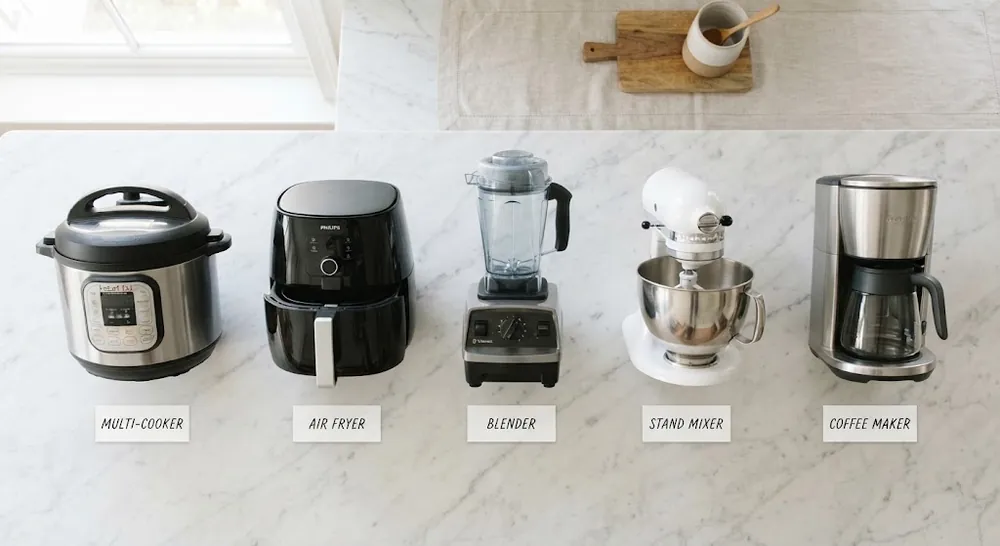
If you’re building a kitchen from scratch, start here. These are the must-have small kitchen appliances that earn their counter space in nearly every home. We’ve included one genuine drawback for each, because no machine is perfect.
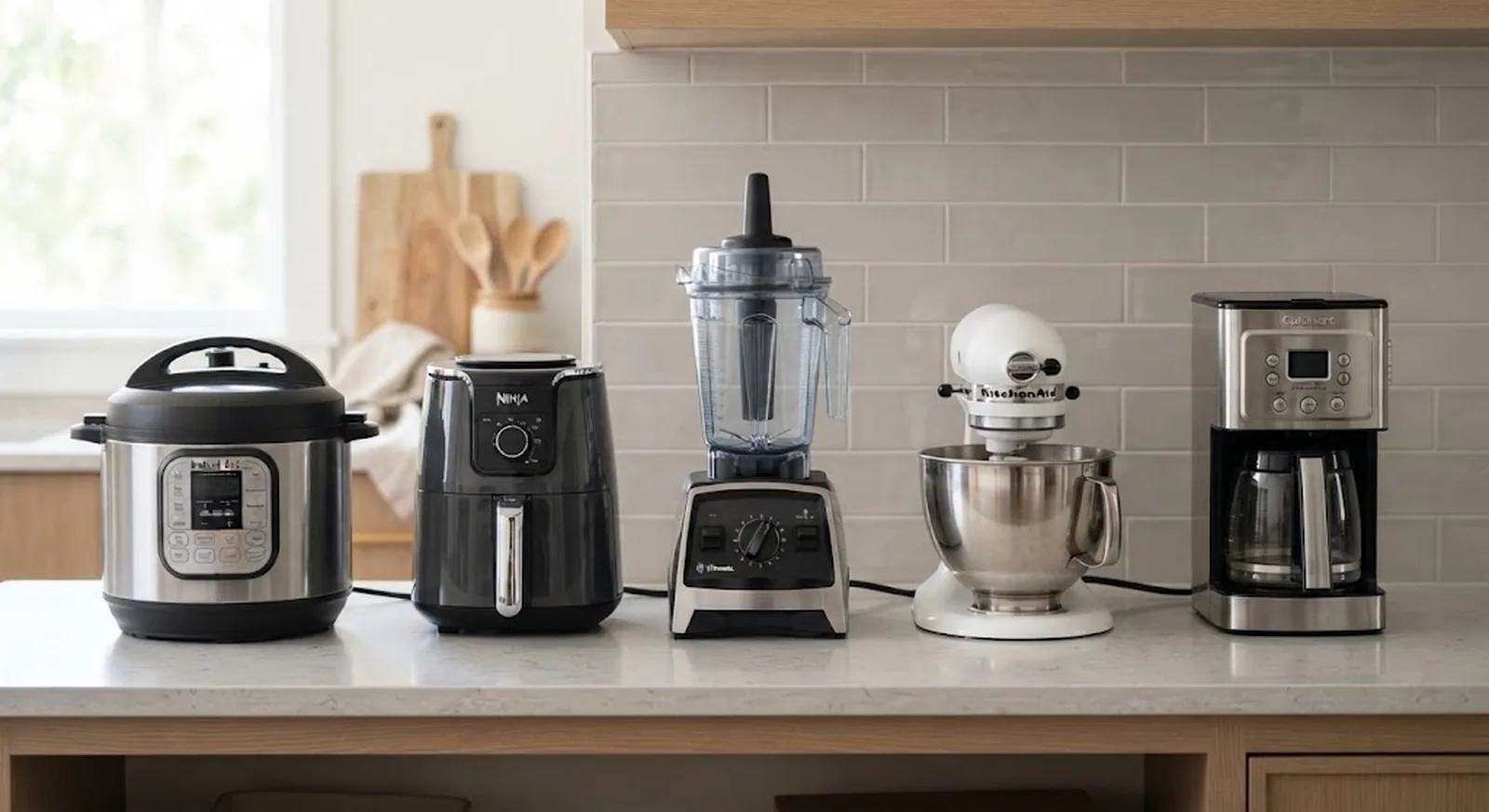
1. A 6-quart multi-cooker (Instant Pot Duo Plus)
The multi-cooker is the single best small kitchen appliance for new cooks. Pressure cooking at 10–12 PSI cuts braises, beans, and tough cuts to a fraction of stovetop time — spec comparisons show it can cut typical simmer times dramatically. It also replaces a slow cooker, rice cooker, and steamer, so it’s three appliances in one footprint.
The honest con: the sauté function runs hot and uneven, and the learning curve on pressure release trips up everyone for the first week. Budget a couple of mediocre dinners while you learn it.
2. A mid-size air fryer (5–6 quart)
Across buyer reviews, the air fryer consistently earns permanent counter status. It crisps frozen food, reheats leftovers better than a microwave, and roasts a sheet of vegetables in 15 minutes without heating the whole kitchen. For most homes, a 5–6 quart basket fits a family meal without crowding.
The honest con: capacity is the catch. A single basket cooks for two comfortably, but feeding four means cooking in batches. We cover the trade-offs in our full air fryer buying guide. If you’re still deciding between an air fryer and a convection oven, our air fryer vs. convection oven comparison has a meal-by-meal verdict, and if you’re deciding between the two leading dual-zone models, our Ninja vs. Instant Pot air fryer comparison picks a clear winner. One more thing that shows up again and again in buyer reviews: cheap models with a dial timer instead of digital controls tend to drift and run hot, turning “crispy” into “charred” more often than digital models.
3. A high-torque blender
A good blender does far more than smoothies — it makes soups, sauces, nut butters, and frozen drinks. Buyers who own one report reaching for it several times a week. Motor torque matters more than wattage marketing; a strong 1,000+ watt motor blends frozen fruit without leaving icy chunks.
The honest con: the genuinely powerful blenders are loud and pricey. Budget models under $50 handle soft ingredients fine but stall on ice and frozen fruit — see our best blenders for home cooks for the tiers. A trick that comes up often in buyer reviews: if a budget blender struggles, add liquid first and pulse in short bursts rather than running it continuously. It won’t match a high-torque motor, but it stops the blades from spinning uselessly in a frozen pocket and saves the motor from burning out early. For chopping, shredding, and dough work a blender isn’t built for, see our picks for the best food processors under $200.
4. A stand mixer (for bakers)
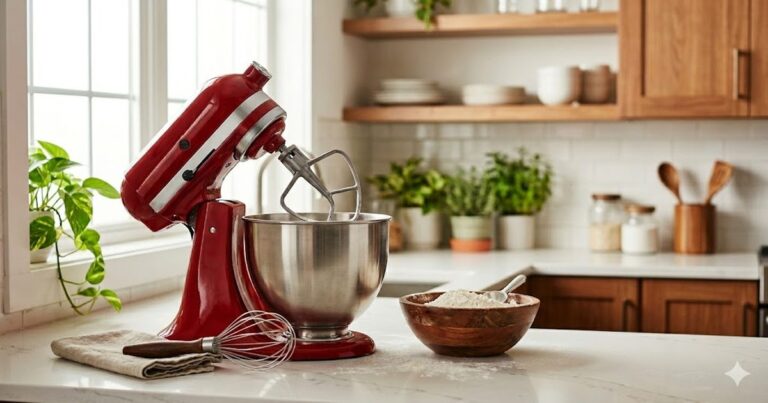
If you bake more than a few times a year, a stand mixer changes the game on bread dough, cookie batches, and whipped cream. The planetary mixing action does in four minutes what takes fifteen by hand. If fresh sandwich bread specifically is your goal, an automatic machine may suit you better than a mixer — see our picks for the best bread makers under $150.
The honest con: it’s heavy, expensive, and pure dead weight if you rarely bake. We’re upfront that this is the one pick on the list that isn’t for everyone — read our honest verdict on whether the KitchenAid stand mixer is worth it before you commit $300+, or compare it head-to-head with the competition in our roundup of the best stand mixers under $300.
5. A programmable coffee maker
The least glamorous pick and one of the most used. A programmable drip maker that wakes up before you do pays for itself against a daily café habit within weeks.
The honest con: carafe heat retention is mediocre on most models — coffee tastes scorched after 40 minutes on a hot plate. A thermal carafe model fixes it but costs more. If you want to graduate from basic drip to cafe-quality brewing, see our guide to the best coffee makers for home baristas.
Best small kitchen appliances for the money: $50, $100, and $300+ tiers
Here’s where most guides fall short — they list winners without telling you what tier you’re shopping in. These are the best small kitchen appliances for the money at three honest price points.
| Budget tier | Best buy | What you get | What you give up |
|---|---|---|---|
| Under $50 | Compact air fryer or immersion blender | Genuine utility, tiny footprint | Smaller capacity, fewer presets, shorter lifespan |
| Around $100 | 6-qt multi-cooker or full-size blender | The sweet spot — durable, versatile | Not the absolute top performance |
| $300+ | Stand mixer or premium blender | Decades of use, pro-level results | High upfront cost, heavy, overkill for light users |
Under $50: This tier is real. The Kitchn and Consumer Reports both maintain solid under-$50 and under-$100 lists, and we agree — a compact air fryer or a decent immersion blender delivers most of the value for a fraction of the price. Just go in knowing the trade-off: lighter materials and a shorter expected life.
Around $100: The value sweet spot. A 6-quart multi-cooker or a full-size blender at this price lasts years and does real work. If you buy one thing from this whole guide, buy here.
$300+: Reserved for machines you’ll use for decades. A quality stand mixer or premium blender at this tier genuinely outlasts cheaper rivals — but only worth it if you actually use it weekly.
Small kitchen appliances list: 12 picks by category
If you’d rather scan a small kitchen appliances list than read the full breakdown above, here it is — the same recommendations, organized by category instead of budget tier. It works whether you searched “small kitchen appliances list” or came at it backwards as “kitchen small appliances”: same machines, same reasoning, different word order.
- Multi-cooker (6-qt) — pressure cooks, slow cooks, and steams. The single best small kitchen appliance for a new cook building a kitchen from zero.
- Air fryer (5–6 qt) — crisps, reheats, and roasts in a fraction of oven time. The appliance most buyer reviews say gets used the most.
- Blender (1,000+ watt) — smoothies, soups, sauces, and nut butters. Torque matters more than the wattage number on the box.
- Stand mixer — bread dough, cookie batches, and whipped cream in minutes instead of by hand. Skip it entirely if you rarely bake.
- Programmable coffee maker — brews before you’re out of bed. Pays for itself against a daily café habit within weeks.
- Toaster oven — toasts, bakes, and reheats in a footprint smaller than a full oven, and cheaper to run for small batches.
- Immersion blender — blends soup right in the pot and stores flat in a drawer. The small-kitchen alternative to a full-size blender.
- Electric kettle — boils water in 2–3 minutes for tea, pour-over coffee, or instant meals, far faster than a stovetop kettle.
- Food processor — chopping, shredding, and dough work a blender’s blades aren’t built for.
- Rice cooker — only worth owning standalone if you eat rice most days; otherwise a multi-cooker’s rice setting covers it. If you do cook rice often, see our picks for the best rice cookers under $80.
- Waffle maker — an occasional-use pick. Store it between uses rather than giving it permanent counter space.
- Slow cooker — set-and-forget braises and soups; skip it if your multi-cooker already has a slow-cook function.
Look at the overlap: a single multi-cooker replaces three separate items on this small kitchen appliances list — the rice cooker, the slow cooker, and a steamer. That’s the footprint argument from earlier in this guide, made concrete in list form.
How many is too many? Most functional kitchens run on 5–7 items from this list, not all twelve. If you count more than that on your counter, some of them are earning their spot out of guilt rather than actual use — the “we should really use this more” pile. A useful test: box up anything you haven’t touched in a month and see what you genuinely miss. Whatever’s left is your real small kitchen appliances list, not the aspirational one.
Best small appliances for a small kitchen
If counter space is your real constraint, the calculus changes. The best small appliances for a small kitchen are the ones that do double duty or tuck away.
A multi-cooker is the obvious win — it replaces three or four single-purpose machines. A toaster oven is the dark-horse pick here: Consumer Reports specifically calls it a standout for small kitchens because it handles toasting, baking, and reheating in a footprint smaller than a full oven, and it’s far more energy-efficient for small batches.
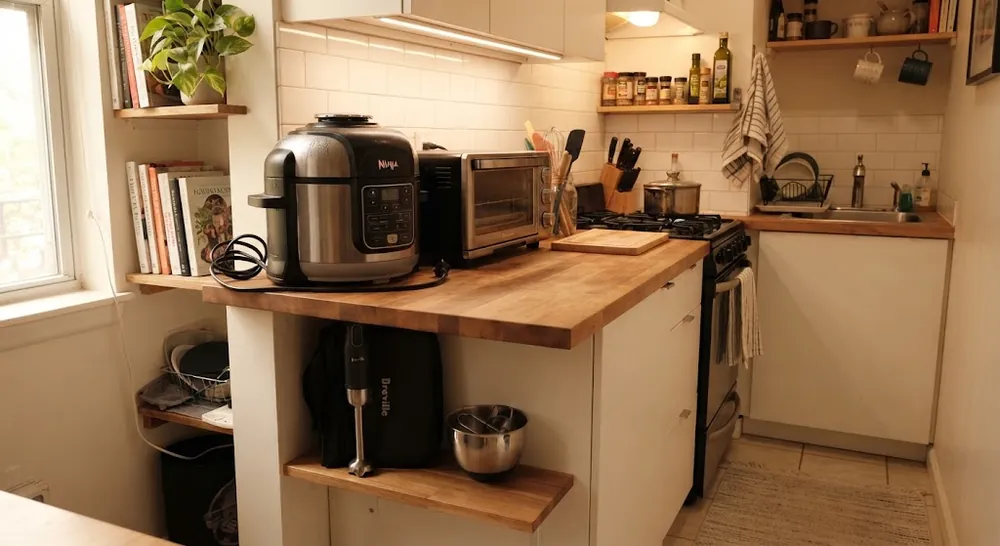
We’d also nudge apartment cooks toward an immersion blender over a full countertop blender. It lives in a drawer, blends soup right in the pot, and cleans in seconds. For a fuller starter setup, our guide to kitchen essentials for a first apartment maps out exactly what to buy first when space and budget are both tight.
One thing to skip in a small kitchen: single-purpose machines. A standalone rice cooker, egg cooker, or quesadilla maker each claims permanent counter real estate for one narrow job. In tight kitchens, versatility beats specialization every time.
A layout tip worth following in a tight kitchen: keep the appliances you use daily at counter height and within arm’s reach of the outlet you actually use, and store the rest. A machine buried in a low cabinet behind the pots simply stops getting used — the friction of digging it out is enough to kill the habit. If counter space is the real bottleneck, that “use it or lose it” reality should drive your buying as much as any spec sheet. Buy fewer machines, keep them reachable, and you’ll cook more.
How much these actually cost to own (energy and lifespan)
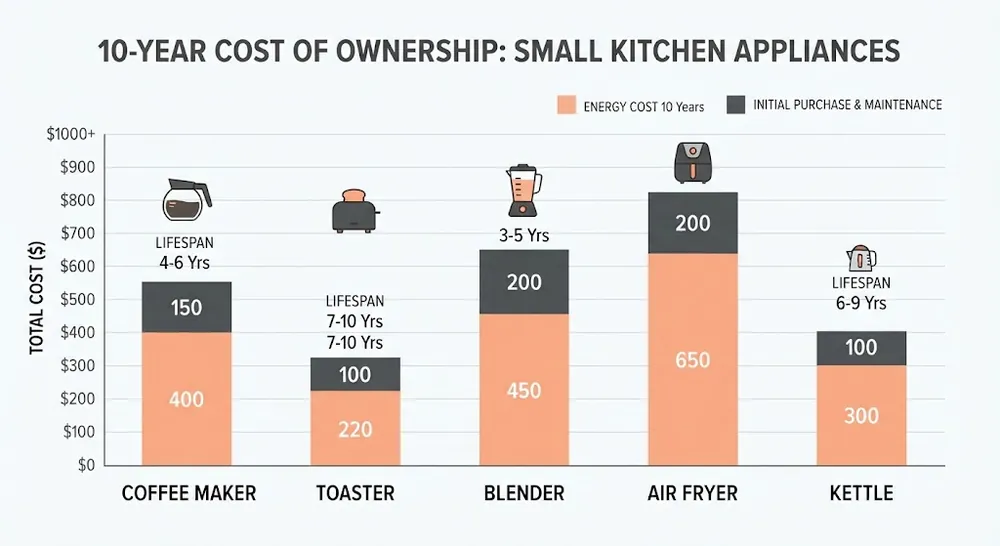
This is the section nobody writes, and it’s the most useful one. The sticker price of a small kitchen appliance is just the down payment. Total cost of ownership folds in energy use, repairs, and how often you replace it.
Energy adds up quietly. Reheating a single serving in a conventional oven burns roughly $0.15–0.25 in energy; the same job in a microwave or toaster oven costs about $0.02–0.04. For a household reheating a couple of items daily, switching to the efficient appliance saves on the order of $100–200 a year. That’s a real line item, not a rounding error.
Lifespan is the bigger lever. Budget appliances built from lighter materials are often designed to be replaced, not repaired — they may perform fine out of the box but fade in a couple of years. Better-built machines routinely run 15–20 years versus 7–10 for entry-level. Pay once, or pay three times.
Here’s how we think about it: a $40 air fryer replaced every two years costs you roughly $20 a year, plus the hassle of re-buying. An $90 model that lasts six years costs $15 a year and never strands you mid-recipe. The “cheaper” option was the more expensive one.
There’s a maintenance angle here too. The appliances that last are usually the ones that are easy to clean, because a machine that’s a pain to scrub gets used less and replaced sooner. Across buyer reviews of the best small kitchen appliances, dishwasher-safe parts and wipe-clean exteriors quietly extend an appliance’s real-world life — not because the motor lasts longer, but because you keep using it. A removable, dishwasher-safe air fryer basket is worth more over five years than one extra preset you’ll never touch.
The takeaway for the best small kitchen appliances in 2026: spend at the value tier on the machines you use weekly, and only go budget on things you’ll use occasionally. Match the build quality to the frequency of use, factor in the energy and the lifespan, and the math almost always points to buying one good machine instead of two cheap ones.
Small kitchen appliances we’d skip (and what to buy instead)
Honesty is the whole point of this site, so here’s the short list of small appliances we wouldn’t buy again — and the better move for each.
Single-serve electric egg cookers. A pot of water and a timer do the same job for free. Instead: learn the multi-cooker egg setting if you already own one.
Electric quesadilla makers and panini-only presses. Narrow use, permanent footprint. Instead: a cast iron skillet or the toaster oven you already have.
Cheap “8-in-1” multi-tools that do nothing well. The jack-of-all-trades machines under $40 tend to underperform at every function. Instead: one solid single appliance from the value tier.
Countertop deep fryers. Messy, smelly, hard to clean, and your air fryer covers 90% of the cravings with a fraction of the oil. Instead: the air fryer that’s already on your list.
None of these are scams — they just lose on our frequency-of-use and footprint math. Your kitchen, your call, but that’s where our money goes.
FAQ
What small kitchen appliances do I actually need?
For most homes, five cover almost everything: a multi-cooker, an air fryer, a blender, a coffee maker, and — if you bake — a stand mixer. Everything else is a nice-to-have, not a need.
What is the most useful small kitchen appliance?
For sheer versatility, the multi-cooker, because it replaces several single-purpose machines. For frequency of use, the air fryer wins in most households, according to buyer reviews.
Are expensive small appliances worth it?
Sometimes. They’re worth it for machines you use weekly, where durability and performance compound over years. For appliances you’ll use occasionally, a value-tier model is the smarter buy.
What small appliances are best for a small kitchen?
Pick double-duty machines: a multi-cooker, a toaster oven, and an immersion blender that stores in a drawer. Avoid single-purpose gadgets that claim permanent counter space.
How long do small kitchen appliances last?
Entry-level models typically last 7–10 years; better-built ones run 15–20. Lighter, budget-built appliances are often designed to be replaced rather than repaired.
What’s on a basic small kitchen appliances list?
The core five — a multi-cooker, an air fryer, a blender, a coffee maker, and a stand mixer if you bake — cover most kitchens. Add a toaster oven, immersion blender, and electric kettle next if you have the counter space.
Is “kitchen small appliances” the same thing as “small kitchen appliances”?
Yes. It’s the same category with the words reordered — compact, single- or multi-task machines like air fryers, blenders, and multi-cookers, as opposed to full-size appliances like ranges, ovens, and refrigerators.
Key takeaways
- The best small kitchen appliances of 2026 for most homes are a multi-cooker, an air fryer, a blender, a coffee maker, and (for bakers) a stand mixer.
- Score every appliance on three things: how often you’ll use it, how much counter it eats, and what it costs over its full life — not just the sticker price.
- The ~$100 value tier is the sweet spot for machines you use weekly; only go budget on occasional-use items.
- In a small kitchen, versatility beats specialization — a multi-cooker and toaster oven outperform a shelf of single-purpose gadgets.
- Heading into the holidays? Our fall kitchen refresh checklist walks through which of these appliances are actually worth upgrading before the season gets busy.
- Skip single-serve egg cookers, panini-only presses, cheap 8-in-1 multi-tools, and countertop deep fryers. For smaller hand tools, see our roundup of the best kitchen gadgets that are actually worth buying.
- When you’re ready to pair your appliances with quality pots and pans, our in-depth guide to the best cookware sets of 2026 (and for outdoor cooking this summer, our guide to the best pellet smokers for beginners) covers every budget tier from tri-ply stainless to ceramic nonstick.
Energy and lifespan make a “cheap” appliance the expensive one — efficient, durable machines save $100–200 a year and years of hassle.