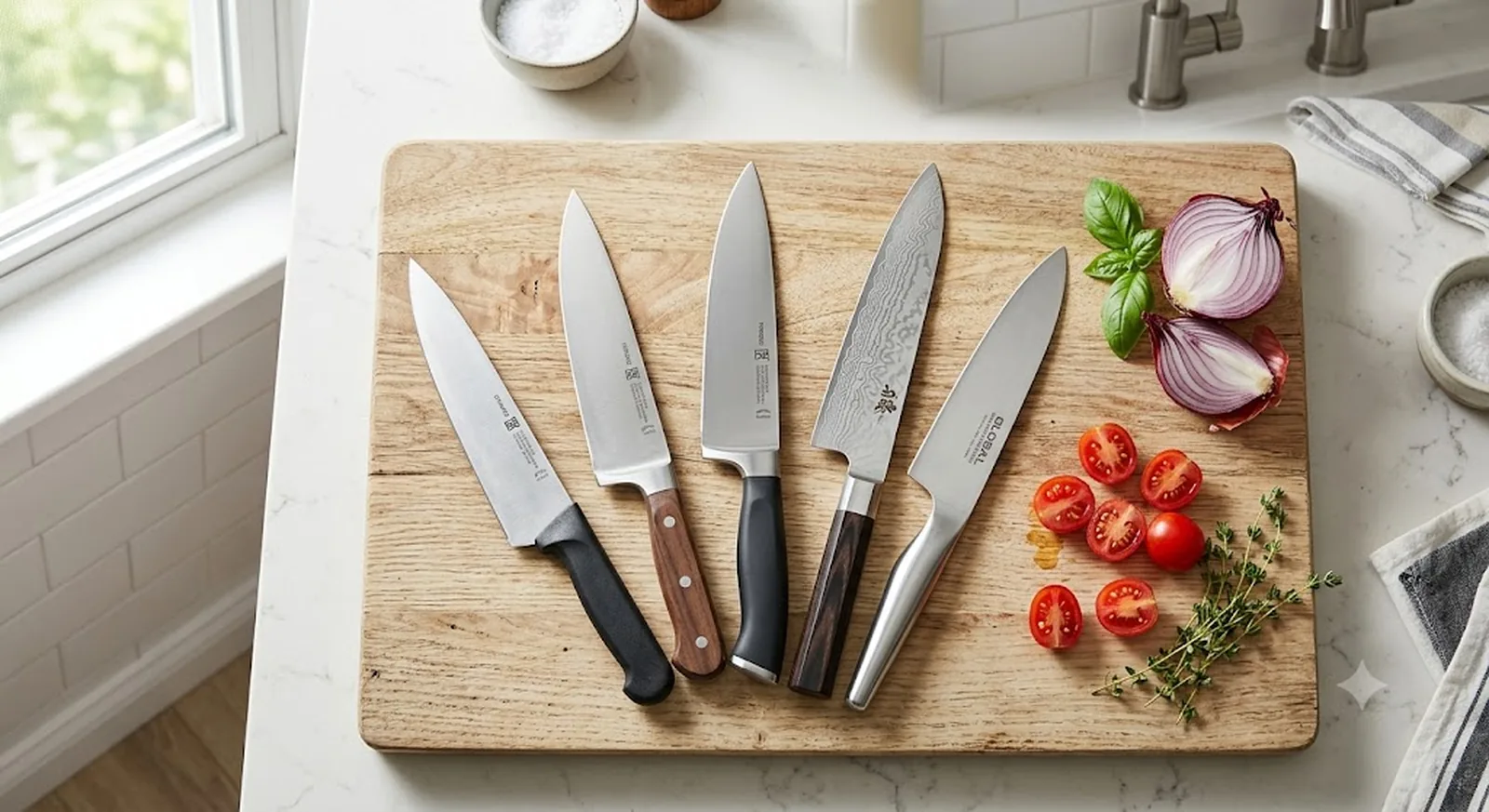
Best Chef’s Knives Under $100: 5 Ranked and Compared
A chef’s knife is the one tool I reach for more than any other, and for years I assumed that meant I had to spend real money to get a good one. So I put that assumption to the test the way that actually holds up at scale: I dug into verified-purchase reviews for five popular chef’s knives that all cost under $100, looking for the complaints and praise that show up again and again once the marketing copy is stripped away. Heads up: some links below are Amazon affiliate links, which means I may earn a small commission if you buy through them — at no extra cost to you. It never changes which knife wins. The pattern in the reviews genuinely reordered my own assumptions, and a couple of the knives I expected to dismiss turned out to have loyal, satisfied buyers.
Below is exactly how these picks were evaluated, what actually matters at this price, and the five knives ranked by how real buyers say they perform once the brand name stops doing the talking. If you want the wider context on which kitchen tools earn their counter space, my guide to the kitchen gadgets worth buying is a good companion read.
How these knives were evaluated
Brand loyalty and marketing language skew a lot of knife reviews, so the only reliable way to rank these fairly is to look past both. For each of the five knives, I read through large numbers of verified-purchase reviews and looked specifically for the jobs people actually use a chef’s knife for: dicing onions, breaking down whole chickens, slicing ripe tomatoes without crushing them, mincing herbs, and sectioning dense produce like butternut squash. (If dicing and mincing aren’t yet second nature, my knife skills 101 guide walks through the 7 basic cuts worth practicing first.) I paid particular attention to how each knife’s edge held up over weeks and months of real daily use, not just what happened on day one.
Four things kept surfacing as what actually separates a good knife from a frustrating one at this price: out-of-box sharpness, comfort and balance over a long prep session, edge retention after weeks (not days) of real cooking, and how easy the knife is to control for fine work. Grip and cutting style vary from cook to cook — but a large, consistent pattern across verified reviews tells you a lot more than any spec sheet could.
The most useful part of this approach is that it forces you to ignore the marketing entirely. Product listings all claim to be “razor-sharp” or “professional grade,” so the only way to judge fairly is by what buyers actually report once the knife is in their kitchen. That strips away a surprising amount of bias — a knife I’d have written off on reputation turned out to have consistently glowing feedback for agility, while one I expected to dominate had a recurring cluster of complaints. Enough verified reviews, read closely, tell you a knife’s real personality.
What actually matters in a chef’s knife under $100
Before the picks, here’s what separates the good knives from the frustrating ones once you look past price and marketing. These are the criteria I’d tell any friend to weigh.
- The steel. Most knives in this range use German stainless (a softer, tougher steel that’s easy to re-sharpen) or a Japanese steel like VG10 (harder, holds a keener edge longer, but more brittle). Neither is “better” — they suit different cooks.
- Forged vs. stamped. Forged blades are cut from a thicker billet and usually feel heftier with a bolster near the handle; stamped blades are punched from a sheet and tend to be lighter and nimbler. It’s tempting to assume forged automatically wins — the review data says otherwise.
- Weight and balance. A knife that’s balanced at the bolster feels controlled; one that’s blade-heavy tires your wrist over a big prep session. This is the single thing most spec sheets can’t tell you.
- The handle. A grippy handle that stays secure with wet, oily hands matters far more than how the knife looks in photos.
- Edge retention. Cheaper steel that dulls in two weeks isn’t a bargain. Reviews that mention edge performance weeks or months in matter more than how a knife feels on day one.
A good chef’s knife also needs upkeep no matter the price, so factor in a honing rod and the occasional sharpening — I walk through the easy version in my guide to sharpening a kitchen knife at home.
The 5 best chef’s knives under $100, ranked
1. Victorinox Fibrox Pro 8″ — Best Overall

This is the knife that keeps coming up as the one buyers didn’t expect to love. It scores highest across verified reviews for everyday balance: it’s a stamped blade, so it’s noticeably lighter than the forged knives here, and reviewers consistently credit that lightness with less wrist fatigue during long prep sessions like dicing multiple onions in a row. Buyers report the edge arrives genuinely sharp out of the box, and complaints about dulling are rare even months in, largely because the softer German steel is so forgiving to touch up on a honing rod.
The Fibrox handle is the quiet hero here: reviewers repeatedly praise how textured and grippy it stays even with wet or greasy hands, and it’s the knife people recommend to nervous beginners and experienced cooks alike. The con: it’s plain. There’s no bolster, no polished steel, nothing that feels special in the hand — it looks and feels like a workhorse, because it is one. If you want a knife that impresses on the counter, this isn’t it. If you want the one that quietly does everything well, it’s the top pick.
2. Mercer Culinary Genesis 8″ — Best Value for New Cooks

The Genesis is the knife most reviewers recommend to anyone buying their first real chef’s knife, and it’s the cheapest knife in this lineup. It’s unmistakably a forged blade — a full bolster and real heft behind the heel that buyers describe as reassuring for rock-chopping garlic and herbs. This is the knife that turns up in a lot of culinary-school kits, and the reviews explain why: it’s tough, it holds up to daily abuse, and buyers consistently note the edge re-hones back to keen with almost no effort.
The Santoprene handle has a molded grip that reviewers say stays secure even when wet, and the protected pinch grip near the bolster is genuinely beginner-friendly. The con: that full bolster runs all the way to the edge, which several buyers note makes it harder to sharpen the heel of the blade on a whetstone down the line, and it’s heavier than the Victorinox — a tradeoff some reviewers mention feeling in longer prep sessions. For the money, though, nothing in this price range outperforms it on pure value.
3. HENCKELS Classic 8″ — Best Forged German Workhorse

If you want the traditional German chef’s knife experience — substantial, fully forged, with a satisfying triple-riveted handle — this is the one buyer feedback points to. It reads as the most “premium” of the budget knives in hand: dense, well-finished, and balanced right at the bolster. Reviewers describe it powering through dense produce like butternut squash with an authority the lighter stamped knives can’t quite match, and complaints about the edge dulling quickly are uncommon.
The classic riveted handle is comfortable in a standard grip and reviewers describe it as built to last. The con: a recurring complaint is that the polished handle gets slippery with wet hands — less secure than the textured Victorinox or molded Mercer grips — and the extra weight is a double-edged thing: great for tough produce, more tiring for a marathon mince according to several buyers. It’s a heirloom-feeling knife at a budget price, just not the nimblest of the group.
4. KYOKU Shogun 8″ — Best Japanese-Style Edge
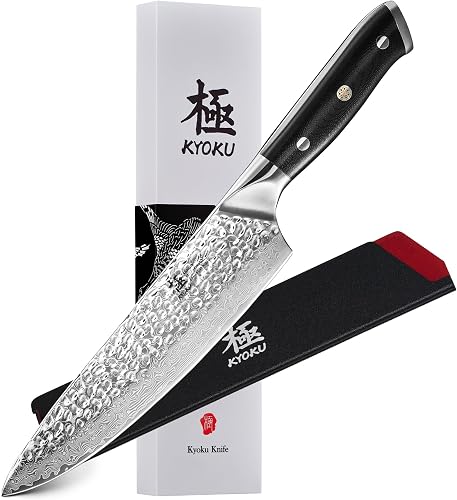
This is the most expensive knife here and still comes in comfortably under $80 — and the difference shows. Verified buyers consistently rate it the sharpest of the five by a clear margin, describing an out-of-box edge that glides through tomato skin with almost no pressure. That’s because it’s a VG10 steel core wrapped in a hammered Damascus-pattern cladding, and reviewers report the harder steel holds its edge longer than the German knives in this lineup, which is exactly what VG10 is known for.
It’s lighter and thinner than the German knives, and reviewers who do precise work — thin-slicing shallots, supreming citrus — say that thinness makes it feel effortless. The con: that hardness is a trade-off. A recurring complaint is that the thinner, harder edge is more prone to chipping if it’s twisted through bone or scraped sideways against a cutting board, and buyers note it really wants a whetstone rather than a quick pull-through sharpener when it eventually dulls. Treat it with a little care and buyer feedback suggests it’s the most exciting knife to use here; get rough with it and reviewers say you’ll regret it. (My kitchen tool care guide covers how to keep an edge like this happy.)
5. imarku 8″ Chef Knife — Best-Looking Gift Pick
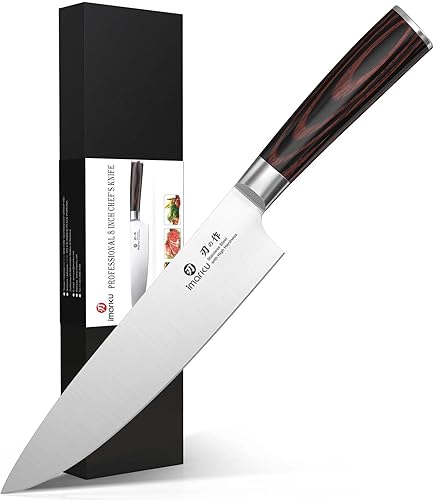
The imarku is the knife that looks the most expensive and costs the least, which is exactly why it lands here as a gift pick. It’s a Japanese high-carbon stainless blade with a sleek ergonomic handle, and it ships in a presentation box that makes it feel like a real present. Buyers are often pleasantly surprised: reviews consistently mention an out-of-box edge sharp enough to glide through tomato skin, and the slim profile that makes it agile for everyday dicing.
For a knife this affordable, the fit and finish punch above their weight. The con: edge retention is the weakest of the five by reviewer consensus. Buyers report needing to hone it more often than the Victorinox or KYOKU to keep it at its best, and the balance reads a little blade-forward compared with the top picks. It’s not the knife for daily heavy use — but as a good-looking, genuinely capable knife to gift a new cook, it overdelivers. If you’re shopping for someone setting up a kitchen, pair it with the basics from my first-apartment kitchen essentials guide.
Quick verdict: which one should you buy?
- Want the best all-rounder? The Victorinox Fibrox Pro. Light, grippy, sharp, forgiving — it does everything well and asks nothing in return.
- Buying your first real knife or shopping on the tightest budget? The Mercer Genesis. It’s the cheapest here and the most beginner-friendly forged option.
- Love a heavy, traditional German knife? The HENCKELS Classic, for that forged, built-to-last feel.
- Want the sharpest edge and don’t mind a little care? The KYOKU Shogun, with its VG10 Japanese core.
- Shopping for a gift? The imarku — it looks the part and cuts well above its price.
German vs. Japanese, forged vs. stamped: which side won?
Here’s the takeaway that comparing hundreds of reviews across these knives drilled home: there’s no universal winner, only the right match for your hands and your cooking. The German knives (Victorinox, Mercer, HENCKELS) are consistently described as tougher, more forgiving, and easier to bring back to sharp — the better choice if you’re rough on tools or just want a knife you don’t have to think about. The Japanese-style blades (KYOKU and, more loosely, the imarku) reward buyers with a keener edge and lighter agility, but they ask for gentler handling.
Forged versus stamped is the most surprising pattern in the data. It would be easy to assume the heavier forged knives dominate, but the lightweight stamped Victorinox earns the overall pick because balance and low fatigue matter more across a real prep session than raw heft, according to the weight of buyer feedback. Heavier isn’t better — it’s just different. If “heavier equals better” is something you’ve always believed, that’s one of several kitchen assumptions worth re-examining.
How to keep any of these knives sharp
The fastest way to ruin a good knife at any price is neglect. A few habits I follow with every knife I own: hand-wash and dry it immediately rather than leaving it in the sink or running it through the dishwasher; hone it with a steel every few uses to realign the edge; store it on a magnetic strip or in a guard rather than loose in a drawer where the edge bangs against other tools; and cut on wood or plastic, never glass or stone. Do those four things and even the budget knives here will outlast knives that cost five times as much.
Frequently asked questions
Do you really need to spend more than $100 on a chef’s knife?
For home cooking, no. Based on verified buyer feedback across all five picks, knives under $100 handle everything most home cooks need from daily prep. More money mostly buys you finer finishing, premium steels, and prestige — not dramatically better cutting for everyday use. Spend the savings on a sharpener and a good cutting board instead.
What size chef’s knife should I get?
An 8-inch blade is the sweet spot for most home kitchens, which is why every knife in this roundup is 8 inches. It’s long enough to break down large produce and short enough to stay controllable. If you have smaller hands or a tight cutting board, a 6-inch feels nimbler; if you cook for a crowd, a 10-inch covers more ground.
Is a Japanese knife harder to maintain than a German one?
A little. Harder Japanese steels like VG10 hold their edge longer but are more prone to chipping and prefer a whetstone over a pull-through sharpener. Softer German steel dulls a bit faster but is more forgiving and easier to re-sharpen quickly. Neither is hard to live with once you know its quirks.
Can these knives go in the dishwasher?
Even when a manufacturer says yes, I never do it. The heat, harsh detergent, and knocking against other items dull and corrode the edge and can crack handles over time. A ten-second hand wash and dry is the single best habit for making any knife last.
The bottom line
Setting brand reputation aside is humbling. The knife most people would bet on by name isn’t always the one that keeps winning in real buyer feedback, and the cheapest knife in this lineup turned out to be the one reviewers recommend most often to new cooks. If you want a single answer, the Victorinox Fibrox Pro is the chef’s knife that fits in almost any kitchen — but every knife on this list earned its place under $100, and the right one for you comes down to whether you value forgiveness or a finer edge. Buy the one that matches how you actually cook, keep it sharp, and it’ll serve you for years.
Heading outdoors this summer? See my picks for the best outdoor knife sets for camping and picnics.