24 Kitchen Organization Ideas That Actually Work (With Product Picks)
Most kitchen organization ideas look great on Pinterest and fall apart inside of a week. The gap between “looks organized” and “stays organized” comes down to a few honest principles, drawn from what verified-purchase reviews and spec comparisons consistently show about what actually holds up in a real kitchen — not a staged one. This post covers 24 kitchen organization ideas, with the specific products worth buying and the ones you can skip.
Disclosure: This post contains affiliate links. If you purchase through them, I may earn a commission at no extra cost to you.
In Brief:
The best kitchen organization ideas share three traits: they reduce the number of decisions required to put something away, they work with your existing cabinet and drawer dimensions, and they use gravity-resistant storage (items stay put when you grab something nearby). Shelf risers, drawer dividers, lazy susans, and under-sink racks are the four categories with the highest return on effort.
Why Most Kitchen Organization Ideas Fail Before Month Two
Kitchen organization projects usually start with an all-in overhaul — matching containers, color-coded labels, the works — and just as often fall back into chaos within a few weeks. When that happens, the useful question isn’t “what else do I need to buy,” it’s: why does this break down?
The answer is almost always friction. When putting something away takes longer than just leaving it on the counter, the counter wins. Good kitchen cabinet organization has to be faster, not just prettier. That means fewer steps to store, fewer items competing for the same space, and clear visual logic that anyone in the household can follow without a tour.
Every idea below passes that friction test. If it costs more time to maintain than it saves, I’ve left it out.
Kitchen Cabinet Organization Ideas
1. Shelf Risers Double Your Vertical Space Immediately
The average kitchen cabinet has 12–14 inches of vertical clearance. Most plates and bowls are 3–4 inches tall. That means you’re wasting 8–10 inches of air above every stack. A shelf riser fills that air with a second usable layer — and it takes about 60 seconds to install.
The Dedomy Expandable Cabinet Shelf Riser is a strong pick here. It adjusts from 14 to 25 inches wide, so it fits virtually any cabinet without cutting or tools. Buyer reviews consistently note the powder-coated steel frame handles 50 lbs without flex — important if you’re stacking heavy dinner plates.

Dedomy Expandable Cabinet Shelf Riser — adjustable 14–25 inches, 50 lb capacity.
Con: It doesn’t grip shelves with a lip over ½ inch — check your cabinet edge first.
2. Bamboo Cabinet Organizer Sets Work Better Than Wire Racks
Wire racks are common, but bamboo organizers tend to outperform them. The reason is simple: wire racks shift when you pull items out, and spices and small jars fall through the gaps. Bamboo is solid, looks better, and doesn’t rust.
The Goozii Cabinet Shelf Organizer Set of 4 gives you four shelf risers in a mix of heights, all made with natural bamboo and black metal frames. The varied heights work especially well in a spice cabinet, creating a visual tier so every label stays readable instead of getting buried in a flat pile.

Goozii Bamboo Cabinet Shelf Organizer Set of 4 — tiered heights for plates, cups, and spice jars.
Con: The bamboo base can pick up stains from wet dishes. Wipe down after use.
3. Group Items by Meal Type, Not by Category
Most people organize by category: all the pots together, all the baking pans together, all the mixing bowls together. Grouping by meal type instead — “breakfast zone,” “dinner zone,” “baking zone” — can cut the number of cabinet doors you open per meal roughly in half.
Your breakfast zone might be: French press, coffee mug, small cutting board, and the one knife you use every morning. It all lives in one cabinet or on one shelf. You open one door; you grab what you need; you close it. No hunting. This works especially well in small kitchens where you can’t afford to waste movement. Pair it with a good kitchen essentials starter setup and you’ll eliminate most of the daily counter clutter.
4. Lazy Susans Fix the Corner Cabinet Problem Permanently
Corner cabinets are the worst storage in most kitchens — deep, dark, and impossible to reach the back of. A turntable lazy susan turns the entire depth of that cabinet into accessible storage. Spin it; everything comes to you.
The LANDNEOO 10-Inch Lazy Susan Set of 4 works well for this. The non-skid silicone base means condiments and oil bottles don’t slide when you spin, and the clear design lets you see what’s on each tier without pulling everything out.

LANDNEOO 10-Inch Non-Skid Lazy Susan Organizers, Set of 4 — turntable for corner cabinets, pantry, and fridge.
Con: The 10-inch size is ideal for spices and small bottles; bigger pots still need a different solution.
5. Store Pots by Nesting, Not Stacking
Stacking pots means lifting everything above to reach the one you want. Nesting — placing lids in a vertical lid organizer alongside the pots — means you pull out only what you need, without digging through a stack every morning. A simple vertical divider added to one lower cabinet is usually all it takes. If you have a cookware set with uniform sizes, nesting works perfectly. For mismatched collections, a simple wire plate rack stores lids on their sides so they’re visible and accessible without stacking.
6. Move Appliances You Use Weekly, Not Daily, Out of Prime Cabinet Space
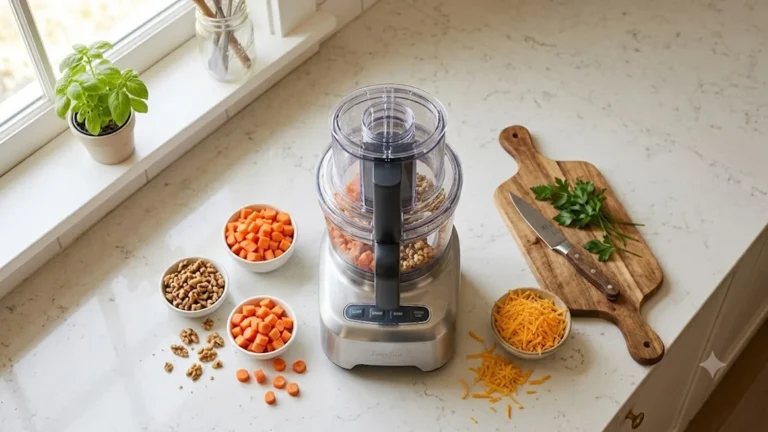
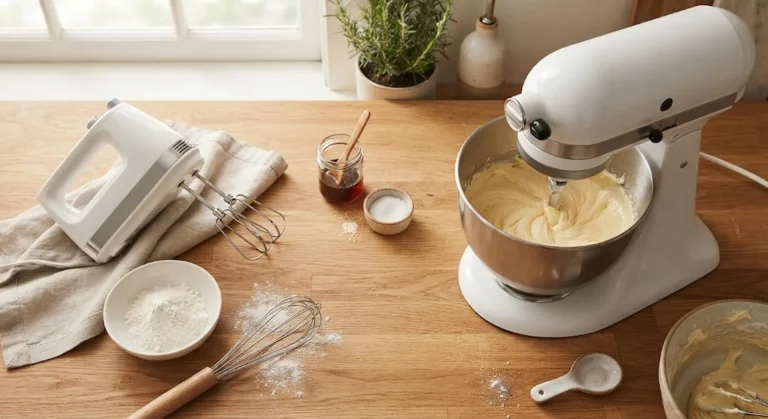
The blender, the stand mixer, the food processor — these are all volumetrically expensive appliances that often live in cabinets and need to come out and go back in for every use. If you use them more than twice a week, leave them on the counter. If you use them less than once a week, get them out of your primary cabinet zone entirely. An appliance you pull out twice a month belongs on a high shelf or in a pantry — not blocking your everyday storage.
Kitchen Drawer Organization Ideas
7. Bamboo Drawer Dividers Are the Single Highest-Return Kitchen Upgrade
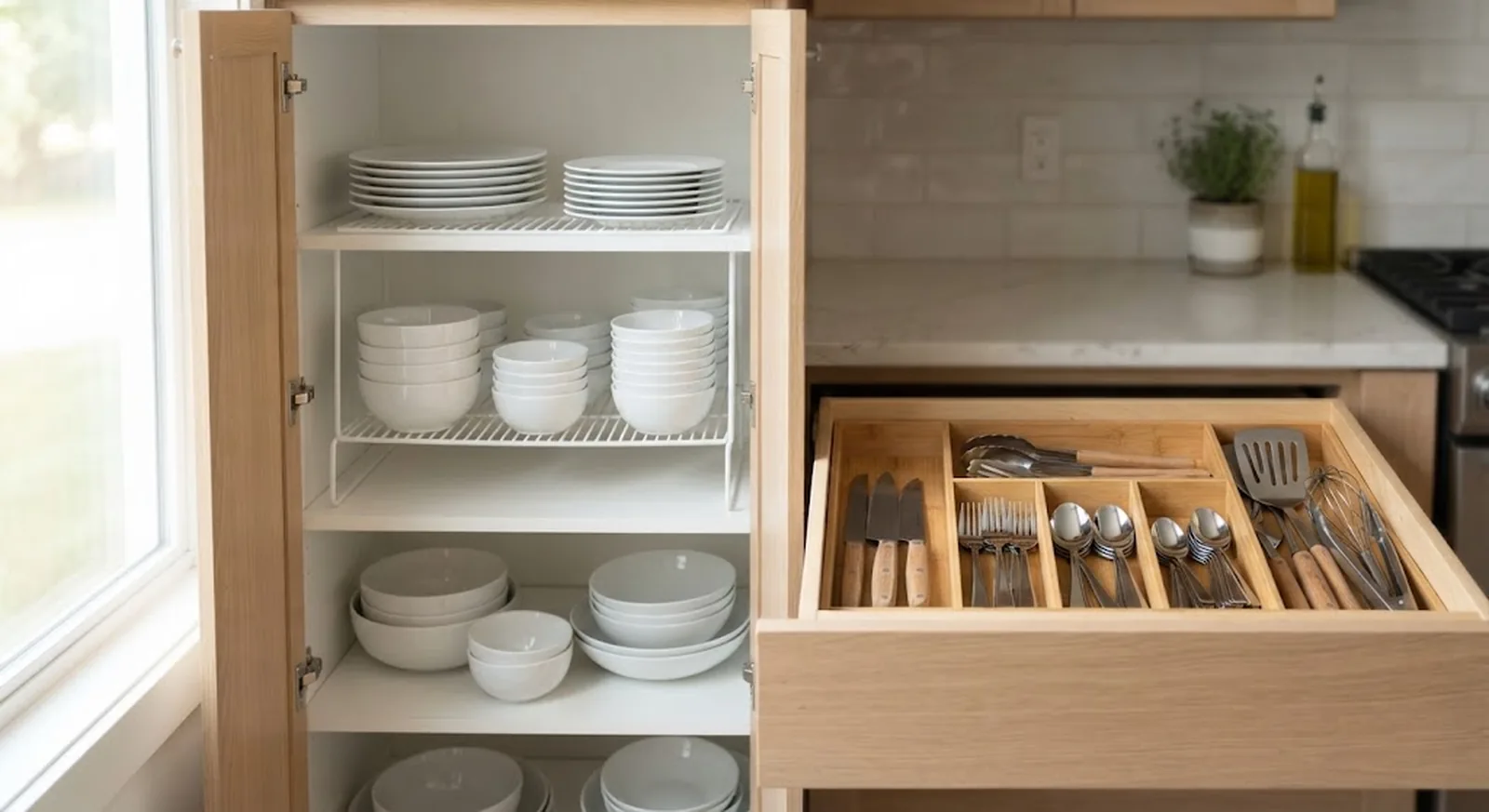
Drawer dividers are among the most consistently praised kitchen upgrades in buyer reviews, with people often saying they wish they’d installed one sooner. An unorganized utensil drawer can mean 10–15 seconds of hunting per use; a well-divided one cuts that down to just a couple of seconds. Over a year, across three meals a day, that adds up to hours of recovered time.
The Totally Bamboo Expandable Drawer Organizer is a standout pick. It expands from 13 to 22 inches wide, has 8 compartments including adjustable sliding dividers, and the bamboo construction is easy to clean. Verified-purchase reviews consistently mention it holding up for years without warping.

Totally Bamboo Expandable Drawer Organizer — 8 compartments, expands 13–22 inches.
Con: The fiberboard base can swell if the drawer gets consistently wet. Keep it dry.
8. Adjustable Bamboo Drawer Dividers Work Better Than Fixed Trays
Fixed trays assume you know exactly what you’ll store forever. Adjustable dividers work with your actual habits. The SpaceAid Bamboo Drawer Dividers with Inserts and Labels give you 4 adjustable dividers that expand from 17 to 22 inches, plus 9 customizable inserts for sub-compartments. They work well even in a junk drawer — yes, even that can be organized. For the full lineup of trays and dividers we’ve compared, see my guide to the best kitchen drawer organizers.

SpaceAid Bamboo Drawer Dividers with Inserts and Labels — 4 dividers + 9 inserts, 17–22 inch range.
Con: The adhesive labels don’t release cleanly from all bamboo finishes.
9. The “Top 5 Tools” Rule Keeps Drawers from Refilling
Here’s what I call the drawer reset rule: before you install any organizer, take every item out of the drawer and ask yourself which 5 utensils you use every single day. Those go in. Everything else goes in a secondary holder on the counter or back in a cabinet. If you skip this step, you’ll fill the organizer just as chaotically as before.
For most home cooks, the top 5 are: chef’s knife, spatula, wooden spoon, ladle, and peeler. Everything else is occasional-use. Treat it that way. Refer to my roundup of kitchen gadgets that are actually worth buying if you’re trying to pare down to what earns its drawer space.
10. An In-Drawer Knife Block Beats a Counter Block
Counter knife blocks take up square footage that’s almost always in short supply. An in-drawer knife block — a foam-lined tray that stores knives horizontally inside the drawer — frees the counter entirely and protects blade edges better than vertical storage. Making the switch typically reclaims several inches of counter space. Universal foam knife drawer inserts run under $20 on Amazon and fit most standard kitchen drawers.
Proper knife storage also matters for blade longevity — read more in my complete guide to kitchen tool care.
11. Color-Coding Works, But Only for One Category
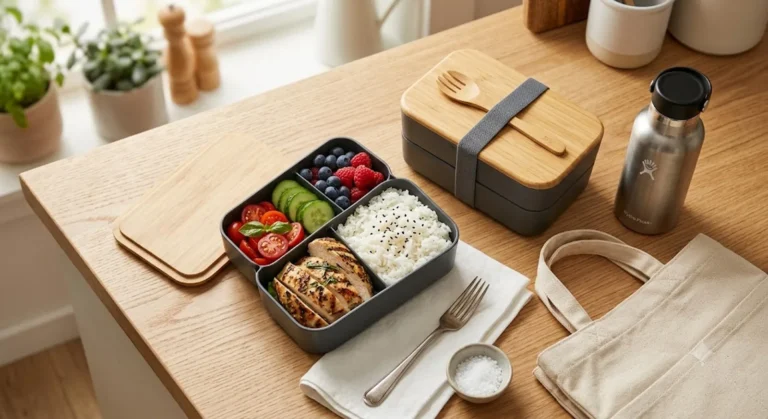
Color-coding every drawer and container is a maintenance nightmare. Pick one category — meal-prep containers work well — and apply color to that category only: one color for lunch containers, another for dinner prep. That way you can grab the right lid without reading labels. Everywhere else: clear containers, no color system needed.
Pantry Organization Ideas
12. Pantry Organization Starts with a Purge, Not a Purchase
Every successful pantry organization project starts the same way, regardless of the kitchen’s size: pull everything out and throw away everything expired. Most pantries contain 30–40% expired items. Organizing around them is pointless.
Once you’ve purged, group by category: grains and pasta together, canned goods together, baking supplies together, snacks together. Only after grouping do you know what containers and bins you actually need. Buying storage before purging almost always results in the wrong sizes.
13. Decant Dry Goods into Clear Containers — With One Caveat
Decanting pasta, rice, and cereal into clear uniform containers is genuinely useful for three reasons: you can see quantities at a glance, containers stack better than bags, and bags tend to tip and spill. The caveat: only decant things you regularly refill. If you buy a specialty flour twice a year, leave it in the bag.
For everyday dry goods, airtight clear containers with wide mouths — so you can scoop without a funnel — are the practical choice. OXO Pop containers have the best seal and most durable lids of any set in this category, according to verified-purchase reviews. If you’re stocking a pantry on a budget, I rounded up the best pantry organization products under $30 separately.
14. Lazy Susans in the Pantry Work as Well as in Cabinets
The same logic that makes a lazy susan great in a corner cabinet applies in a pantry: spinning access beats leaning in and moving items. A couple of 10-inch lazy susans work especially well for oils, vinegars, and hot sauces — a category that tends to multiply over time — keeping it contained without requiring much willpower about buying interesting sauces.
15. Label the Top of Cans So You Skip the Rotation Step
The traditional advice is to rotate cans so the oldest is in front. Practical advice: label the year directly on the top of the can with a marker when you buy it. Stack cans freely, glance at the tops to find the oldest, use that one. No rotation required, no shuffling needed. This is faster and it actually works with how people use pantries — reaching in from the front, not carefully pulling from the back.
16. Use the Inside Pantry Door for Flat Storage
The inside of a pantry door is usually wasted space. A shallow over-door organizer with pockets — not a full rack — works well for flat items: chip bags, ramen packets, seasoning envelopes, or snack bars. Keeping everything single-serve and flat on a door organizer creates a “grab something quick” zone and prevents those items from getting lost in the shelving.
Under-Sink Organization Ideas
17. A 2-Tier Under-Sink Rack Solves the Plumbing Pipe Problem
The challenge with under-sink storage is that pipes take up a significant portion of the horizontal center space. A 2-tier expandable rack works around this by raising items above the pipe level on one side while storing shorter items below on the other. It turns what’s usually dead space into roughly 80% of its theoretical maximum.
The SimpleHouseware Under Sink 2-Tier Heavy Duty Expandable Rack is a solid pick. It adjusts from 15.75 to 25 inches wide, offers 4 shelf-height settings, and buyer reviews describe the steel frame as heavy enough to stay put even fully loaded with cleaning products.

SimpleHouseware Under Sink 2-Tier Heavy Duty Expandable Rack — adjustable 15.75–25 inches, 4 height settings.
Con: Requires measuring your pipe clearance before buying — pipes over 8 inches from the cabinet floor may limit the lower tier’s usability.
18. Keep Cleaning Products and Dishware Supplies Physically Separated
Under-sink cabinets are tempting to mix — cleaning products next to dish soap next to spare sponges. The problem: any leak from a cleaning product can contaminate dishware. Keep the two categories separated — cleaning products on one side or in a dedicated bin that contains drips, dishware supplies on the other.
19. A Tension Rod Creates a Free Spray Bottle Tier
This is the most useful zero-cost kitchen organization idea I know: install a tension rod horizontally across the inside of the under-sink cabinet, about 4–6 inches from the top. Hang spray bottle triggers over it. Your bottles are stored vertically in midair, freeing the entire floor of the cabinet for bins and larger items. A spring tension rod costs under $5 and installs in 30 seconds.
20. Line the Cabinet Floor with a Waterproof Mat
Under-sink cabinets are the most likely to get wet from a slow pipe drip or minor leak. A cut-to-fit waterproof shelf liner means a drip stains the liner rather than the cabinet floor. Replace it once a year. It’s not glamorous, but it prevents real damage that’s expensive to repair.
Small Kitchen Storage Ideas
21. Vertical Storage Beats Horizontal in Small Kitchens
In a kitchen under 100 square feet, wall and door real estate is more valuable than floor or counter space. Magnetic knife strips on the wall, hooks inside cabinet doors for measuring spoons and lids, pegboards above the stove for frequently-used tools — these move storage from the horizontal plane to the vertical. The footprint stays the same; the capacity increases substantially. For a renter-friendly breakdown, see my guide to small kitchen storage ideas that don’t require a renovation.
22. A Rolling Cart Is the Most Flexible Small Kitchen Storage Idea
A slim rolling cart (typically 12–14 inches wide) with 3–4 tiers can serve as a kitchen island, extra counter, appliance storage, or pantry overflow — and rolls out of the way when not needed. This is the one purchase I recommend above all others for kitchens under 80 square feet. It requires no installation, it’s movable, and it costs under $50 in most cases.
23. One “Dump Zone” Prevents General Clutter
The single biggest predictor of a kitchen staying organized long-term is whether there’s a designated home for the random stuff — keys, mail, coupons, loose batteries — that otherwise lands on the counter. A small tray or shallow bowl in the kitchen designated as the “daily dump zone” keeps the counter clear. Everything in the tray gets sorted once a week — and for the work surface itself, my one-zone counter organization method keeps it clear for good. Two minutes, maximum.
24. Reassess Every Three Months, Not Every Year
Kitchen organization decays over time. New products arrive, habits shift, households change size. The kitchens that stay organized long-term aren’t the ones that had the biggest initial overhaul — they’re the ones where someone spends 10 minutes every three months asking: “what’s not working?” Small adjustments beat big seasonal reorganizations. Pair this habit with a regular kitchen gadgets audit to identify what you’re actually using versus what’s just taking up space.
Key Takeaways
- Shelf risers (metal or bamboo) are the highest-ROI cabinet upgrade — they double vertical storage in 60 seconds with no tools
- Drawer dividers recover 10–15 seconds per use, which compounds to hours over a year of daily cooking
- Lazy susans solve the corner cabinet and pantry reach problem permanently — the non-skid variety stays in place
- Under-sink racks reclaim dead space by routing around plumbing with an adjustable expandable frame
- Small kitchens benefit most from vertical storage: magnetic strips, hooks, pegboards, and rolling carts
- Maintenance matters more than setup — a 10-minute quarterly reset beats one big annual overhaul
Once your cabinets are organized, the next upgrade is the containers themselves — see my picks for the best reusable food storage containers.
If spices are the one corner that never stays tidy, I go deeper in my guide to the best spice organizers and racks, which sorts the options by where the jars actually live — drawer, shelf, wall, or counter.