Best Mini Fridges for Dorm Rooms (Noise and Capacity Compared)
This post contains Amazon affiliate links — if you buy through them, I earn a small commission at no extra cost to you.
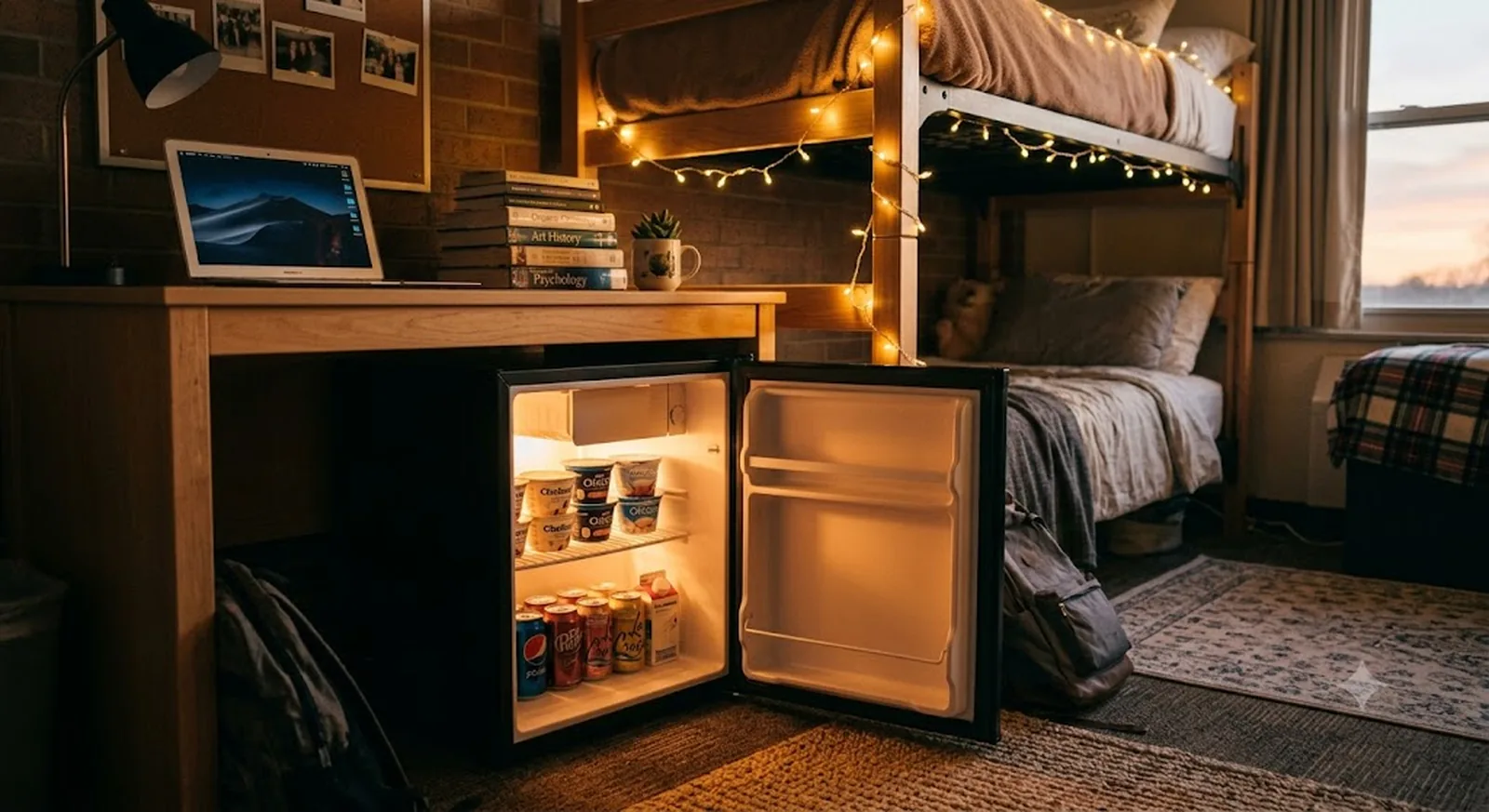
For most students, the best mini fridge for a dorm room is a 3.1–3.2 cubic foot model: big enough for a week of food, small enough to slide under a lofted bed, and within the size cap most housing offices enforce. After comparing manufacturer specs and cross-referencing buyer reviews across five popular models, my overall pick is the two-door Midea — it’s the only one here whose separate freezer buyers consistently report keeps ice cream actually frozen — with the Upstreman SR321 as the clear winner for light sleepers.
How I Compared Them
For this roundup, I cross-referenced each manufacturer’s published specs — capacity, noise rating, freezer type — against hundreds of verified-purchase buyer reviews for recurring, real-world feedback. For noise, that means looking past the spec-sheet number to what reviewers actually say about living with the compressor cycle (the hum that’s fine across a room but noticeable at a headboard). For capacity, it means comparing what buyers report actually fitting inside — a typical week of dorm groceries — against the rated cubic footage. And since it’s the single biggest complaint/praise split in dorm fridge reviews, I paid close attention to how each model’s freezer compartment performs, including whether reviewers say it can keep something like ice cream properly frozen.
The Showdown at a Glance
| Model | Capacity | Doors | Freezer | Noise (mfr. spec, active cycle) | Energy Star |
|---|---|---|---|---|---|
| Midea 3.1 | 3.1 cu ft | 2 | True separate freezer | Mid-40s dB | Yes |
| Upstreman SR321 | 3.2 cu ft | 1 | Small internal compartment | High-30s dB — quietest here | No (low annual kWh) |
| Igloo 3.2 | 3.2 cu ft | 1 | Small internal compartment | Low-40s dB | No |
| BLACK+DECKER BCRK25B | 2.5 cu ft | 1 | Chiller compartment only | Low-40s dB | Yes |
| Frigidaire Retro 3.2 | 3.2 cu ft | 1 | Chiller zone | Mid-40s dB | No |
Midea 3.1 Cu.Ft Two-Door — Best Overall (and the Only Real Freezer)

Here’s the dirty secret of single-door mini fridges: that little “freezer” shelf inside can’t hold ice cream. It hovers too warm, and buyer reviews for single-door models consistently mention things turning to mush. The Midea 3.1 Cu.Ft two-door is the only fridge in this roundup with a genuinely separate freezer door — and it’s the only one where reviewers report frozen food, ice cream included, actually stays solid. The fridge side has enough room for a full week of groceries with space to spare, the door holds a 2-liter bottle upright, and it’s Energy Star certified, which matters because some housing offices require it. It’s also the reason my dorm cooking setup can lean on frozen vegetables and batch-cooked leftovers instead of takeout.
The con: it’s the tallest, heaviest fridge here, and the compressor cycle is audible — a steady mid-40s dB hum. Fine across the room, annoying if it sits right at your headboard. Budget-wise it sits in the mid tier for dorm fridges.
Upstreman SR321 3.2 Cu.Ft — Quietest for Light Sleepers
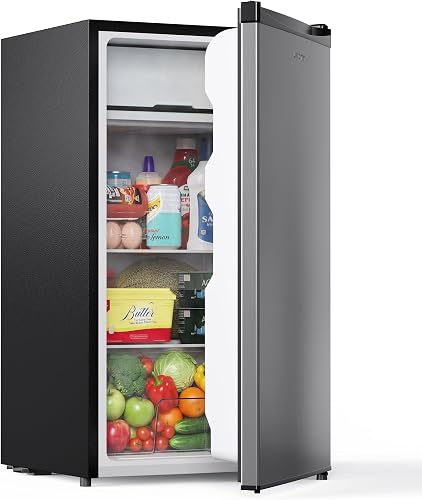
If you share a room — or you’re the kind of sleeper who hears a phone vibrate two floors away — the Upstreman SR321 is the pick. Its published noise spec sits in the high-30s dB range during active cycles, noticeably softer than everything else in this roundup and closer to a library murmur than an appliance — and it’s the model reviewers most often single out as unusually quiet. You still get a full 3.2 cubic feet, adjustable glass shelves that wipe clean in seconds, a reversible door for awkward corners, and a small internal freezer compartment for ice packs and frozen snacks.
The con: that internal freezer compartment is strictly for ice packs and freezer pops — reviewers consistently report it can’t keep ice cream solid, same as every single-door model here. And unlike the Midea and BLACK+DECKER, it doesn’t carry Energy Star certification, so double-check if your campus requires it.
Igloo 3.2 Cu.Ft — Classic Single-Door With Glass Shelves
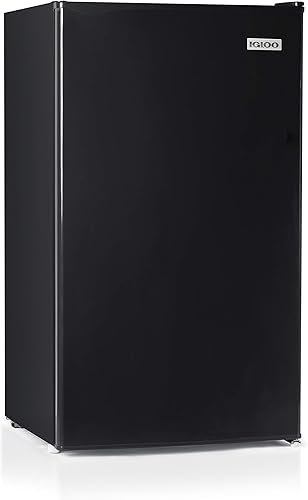
The Igloo 3.2 is the straightforward, no-drama dorm fridge: one door, glass shelves instead of wire (spills stay put instead of dripping through), a crisper-style bottom zone, and door storage that took tall bottles without a fight. Based on its rated capacity, it holds the most usable fridge space of the group — with no separate freezer door eating into the interior, nearly all 3.2 cubic feet goes to actual food. Temperature control is a simple dial, and reviewers note it recovers to temp quickly after the door’s been open.
The con: the fit and finish is more “functional” than premium — several reviewers describe the door shelf trim as flimsier than sturdier competitors like the Upstreman, and at low-40s dB it’s average on noise, not special. The internal freezer shelf has the same ice-cream limitation as every single-door.
BLACK+DECKER BCRK25B 2.5 Cu.Ft — Best Compact Budget Pick

Tight room, tight budget, or a fridge that genuinely needs to fit under a standard desk? The BLACK+DECKER BCRK25B is the budget-tier pick that doesn’t feel like a punishment. At 2.5 cubic feet, reviewers say it comfortably handles a week of basics for one person (minus the bulk Costco ambitions), it’s Energy Star certified, and the reversible door plus leveling legs make it easy to squeeze into whatever corner your roommate didn’t claim first.
The con: the top compartment is a chiller, not a freezer — it keeps things icy-cold but won’t hold frozen food long-term, full stop. And the smaller interior means the door shelves do a lot of the work; a half-gallon of milk plus juice fills them completely.
Frigidaire Retro 3.2 Cu.Ft — The Style Pick

Every dorm floor has one room that actually looks good, and it usually contains something like the Frigidaire Retro. The rounded vintage lines and chrome handle make it the only fridge here anyone will comment on, and the built-in side bottle opener is a legitimately fun touch. Function-wise you get 3.2 cubic feet, a chiller zone up top, and a simple dial — the basics, wrapped in the best-looking shell of the bunch.
The con: you’re paying a style premium for spec-sheet basics — no Energy Star, a chiller rather than any real freezer, and mid-40s dB noise that ties it with the Midea for loudest here. At the time of my check, stock was also running thin. Buy it for the look; buy the Midea for the function.
Before You Buy: Dorm Rules That Can Get Your Fridge Sent Home
Check your housing handbook before you order anything — mini fridge rules are real and enforced during room checks. Most campuses cap capacity somewhere between 3.1 and 4.5 cubic feet, which is exactly why every fridge in this roundup sits at or under 3.2. Some schools also require Energy Star certification (the Midea and BLACK+DECKER qualify), limit rooms to one fridge total, or push a rented MicroFridge combo unit instead. Two placement tips worth knowing: leave a few inches of clearance behind the coils so the compressor doesn’t run constantly, and put the fridge on a hard mat if your room is carpeted — carpet muffles nothing and makes the compressor work harder. If you’re building out the rest of your setup, my $150 back-to-college starter pack covers the tools that pair with it, and my microwaves under $100 showdown finds the one that fits the same tight footprint.
FAQ: Dorm Mini Fridges
Can a mini fridge keep ice cream frozen?
Only if it has a separate freezer door, like the two-door Midea. The freezer shelf inside a single-door fridge typically can’t stay cold enough to keep ice cream solid — buyer reviews for every single-door model here mention the same complaint, with ice cream turning soft within a day or so. Use those compartments for ice packs and freezer pops instead.
How loud is a mini fridge, really?
The compressor models compared here run between the high-30s and mid-40s dB per their published specs during active cycles — roughly library-quiet to quiet-conversation level. The catch is the cycling: a fridge that’s silent for twenty minutes and then kicks on at 2 a.m. is what wakes light sleepers, which is why I’d spend on the quieter Upstreman for shared rooms.
What size mini fridge do I need for a dorm?
For one person, 2.5–3.2 cubic feet is the sweet spot — a week of drinks, lunches, and snacks without dominating the room. Go 3.1–3.2 if you cook or split the fridge with a roommate; the compact 2.5 works if it must fit under a desk. Always check your school’s cap first.
Do I need Energy Star for a dorm fridge?
Some housing offices require it, and it’s worth having regardless — certified compact fridges are designed for low annual power draw, which keeps you clear of both the rules and any energy surcharges. Of the models compared here, the Midea and the BLACK+DECKER carry the certification.
The Bottom Line
If you want one fridge that does everything a dorm actually demands, get the Midea two-door — real freezer, Energy Star, sensible size. Light sleepers should trade the freezer for the hush of the Upstreman SR321. Whichever you pick, it’ll earn its floor space faster than almost any appliance in my small kitchen appliance guide — a cold drink at 1 a.m. during finals week is its own kind of essential.