Best Immersion Blenders for Home Cooks (Hand Blenders I’d Actually Buy)
An immersion blender is one of the most underrated tools in a home kitchen. It lives in a drawer, costs a fraction of a countertop blender, and turns a pot of simmering vegetables into velvety soup without ladling anything into a separate jar. Based on how consistently it shows up in buyer reviews and kitchen-gear comparisons, it’s the small appliance home cooks reach for most between October and March. Heads up: this post contains affiliate links, which means I may earn a small commission if you buy through them — at no extra cost to you. I only recommend gear I’d put in my own drawer.
Below are the five immersion (also called hand or stick) blenders I’d actually buy in 2026, plus the short list of specs that separate a tool you’ll use for years from one that rattles itself loose in a season. If you’re after a full-size machine for daily smoothies and frozen drinks instead, read my guide to the best countertop blenders for home cooks — that’s a different tool for a different job.
Immersion vs. countertop: when a hand blender actually wins
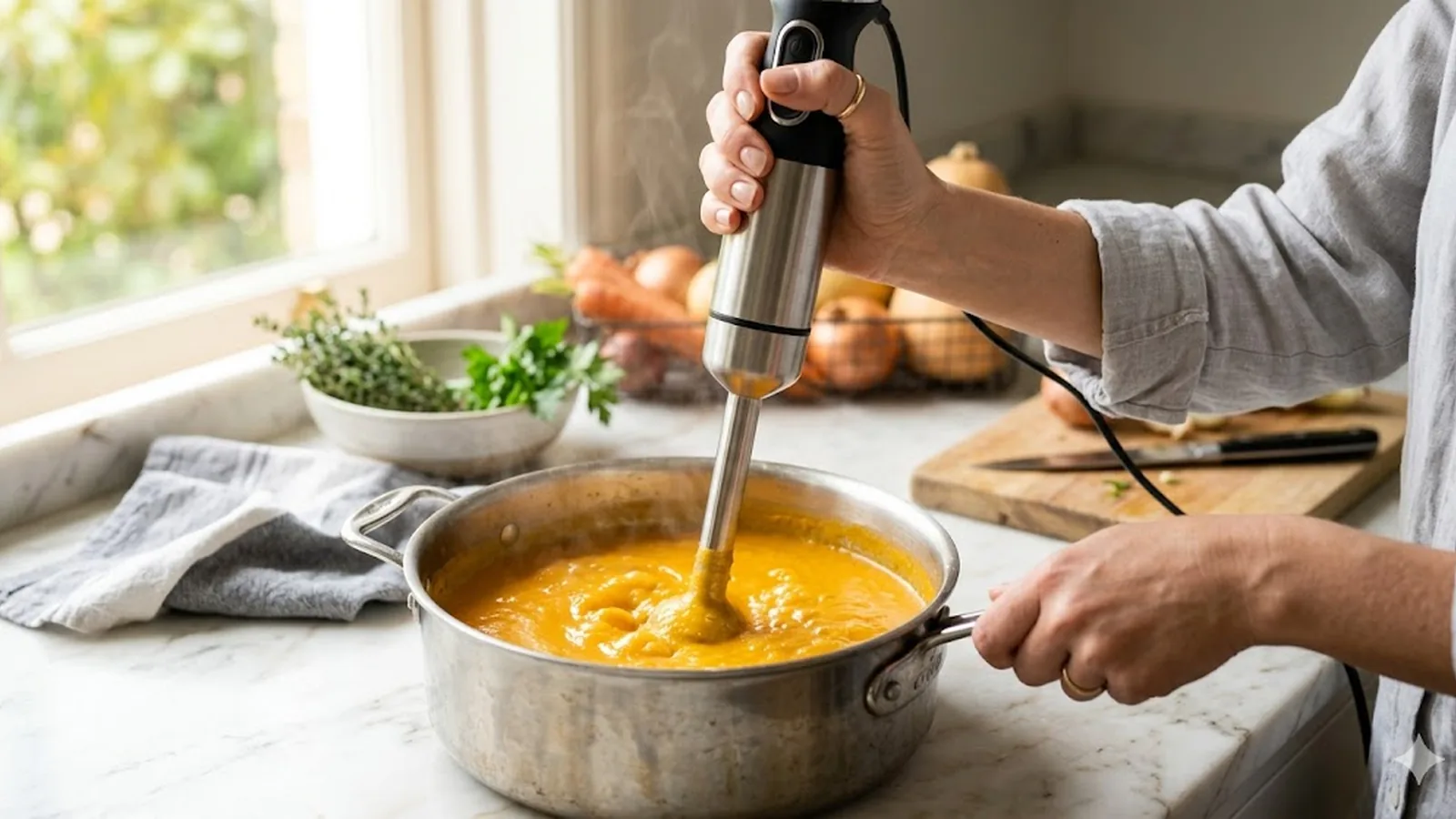
The two tools overlap less than the marketing suggests. A countertop blender is built for volume and brute force — frozen fruit, ice, thick nut butters, big batches of smoothies. An immersion blender wins on everything you’d rather not pour out of a pot: pureeing soup directly in the saucepan, emulsifying a quick vinaigrette or mayo, whipping a single bowl of cream, blending a smoothie for one, or smoothing out lumpy gravy at the stove.
The practical difference is cleanup and storage. After blending soup with a hand blender, you rinse one shaft under the tap; with a countertop blender, you’re disassembling and washing a heavy jar, a lid, and a blade assembly. The immersion blender also tucks into a drawer instead of claiming permanent counter real estate — a real consideration if your kitchen is short on space (it’s one of the first tools I recommend in my first-apartment kitchen essentials guide).
What actually matters (the engineer’s checklist)
Wattage gets all the attention on the box, but it’s only one variable. Here’s what I look at, roughly in order of how much it affects real use:
- Motor power and how it’s delivered. Most home tasks are fine in the 200–500 watt range; a true “turbo” burst button matters more than the headline wattage for breaking down fibrous vegetables. Anything claiming 1,000W+ is usually a budget brand padding the spec sheet.
- Shaft material. A stainless-steel blending foot tolerates hot soup far better than plastic, which can warp, stain, or pick up odors over time. This is the single spec I won’t compromise on.
- Variable speed vs. two-speed. Variable speed lets you start slow (no splatter) and ramp up. Two-speed models are cheaper but messier on liquids.
- Detachable shaft. If the blending arm pops off the motor body, you can rinse or dishwasher it and keep the motor dry. Non-detachable designs are a cleaning headache.
- Attachments. A whisk and a mini-chopper bowl turn a one-trick tool into a three-in-one. Useful, but don’t pay a premium for attachments you won’t use.
- Corded vs. cordless. Cords are a non-issue for most people and mean consistent power; cordless is genuinely nice if your outlets are awkward, but you trade some torque and add a battery to maintain.
The 5 immersion blenders I’d actually buy
Braun MultiQuick 7 — Best Overall

The Braun is the one I hand to friends who want to buy once and stop thinking about it. The standout feature is its speed control: instead of fixed buttons, you squeeze a trigger harder to go faster, so you can feather it at the start of a pot of soup and avoid the classic ceiling-splatter. The metal shaft handles hot liquids confidently, and the included food-processor bowl genuinely replaces a small chopper for onions and herbs.
The honest con: it’s bulkier than a bare stick blender, so the full kit takes up more drawer space than minimalists will want — and you’re paying for attachments you might not all use.
Cuisinart CSB-179 Smart Stick — Best Value
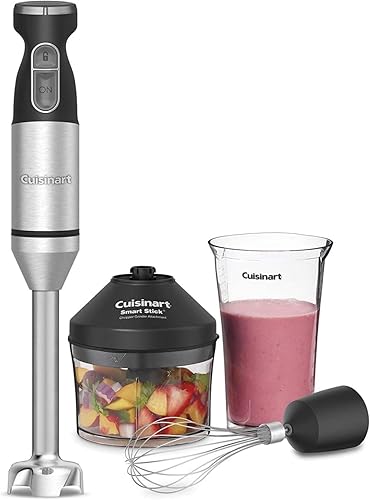
If I had to pick the model that gives most people the best return for the money, it’s this one. The CSB-179 has variable speed, a stainless shaft, and a comfortable grip, plus it ships with a whisk and a chopper attachment — the same three-in-one functionality as pricier models for noticeably less. The older Cuisinart Smart Stick has built a loyal following as the workhorse buyers quietly default to, according to reviews that span years of regular use.
The honest con: the speed dial sits on top where your palm rests, so it’s easy to nudge mid-blend. You learn to grip around it, but it’s a small design annoyance.
MuellerLiving Ultra-Stick — Best Budget

For anyone who wants to test whether they’ll even use an immersion blender before committing more money, the Mueller is a sensible entry point. It comes with a blending shaft, whisk, milk frother, and a measuring beaker, and the eight-speed dial plus turbo covers everyday soups and smoothies without drama. For occasional use, it punches above its price.
The honest con: the motor housing is described as lighter and more plastic than the Braun or Cuisinart, and reviewers report it straining on really thick purees. It’s a “use it a few times a month” tool, not a daily-driver for heavy batches.
Ninja Immersion Blender & Whisk — Most Versatile

Ninja’s hand blender leans into thoughtful extras: a SplatterShield guard that actually keeps soup off your backsplash, a whisk for cream and eggs, and four clear speeds. If you’ve owned a Ninja countertop blender and liked the feel, this is the familiar, no-surprises pick for the stovetop tasks the big machine can’t reach.
The honest con: four fixed speeds give you less fine control than the Braun’s trigger, so you’re working in steps rather than a smooth ramp. For most cooks that’s fine; for fussy emulsions it’s slightly less precise.
Vitamix 5-Speed Immersion Blender — Premium Pick

If you cook a lot and want the immersion blender that feels most like a professional tool, the Vitamix earns its keep. The 625-watt motor and stainless blade power through fibrous vegetables and thick purees that make cheaper models bog down, and the build quality is consistently described as solid and reassuring in buyer reviews. It’s the one I’d buy if soup season runs long in your house and you blend several times a week.
The honest con: it’s expensive for a hand blender and ships with fewer accessories than the mid-priced models, so you’re paying for the motor and the name, not a bundle of attachments.
How these picks are evaluated
These picks aren’t based on a single use case. Each recommendation comes from cross-referencing patterns in verified Amazon buyer reviews — how a model performs on soup blended directly in a hot pot (power and splatter control), on emulsions like mayonnaise or vinaigrette (low-speed control), and on lighter jobs like whipped cream — alongside spec comparisons (motor power, shaft material, speed control) and price-to-feature comparisons. All the models above get consistently positive marks for handling soup; where buyer feedback and specs separate them is fine control, perceived build quality, and how they hold up on thick, fibrous purees. For more on how these evaluations work, see my kitchen gadgets guide.
Keeping it clean (and safe)
The cardinal rule: never submerge the motor body. Detach the shaft, and either rinse it immediately (dried-on soup is the real enemy) or run it through the dishwasher if the manufacturer allows. A quick trick I use — fill a tall cup with warm soapy water and run the blender in it for a few seconds, like cleaning a French press wand. For more on extending the life of your tools, my small kitchen appliances guide covers care across the whole counter.
Frequently asked questions
How many watts do I really need in an immersion blender?
For soups, sauces, smoothies, and emulsions — the everyday jobs — anything in the 200–500 watt range is plenty. Higher wattage helps only with thick, fibrous loads done often. Don’t pay a premium chasing the biggest number on the box; a quality motor at 350 watts beats a cheap 1,000-watt claim.
Can an immersion blender crush ice or make frozen drinks?
Not well, and I wouldn’t ask it to. Ice and frozen fruit are jobs for a countertop machine. A hand blender can handle softened or partially thawed fruit, but repeatedly crushing hard ice will dull the blade and strain the motor.
Metal shaft or plastic — does it matter?
It matters most with heat. A stainless-steel shaft tolerates blending hot soup straight from the stove; plastic can warp, scratch, or absorb odors and stains over time. If you’ll use it for soup at all, choose metal.
Is it safe to blend hot soup directly in the pot?
Yes — that’s the immersion blender’s signature trick. Keep the blending head fully submerged before you switch it on to avoid splatter, tilt the pot slightly to pool the liquid, and pull the head up only after the motor stops. Take the pot off the heat first so you’re not working over an open flame.
My bottom line
For most home cooks, the Cuisinart CSB-179 is the smart buy — variable speed and a metal shaft with attachments at a fair price. Step up to the Braun MultiQuick 7 if you want the best control and a food-processor bowl, or the Vitamix if you blend often and want professional muscle. The Mueller is the low-risk way to find out if you’re an immersion-blender person at all. Whichever you pick, prioritize a stainless shaft and a detachable design — those two things decide whether it’s still in your drawer in five years.