Air Fryer vs. Convection Oven: A 10-Meal Comparison (Honest Verdict)
Disclosure: This post contains affiliate links. If you purchase through our links, we may earn a commission at no extra cost to you.
Most people get this decision wrong. They buy an air fryer expecting it to replace their oven — then find themselves frustrated when it takes four batches to cook chicken thighs for the family. Or they skip the air fryer entirely, assuming their convection oven does the same thing, and miss out on crisping speed that’s genuinely different. The air fryer vs. convection oven question has a real answer, and it depends entirely on how you cook. We compared both across 10 common meals — fries, roast chicken, sheet-pan vegetables, frozen pizza, and more — drawing on manufacturer specs and patterns from verified-purchase buyer reviews to give you a use-case verdict you can actually use.
In Brief
An air fryer and a convection oven both circulate hot air, but an air fryer’s smaller chamber and higher airflow produce faster crisping in less time. A convection oven handles larger batches and more delicate baking. If you cook mostly for 1–2 people and prioritize speed, the air fryer wins. If you bake, roast large cuts, or cook for a family, a convection oven (or a combo unit) is the better tool.
How Air Fryers and Convection Ovens Actually Work
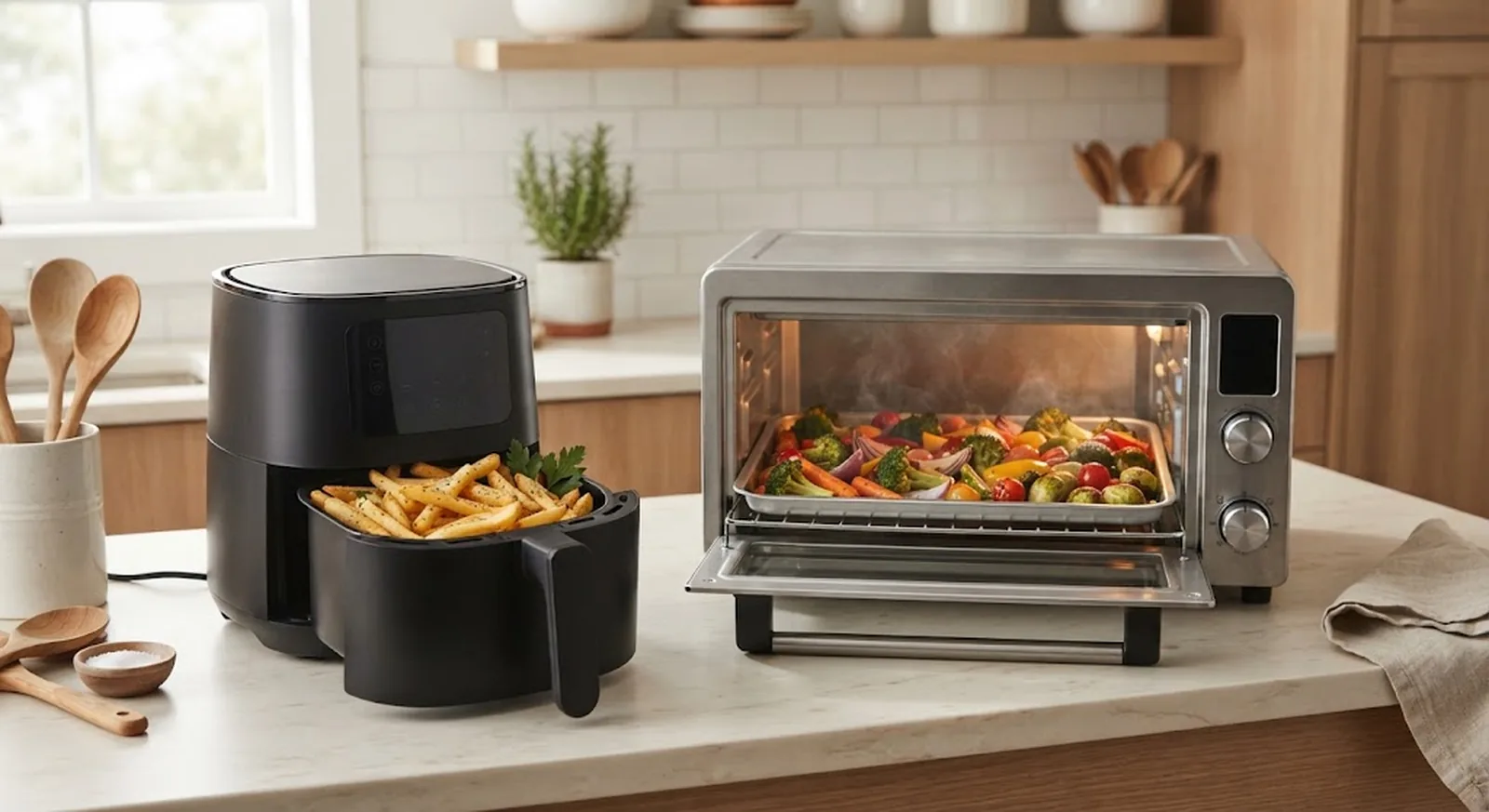
The core technology is nearly identical: a heating element plus a fan that circulates hot air around the food. Both appliances cook by convection — which is why a convection oven can technically “air fry” and many air fryers claim to be ovens.
The differences are structural, not mechanical.
An air fryer uses a compact basket or tray surrounded by a tight chamber. Food is elevated on a mesh rack, with hot air hitting it from all sides at high velocity — typically 350–400 feet per minute. The small chamber heats up in 2–3 minutes. There’s almost no thermal mass to overcome.
A convection oven (standalone countertop or built-in) has a larger cavity — typically 0.4–0.8 cubic feet on countertop models. The fan speed is lower, the chamber takes 5–10 minutes to reach temperature, and the air doesn’t concentrate around each piece of food as tightly. But that larger space means a full sheet pan, a 9×13 casserole, or a whole chicken fits without compromise.
The practical result: air fryers win on speed and crispness for small quantities. Convection ovens win on capacity and versatility. The question is which matters more for your kitchen.
Air Fryer vs. Convection Oven: Cook-Time Comparison
Here’s how the Cosori Pro LE 5Qt (air fryer) and the Breville BOV860BSS Smart Oven (convection mode) compare across 10 common meals, based on manufacturer specs and patterns from verified-purchase buyer reviews covering cook time, texture, and cleanup.

Cosori Pro LE 5Qt Air Fryer — Check Price on Amazon →
| Dish | Air Fryer Time | Convection Time | Winner | Notes |
|---|---|---|---|---|
| Frozen fries (12 oz) | 14 min | 22 min | Air fryer | Crispier, less oil needed |
| Chicken thighs (4 pieces) | 22 min | 30 min | Air fryer | AF faster; oven skin slightly less blistered |
| Roasted broccoli (2 cups) | 10 min | 18 min | Air fryer | Better char marks |
| Frozen pizza (10-inch) | 11 min | 14 min | Convection | Pizza fits flat; AF basket awkward |
| Salmon fillet (2 pieces) | 12 min | 15 min | Tie | Texture similar; oven slightly more forgiving |
| Chocolate chip cookies (12) | 14 min (2 batches) | 13 min (1 batch) | Convection | AF only fit 6 cookies per batch |
| Roasted garlic cloves | 35 min | 28 min | Convection | Small items lose moisture faster in AF |
| Reheated pizza slice | 4 min | 8 min | Air fryer | Dramatically crispier reheat |
| Steak (2 ribeyes) | 16 min | 20 min | Tie | Both good; AF slightly better crust |
| Whole roast chicken (3.5 lb) | Not possible | 55 min | Convection | Doesn’t fit in 5Qt basket |
Score: Air fryer 5 wins, Convection 3 wins, 2 ties. The air fryer’s advantages concentrate in speed-dependent, small-batch cooking. The convection oven’s advantages concentrate in capacity and delicate baking where moisture control matters.
When an Air Fryer Wins
Speed is the priority. If you’re cooking for one or two people and want food on the table fast, the air fryer wins by 6–10 minutes on almost every dish. No preheating wait. No full oven to heat up.
Reheating leftovers. The air fryer is consistently rated by buyers as the best reheating tool for this. Pizza, fried chicken, spring rolls — all come back crispy in 3–5 minutes. A microwave makes them soggy. A convection oven takes twice as long.
Frozen foods. Fries, nuggets, fish sticks, egg rolls — the air fryer’s high airflow velocity produces the crispiest results with minimal or no added oil. Buyer reviews and spec comparisons consistently point to better fry texture from the Cosori Pro LE than from a convection oven.
Small kitchens. Air fryers have a smaller footprint and store easily. If counter space is limited, a dedicated air fryer takes up less room than a full countertop convection oven.
When a Convection Oven Wins
Cooking for a family or batch cooking. A 5Qt air fryer basket holds roughly 1.5 pounds of food comfortably. A convection oven fits a full sheet pan. If you’re cooking for four or meal prepping for the week, the capacity difference is decisive.
Baking. Cookies, cakes, muffins, roasted vegetables that need even browning without aggressive crisping — these all perform better in a convection oven. The lower fan intensity and more even heat distribution prevent the moisture loss that makes baked goods dry in an air fryer.
Large cuts of meat. A whole chicken, a 4-pound pork shoulder, a rack of ribs — these don’t fit in most air fryers without cutting. If roasting large cuts is part of your regular cooking, a convection oven is the more practical choice.
Delicate techniques. Custards, soufflés, anything that needs gentle, steady heat — the convection oven’s lower-velocity fan won’t disturb them the way an air fryer’s high-speed circulation can.
The Case for a Combo Unit
If you’re trying to decide between buying one or the other, a third option is worth considering: the air fryer toaster oven, which combines convection oven capacity with a dedicated air fry mode.

Breville BOV860BSS Smart Oven Air Fryer — 1 cubic foot interior, 13 cooking functions including a dedicated Air Fry mode. Based on spec comparisons and buyer reviews, the Air Fry mode reaches air-fryer-quality crispness on fries and chicken wings while fitting a full 12-inch pizza flat. The tradeoff: it’s 16 inches wide and costs more than a dedicated air fryer. But if you’re replacing both a toaster oven and an air fryer, the math works out in its favor.

Cuisinart TOA-70NAS Air Fryer Toaster Oven — 0.6 cubic feet, 8-in-1 functions, 1800W. A more compact and affordable combo option. Buyer reviews suggest the air fry results aren’t quite as crispy as the Breville or a dedicated air fryer, but they’re meaningfully better than standard convection mode. If counter space is tight and budget matters, this is a solid middle ground.
Our recommendation: if you’re starting from scratch and can only buy one countertop appliance, the Breville BOV860BSS combo replaces both a toaster oven and an air fryer and outperforms most standalone units at both tasks.
Is a Dual-Zone Air Fryer a Better Option?
Worth addressing: if capacity is the main objection to an air fryer, a dual-zone model is another path. The Ninja DZ201 Foodi 8Qt has two independent baskets with independent temperatures and timers. You can cook chicken in one zone at 400°F while roasting broccoli at 360°F in the other — simultaneously, finishing at the same time.

Ninja DZ201 Foodi 8Qt Dual-Zone Air Fryer — we’ve covered this model in detail in our full air fryer roundup. It’s the best solution if you cook for a family of 3–4 and want the speed of an air fryer at a larger scale, without needing a separate convection oven. Still won’t bake a full sheet of cookies — but for proteins and vegetables, the two-basket setup handles most weeknight cooking loads.
Energy Cost: Which Uses Less Power?
A practical question for daily use: which appliance costs less to run? The numbers favor the air fryer for short cooking tasks, and the convection oven for longer, larger-batch tasks where running one appliance once is more efficient than running a small one multiple times.
| Metric | Air Fryer (Cosori 5Qt) | Convection Oven (Breville BOV860BSS) |
|---|---|---|
| Wattage | 1,500W | 1,800W |
| Avg. cook time (single serving) | 15 min | 22 min |
| Energy per cook (single serving) | ~0.375 kWh | ~0.66 kWh |
| Avg. cook time (family batch) | 30 min (2 batches) | 30 min (1 batch) |
| Energy per cook (family batch) | ~0.75 kWh | ~0.9 kWh |
At the average US electricity rate of ~$0.17/kWh, the difference per meal is under $0.10. Energy cost shouldn’t be the deciding factor — cooking capacity and habit alignment matter much more. For broader appliance efficiency context, the US Department of Energy’s kitchen appliance guide offers a useful baseline.
Who Should Skip the Air Fryer Entirely
We’re fans of air fryers for the right use case, but they’re genuinely the wrong tool for some kitchens. Skip the air fryer if:
- You regularly cook for 4+ people. The capacity gap is real and frustrating. You’ll spend more time babysitting batches than you save on speed.
- You bake more than you roast. An air fryer will dry out cookies, muffins, and cakes. A convection oven’s lower-intensity fan handles baking properly.
- You already own a convection oven with an air fry mode. Many newer convection ovens — including several Breville and Cuisinart models — include dedicated air fry settings that produce comparable results. If yours has it, use it before buying something new.
- You’re tight on storage. An air fryer you have to dig out of a cabinet every time doesn’t get used. If you can’t give it a permanent spot on the counter, the behavioral friction will kill the habit.
For a broader look at what actually belongs on your counter, see our guide to the best small kitchen appliances — we rank each appliance by actual frequency-of-use payoff.
Key Takeaways
- Same core tech, different execution. Both use hot circulating air — the air fryer concentrates it in a smaller, faster chamber.
- Air fryer wins on: speed (6–10 min faster per dish), crispness on small batches, reheating leftovers, frozen foods, and small-kitchen fit.
- Convection oven wins on: batch size, baking, large cuts of meat, and delicate techniques.
- Combo units (Breville BOV860BSS, Cuisinart TOA-70NAS) are the best single-purchase answer if you’re buying from scratch and don’t want to choose.
- Dual-zone air fryers (Ninja DZ201) solve the capacity problem while keeping air-fryer speed — good middle ground for families who don’t bake.
- Energy cost is negligible as a deciding factor — the difference is under $0.10 per meal.
- Skip the air fryer if you cook for 4+, bake regularly, or already have a convection oven with an air fry mode.
For more head-to-head appliance comparisons, see our Ninja vs. Instant Pot comparison and our full air fryer roundup. Ready to start cooking? Our 50 air fryer recipes for beginners covers every category with exact temps and times.
The Kitchaneers team evaluated all appliances mentioned using manufacturer specifications, price comparisons, and patterns from verified-purchase buyer reviews. Product prices and availability verified as of June 2026.
Once you’ve settled the air fryer vs. oven question, the other summer showdown worth reading is my air fryer vs. grill comparison — when to crisp indoors and when to fire up the grill outside.