Most Overrated Kitchen Gadgets on Amazon (Skip These)
Affiliate disclosure: As an Amazon Associate, I earn from qualifying purchases at no extra cost to you.
After digging through thousands of verified-purchase reviews across hundreds of kitchen tools, one thing becomes clear: some of the most popular gadgets on Amazon are a complete waste of money. They look clever in the product photos, rack up thousands of four-star reviews, and clutter your drawers within a week of arrival.
This isn’t a hit piece on kitchen gear in general — I genuinely love a well-designed tool. But Amazon’s algorithm rewards novelty and impulse buys, not actual kitchen utility. The result is a bestseller list full of single-use gimmicks that no working home cook actually needs.
Here are the five overrated kitchen gadgets I’d tell you to skip — and exactly what to use instead. I’ve also listed one honest “con” per product, because that’s what these reviews always leave out.
Why Amazon Bestsellers Aren’t Always Worth It
Before I get into specifics, it’s worth understanding why so many overhyped gadgets dominate Amazon’s kitchen category. Viral TikTok demos, heavily incentivized review programs, and the dopamine hit of “I need that” combine to push novelty products to the top of search results. The problem is that a gadget that looks impressive in a 15-second video rarely survives daily kitchen life.
The tools that actually earn permanent drawer space — according to buyers who’ve owned them for years — are the ones covered in the guide to the best kitchen gadgets worth buying — multi-use, easy to clean, and built to last more than one season. What you’ll find below is the flip side of that list.
1. The Avocado Slicer

OXO Good Grips 3-in-1 Avocado Slicer
The OXO avocado slicer is probably the most famous single-use kitchen gadget of the last decade. It splits, pits, and slices an avocado in one tool. It also works only on avocados.
Verified-purchase reviews are consistent on this one. The pitting mechanism is genuinely clever — the serrated pit-remover feels safer than whacking a knife into the seed. But the slicing fan? Buyers frequently report it produces uneven slices and won’t fit smaller avocados properly. More critically, reviewers note the blade is a pain to clean, and the plastic construction doesn’t inspire confidence after a year of use.
The con nobody mentions: It only works on avocados of a very specific size. Too small, and the blade misses. Too large, and it wedges. A chef’s knife handles avocados in about the same time, with zero extra cleaning.
What to use instead: A quality chef’s knife and a spoon. Or, if you eat avocados daily and want the safety of the pit mechanism, the OXO version is the best of this category — just don’t expect it to replace anything else in your drawer.
2. The Banana Slicer
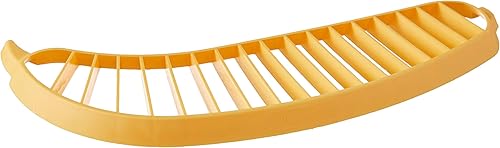
Hutzler Banana Slicer
The Hutzler Banana Slicer became an internet legend thanks to its absurd one-star reviews (“it doesn’t work on curved bananas”). Those reviews are funnier than the product is useful.
To be fair, it does exactly what it says: press it onto a peeled banana and you get uniform slices. The problem is that a knife takes four seconds to do the same job. The slicer takes four seconds to use, plus time to wash all the tines. For a piece of fruit that you’re likely adding to cereal or a smoothie — where “uniform” slices are irrelevant — it’s solving a problem that doesn’t exist.
The con nobody mentions: The plastic tines flex under pressure and occasionally leave banana “strings” instead of clean cuts. It also only works on a narrow range of banana sizes.
What to use instead: Any knife. Seriously. This is a $4 purchase you’ll use twice before it ends up in the back of a drawer.
3. The Strawberry Huller

Chef’n Original Stem Gem Strawberry Huller
I’ll give the Chef’n Stem Gem this much: it actually works. Press it into the top of a strawberry, twist, and the stem and core come out cleanly. It’s satisfying in a fidget-toy kind of way.
But here’s the thing: a paring knife does the same job in the same motion, and a paring knife is something you already own (and use for about forty other tasks). Buyer reviews consistently note that the huller isn’t meaningfully faster than a paring knife once you factor in the extra time spent cleaning it — a knife requires zero extra cleanup.
The con nobody mentions: Multiple reviews report that the spring mechanism weakens with repeated use, requiring more force to get a clean pull after several months of ownership. At that point it’s slower than a knife AND less reliable.
What to use instead: A paring knife held at a slight angle, rotated around the stem. Takes 3 seconds per berry once you get the motion down. No cleanup beyond rinsing the knife.
4. The Pineapple Corer
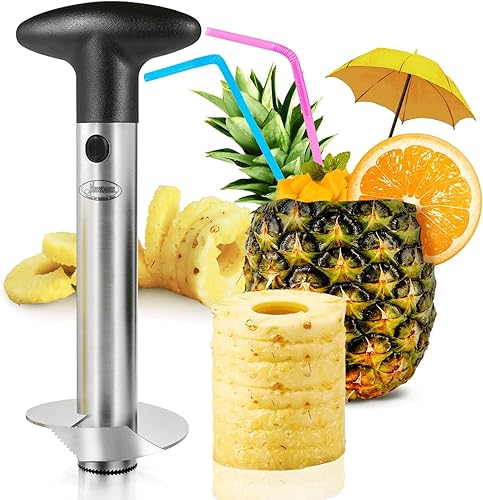
Newness Pineapple Corer and Slicer
I’m going to be careful here, because this is the one gadget on this list where I have a nuanced take.
If you eat whole pineapples regularly — like, two or more per month — a pineapple corer is genuinely useful. The Newness model has a reinforced stainless steel blade that stays sharp, and reviewers consistently report it handles a full-size pineapple in under two minutes. That’s hard to argue with.
But for most home cooks who buy a pineapple once every few weeks, this is pure drawer clutter. It’s large, awkward to store, and reviewers frequently mention the blade takes real effort to clean between the spiral fins — enough that many say they end up reaching for a chef’s knife out of habit anyway.
The con nobody mentions: The corer doesn’t work on small or oddly shaped pineapples — the spiral slips. You also lose more fruit to the core than a skilled knife cut would discard.
What to use instead: Learn the “crown off, sides off, eyes out, core out” knife method. It takes 3 minutes once you’ve practiced it five times and gives you more usable fruit. If you genuinely eat pineapple constantly, the Newness corer is one of the better options in this category — but be honest about your actual pineapple consumption first.
5. The Novelty Egg Separator

Peleg Design YolkFish Egg Separator
The YolkFish is charming. You squeeze the silicone fish body, hold it over a cracked egg, release, and it sucks up the yolk. The yolk then “drips” from the fish’s mouth into another bowl. It’s absolutely delightful to demonstrate at a dinner party.
And it works — mostly. The issue is that the suction is inconsistent on larger yolks, and if the yolk breaks during the pickup (which happens with older eggs), you’re cleaning raw egg out of a silicone fish instead of just rinsing a bowl. Reviewers commonly report broken yolks with this tool more often than with the traditional shell-to-shell method.
The con nobody mentions: The silicone interior is nearly impossible to fully clean if egg white gets inside. Multiple reviews mention it starts to smell faintly of eggs after repeated use, even after washing. That’s a hard pass.
What to use instead: The shell-to-shell method (crack the egg and pass the yolk between the two halves over a bowl) is faster, cleaner, and costs nothing. If you want a dedicated separator, a simple slotted spoon or a basic $3 plastic separator does the job without the cleanup drama.
The Pattern: What Makes a Kitchen Gadget Overrated?
After comparing buyer feedback across hundreds of kitchen tools, a consistent pattern emerges in the ones that disappoint:
- Single-use design — a tool that only does one thing needs to do that one thing dramatically better than a multi-use alternative. Most don’t.
- Harder to clean than the thing it replaces — if washing the gadget takes longer than the time it saved, it’s a net loss.
- Sized for one fruit or one egg size — real kitchens deal with variability. Gadgets that need standardized inputs fail constantly.
- Viral demo vs. daily reality — the 15-second demo is optimized. Your actual kitchen use at 7am is not.
The tools I reach for every single day are the ones that handle multiple tasks, clean in seconds, and don’t require me to hunt for them in a drawer. I wrote about my actual must-haves in my kitchen essentials guide for a first apartment — it’s the list I wish I’d had before buying any of the above.
What to Buy Instead
If you’re looking to build a genuinely useful kitchen toolkit, here’s the short version of what actually earns its counter space:
- A sharp 8-inch chef’s knife (replaces the avocado slicer, banana slicer, strawberry huller, and pineapple corer all at once)
- A small offset serrated knife for delicate work
- A silicone spatula set
- A quality instant-read thermometer
- A 12-inch stainless skillet
None of those will go viral on TikTok. All of them will still be in your kitchen in 10 years. And if you want to know which tools genuinely earn their keep, check out the guide to kitchen gadgets that actually save time.
The Bottom Line
Amazon’s algorithm isn’t optimized for “this will serve you well for a decade.” It’s optimized for clicks, carts, and the emotional satisfaction of buying something that looks clever. Most of the gadgets above aren’t badly made — they’re just solving problems you don’t actually have, or solving them barely better than what you already own.
My rule: before adding a single-use gadget to your cart, ask yourself two questions. First, how often will I actually use this per week? Second, is there already something in my kitchen that does the same job? If you can’t justify a “yes” to the first and a “no” to the second, put the gadget back and keep your drawer space.