Kitchen Gadgets That Actually Save Time
Every kitchen gadget on Amazon claims to save you time. In practice, most of them save you about thirty seconds and then cost you five minutes at the sink. So instead of taking the marketing at its word, we looked at what actually happens once a gadget leaves the box: verified-purchase buyer reviews, spec comparisons, and price comparisons for how each one performs against doing the same task by hand — cleanup included.
Quick note: Kitchaneers is reader-supported. Some links below are affiliate links, which means I may earn a small commission if you buy through them — at no extra cost to you. I only recommend tools that consistently hold up well in verified buyer reviews and spec comparisons. Prices change constantly, so I don’t quote them here; tap through to see the current number.
These are the kitchen gadgets that save time for real — the ones where buyer reviews and spec comparisons, not the marketing, make the case. We’ve also flagged where each one quietly gives some of that time back in extra washing, because a tool that’s slower to clean than it is to use isn’t a time-saver at all.
How These Picks Were Evaluated
For each gadget, we looked at a task most people do every week — dicing an onion, mincing garlic, boiling eggs, zesting a lemon, drying salad greens, breaking down a chicken — and compared how it stacks up against doing the same job by hand, drawing on buyer reviews, spec sheets, and price comparisons rather than the marketing copy. Cleanup counts too, because that’s where a lot of “time-saving” gadgets quietly lose, and it’s a recurring theme in what buyers report.
These aren’t lab measurements — they’re patterns that hold up consistently across buyer reviews and how the tools compare on paper. But the gaps are big enough — minutes, not seconds — that the ranking holds. If a gadget only shaves off a handful of seconds, it didn’t make this list. Here are the six that earned their drawer space.
One more thing about why cleanup gets equal billing here: marketing measures the gadget at its best moment — the three seconds of actual chopping — and conveniently forgets the assembly, the awkward loading, and the wash afterward. Buyer reviews don’t let that hide. They surface the fumbling for the right attachment, the bits that stick in the corners, and the rinse you can’t skip. That full picture is the only honest way to know whether a tool is faster than the knife you already own, and it’s why a couple of gadgets that looked promising on paper didn’t make the cut.
The 6 Kitchen Gadgets That Genuinely Save Time
Fullstar Pro Original Vegetable Chopper

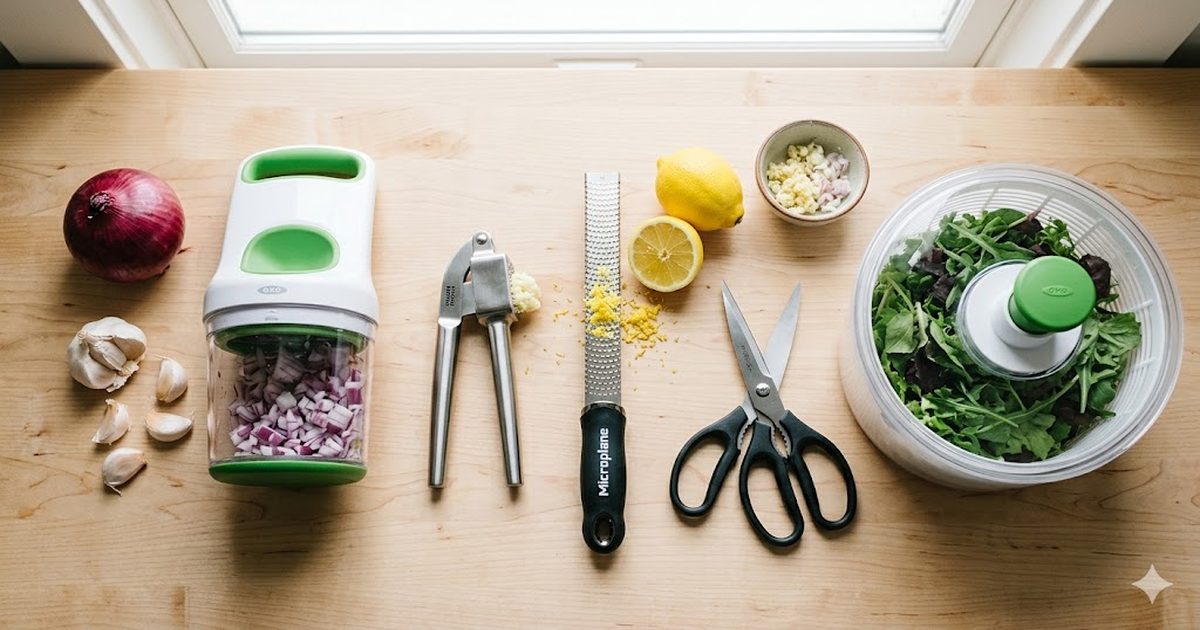
The task: dicing one medium onion. Dicing by hand is one of the slowest routine prep jobs in the kitchen, and buyer reviews consistently point to a chopper cutting that down to seconds, watering eyes included. It’s the single biggest per-use saving of any gadget on this list, and it scales — for a mirepoix or a big batch of salsa, reviewers report the chopper turning a long chopping session into a short one.
The dice is also more uniform than a hand cut, which matters more than it sounds: evenly cut onion cooks evenly, so you’re not left with half-raw chunks next to mush. Buyers who’ve owned this unit for months to over a year consistently report the blades staying sharp.
The honest con: cleanup. The blade grid traps onion and garlic bits, and reviewers note you genuinely need the little brush it comes with to get them out. That washing step eats into the savings on a single onion but matters less once you’re chopping in volume. It’s a batch tool, not a one-onion tool.
Alpha Grillers Stainless Steel Garlic Press

The task: mincing three cloves of garlic. Mincing by hand means a smash-peel-mince-scrape routine that adds up in both time and mess. A garlic press cuts that down dramatically — and reviewers note you don’t even need to peel the cloves first, since the press handles unpeeled garlic fine and the skin stays behind in the basket.
Skipping the peel is the real time win here, and it also keeps garlic smell off your hands. The stainless build feels solid in a way the flimsier aluminum presses don’t, and it’s a good pick for when a recipe calls for “four cloves, minced” and you want them done before the pan even heats up.
The honest con: a press gives you crushed garlic, not the clean fine mince you’d get from a knife, and crushed garlic releases more of that sharp, pungent bite. For a slow-cooked sauce that’s perfect; for a delicate dish where you want mellow garlic, I still reach for the knife. It’s also one more thing to scrub, though this model’s holes pop clean under the tap.
Dash Rapid Egg Cooker

The task: six hard-boiled eggs. On the stove: filling the pot, waiting for the boil, timing, and the ice bath add up to a fairly involved process. In the egg cooker: reviewers report it’s noticeably faster overall, and almost none of it is active — you add water to the line, push one button, and walk away until it beeps.
The time saving is modest. The real win is that it’s hands-off and foolproof: buyers consistently report the eggs peeling cleanly every single time, which sidesteps the most frustrating part of stovetop boiling. For weekly meal prep — a batch of eggs for salads and snacks — it earns a reputation among reviewers as a quiet countertop workhorse.
The honest con: it’s a single-task appliance that takes up counter or cabinet space. If you boil eggs once a month, a pot is fine and you’ll save the storage. The included piercing tool is also easy to lose, and without it you’ll get the occasional cracked shell.
Microplane Premium Classic Zester

The task: zesting one lemon and grating a knob of fresh ginger. The old way: a paring knife for zest (slow, and easy to catch the bitter white pith) and the big box grater for ginger (which shreds it into stringy mush) — a few minutes of fiddling either way. With the Microplane: much faster, with finer, fluffier results and no pith.
This is the gadget we’d save first in a fire. It handles citrus zest, ginger, garlic, nutmeg, and hard cheese, and the razor-fine grate actually changes how food tastes — the zest disperses instead of sitting in clumps. Buyers who’ve owned one for years consistently report it still biting in like new.
The honest con: it is genuinely sharp, and it’ll take a layer off your knuckles if you get casual near the end of a piece of ginger. The blades also pack with fiber, so a quick rinse-and-brush right after use is non-negotiable or it dries on hard.
OXO Good Grips Salad Spinner

The task: washing and drying a head of romaine. By hand: rinse, then pat down leaf by leaf with paper towels — a slow process, and the greens are often still damp enough to water down the dressing. With the spinner: rinse straight into the basket, a few pumps, and the leaves come out genuinely dry in a fraction of the time.
Dry greens are the whole point: dressing actually clings instead of pooling at the bottom of the bowl, and washed-then-spun herbs and lettuce keep far longer in the fridge. The bowl doubles as a serving bowl too, so it’s not single-purpose. Reviewers frequently note the pump-brake mechanism on this OXO outlasting cheaper spinners they’ve owned before it.
The honest con: it’s bulky. This is a real-estate commitment in a cabinet, and if you have a tiny kitchen that alone may rule it out. The basket also doesn’t love delicate herbs like cilantro at full speed — they bruise — so I ease off the pump for the fragile stuff.
Gidli Heavy-Duty Kitchen Shears

The task: spatchcocking a chicken (removing the backbone). With a knife: careful, slow, and frankly a little nerve-racking. With heavy shears: two confident cuts, done in a fraction of the time. Shears also win on a dozen small jobs that would otherwise dirty a cutting board: snipping herbs, trimming fat, opening stubborn packaging, cutting pizza, portioning bacon.
The reason a good pair saves so much time is that it eliminates the board-and-knife setup entirely for quick tasks. Snip the scallions straight into the pan; cut the chicken right over the sheet pan. This pair comes apart at the hinge, which is the feature that actually matters for cleanup.
The honest con: kitchen shears tempt you into using them on things they shouldn’t touch, and cutting through bone or frozen food will roll the edge fast. Keep them for soft bone and prep, not as a substitute for a cleaver. They also need a full dry before reassembly or the hinge can spot over time.
The Net-Time Trap: When Cleanup Cancels the Savings
Here’s the rule I wish product pages would print: a gadget only saves time if the time it saves you in use is greater than the time it costs you to clean. That sounds obvious, but it’s exactly where most “time-saving” tools fail. An electric garlic chopper with five parts can mince garlic in three seconds and then demand two minutes of disassembly and washing. You did not save time. You moved it from the cutting board to the sink.
This is why the simplest gadgets tend to win. A Microplane is one piece. A garlic press is two. The salad spinner has the best ratio of all because the “cleanup” is just a rinse and it replaces paper towels you’d otherwise burn through. The chopper is the closest call on my list — its cleanup is real — which is why I only recommend it as a batch tool, where the savings stack up faster than the washing does. When you’re weighing any gadget, mentally add the dishwashing time before you decide it’s a keeper.
There’s a second hidden cost worth naming: the dishwasher question. A tool that’s technically dishwasher-safe but really needs hand-washing to last — like anything with fine blades or a hinge — quietly adds a chore you’ll resent on a busy weeknight. Every gadget on my list either rinses clean in seconds or comes apart so the dishwasher can reach the parts that matter. That’s not a coincidence; it’s the difference between a tool you keep using and one that migrates to the back of the cabinet within a month.
Time-Saving Gadgets That Actually Don’t
For balance, here are the “time-savers” that don’t hold up once you look past the marketing. An avocado slicer takes longer than a butter knife and a spoon, which is the most foolproof avocado tool ever invented. A strawberry huller does the same job as a paring knife but worse and with more washing. Electric can openers are slower to set up than a five-second manual one for a single can. And most single-fruit gadgets — banana slicers, mango splitters, the dedicated egg-white separator — solve a problem you can solve with a knife, a glass, or your hand.
I went deep on this in my roundup of the most overrated kitchen gadgets to skip, but the pattern is always the same: a tool that does one hyper-specific job, costs setup and cleanup time, and replaces something you already own. If a gadget can’t beat the humble chef’s knife on the clock, it’s clutter, not a shortcut.
How to Decide If a Gadget Earns Drawer Space
Before I buy any gadget now, I run it through three quick questions. They’ve saved me from a lot of impulse purchases.
- How often will I actually use it? A tool you use weekly justifies its drawer space; one you use twice a year does not, no matter how clever it is. Frequency beats novelty every time.
- How much time does it save per use — after cleanup? Net minutes, not gross. If the honest answer is “a few seconds,” skip it.
- Does it replace something I already own, or add a real new capability? A Microplane does something a knife can’t. A banana slicer does something a knife already does, slower.
Multiply frequency by net time saved, then subtract the storage and cleaning cost. The gadgets on my list all clear that bar comfortably. If you’re building out a kitchen from scratch and want the tools that earn their place, my guide to the 25 best kitchen gadgets that are actually worth buying is the bigger picture, and keeping what you own working well is covered in my complete kitchen tool care guide. And because slicing is one of the slowest prep jobs, a good mandoline slicer earns its place on a fast-prep list too. If the real problem is that everything’s crammed into one chaotic drawer, these kitchen organization ideas will help you find the gadgets you already own.
Frequently Asked Questions
What kitchen gadget saves the most time?
For everyday cooking, a vegetable chopper saves the most raw minutes because dicing is one of the slowest prep tasks and it does it in seconds. But for sheer return on how little it costs to clean, a Microplane zester is hard to beat — one piece, multiple jobs, a quick rinse.
Do garlic presses actually save time?
Yes — skipping the peeling step alone cuts a meaningful chunk of time off garlic prep, and buyer reviews consistently confirm a press finishes far faster than mincing by hand. The trade-off is texture: a press crushes rather than finely minces, which gives a sharper flavor that suits cooked dishes more than raw ones.
Are vegetable choppers worth it?
They’re worth it if you cook in any volume. On a single onion the cleanup nearly cancels the savings, but as soon as you’re dicing several vegetables for a soup, stew, or batch of salsa, a chopper turns a long job into a short one and gives you a more even cut. For occasional cooking, a sharp knife is enough.
Which time-saving gadgets are a waste of money?
Single-purpose novelty tools — avocado slicers, banana slicers, strawberry hullers, dedicated egg separators — almost never beat a basic knife on the clock once you factor in setup and washing. If a gadget only does one narrow job that a tool you already own does just as fast, it’s clutter rather than a shortcut.
The Bottom Line
The gadgets that genuinely save time share a personality: they’re simple, they do a job you repeat constantly, and they’re fast to clean. The vegetable chopper, garlic press, rapid egg cooker, Microplane, salad spinner, and a good pair of shears all hold up to that standard. Everything else — the clever-looking single-taskers — mostly just moves the effort from the cutting board to the sink. Buy for the jobs you actually do every week, add up the cleanup before you commit, and your drawer will fill with shortcuts instead of clutter.
Speaking of temperature checks: our best meat thermometers under roundup compares five budget probes side by side — including the one that reads a degree or two low.