Why Tri-Ply Cookware Heats More Evenly (The Science Behind the Price)
Heads up: a few links below are Amazon affiliate links. If you buy through them, I may earn a small commission at no extra cost to you. I only point to gear I’d actually cook on.
I’ve lost count of how many readers have asked me some version of the same question: why does a “tri-ply” pan cost three or four times what a basic stainless pan costs, and is the even-heating thing real or just marketing? After comparing the specs and buyer reviews across tri-ply and disc-bottom cookware, the short answer is that the claim is real — but the reason has almost nothing to do with the stainless steel you can see, and everything to do with the metal you can’t.
Tri-ply cookware heats evenly because it bonds a core of aluminum — which conducts heat roughly 15 times faster than stainless steel — between two stainless layers that run from the base all the way up the walls. The aluminum spreads heat sideways across the whole pan instead of letting it pool over the burner, which is what causes hot spots.
What “tri-ply” actually means
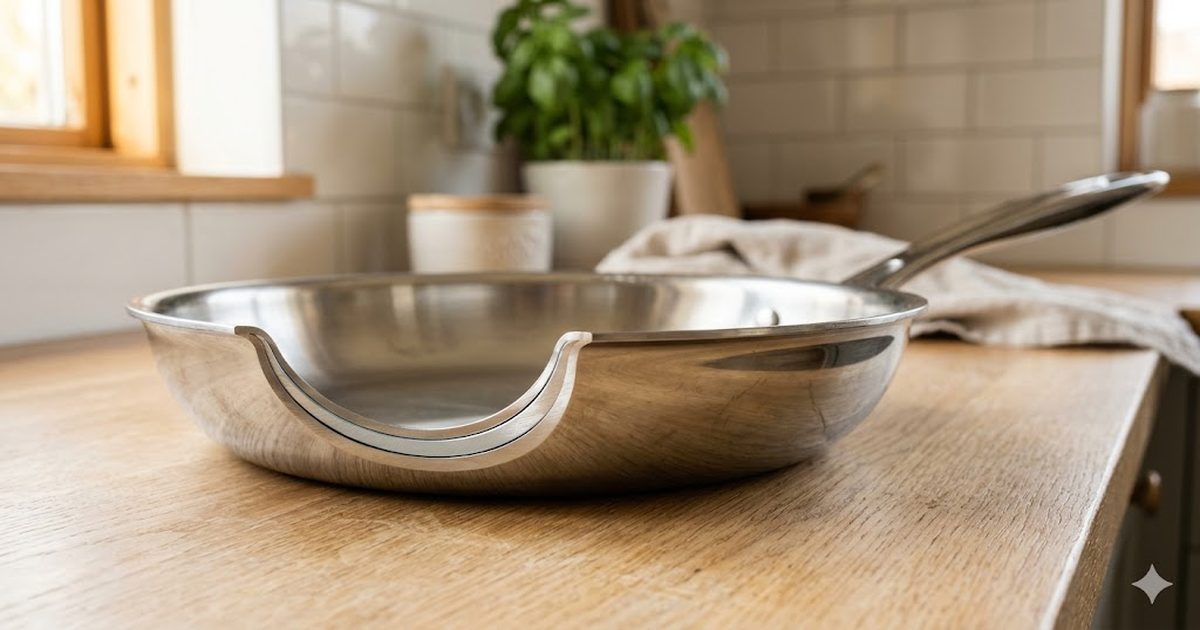
Tri-ply (also written 3-ply) describes how the pan is built, not how thick it is. It’s three bonded layers of metal: a stainless steel cooking surface on the inside, a core of aluminum (or sometimes an aluminum alloy) in the middle, and a layer of stainless on the outside that touches your burner. The three layers are pressure- and heat-bonded into a single sheet, then formed into a pan — so there’s no glue and nothing to separate over time.
The key word is clad. In a fully clad tri-ply pan, those three layers extend all the way up the sidewalls, not just across the bottom. That detail matters more than most people realize, and I’ll come back to it.
The real reason it heats evenly
Stainless steel is a terrible conductor of heat. That’s not an insult — it’s physics. Common 18/10 stainless conducts heat at roughly 15–16 watts per meter-kelvin. Aluminum sits around 205–235. Copper, for reference, is near 400, which is why high-end pans sometimes use a copper core.
What those numbers mean in practice: if you made a pan out of solid stainless, the spot directly over the flame would get screaming hot while an inch away stayed comparatively cool. Heat barely travels sideways through stainless. Aluminum, conducting about 15 times faster, pulls that concentrated heat and spreads it across the entire surface almost instantly. The stainless is there for durability, a non-reactive cooking surface, and (on the outside) induction compatibility — but the aluminum is doing the actual work of evening things out.
This is the same principle behind why a heavy cast iron pan feels even once it’s hot, just achieved a different way. (I broke down that trade-off in my cast iron vs. carbon steel comparison if you’re weighing those instead.)
Why the aluminum going up the walls matters
Here’s where fully clad tri-ply earns its price over the cheaper alternative: disc-bottom cookware.
A disc-bottom pan is stainless steel with a slug of aluminum (or aluminum sandwiched in steel) attached only to the base. It looks similar in the store and often costs much less. The problem is that the conductive metal stops where the base ends. The walls are bare stainless. So the bottom heats evenly, but the sides stay noticeably cooler — and the transition where the disc ends can create its own hot ring.
You feel this the moment you cook anything with liquid. In a disc-bottom pan, sauce that climbs the sides barely moves while the center boils hard; food on the perimeter of the base browns slower than food in the middle. In a fully clad tri-ply pan, the aluminum carries heat up the walls too, so a sauce reduces evenly and a pan of onions caramelizes edge to edge instead of burning in a center bullseye. That’s the practical payoff of “clad to the rim.”
Tri-ply vs. 5-ply: do more layers help?
If three layers are good, five must be better, right? Not necessarily — and this is where marketing gets ahead of the physics.
5-ply adds more alternating layers of aluminum and stainless (or includes a magnetic stainless layer for induction). It can hold temperature a touch more steadily and resist warping under aggressive heat. But the single biggest driver of even heating is the total thickness of conductive metal and how it’s distributed — not the raw layer count. A well-made tri-ply pan with a thick aluminum core will out-cook a thin 5-ply pan every time.
For most home cooks, quality tri-ply is the sweet spot: lighter to lift, cheaper, and functionally indistinguishable from 5-ply for everyday searing, sautéing, and pan sauces. I’d only step up to 5-ply if you cook at high heat constantly or want the extra heft.
A simple evenness test you can run at home
You don’t need a thermal camera to judge a pan. One reliable method is the flour test: dust a thin, even layer of all-purpose flour across a cold, dry pan, set it over medium heat, and watch how it browns. A truly even pan turns the flour from white to tan in a slow, expanding ring that reaches the edges at roughly the same time. A disc-bottom or thin pan browns a dark spot over the burner while the rim stays pale.
This lines up with what verified-purchase buyers report across tri-ply cookware: reviews consistently describe even browning and reliable results when searing eggs, making crepes, or building a fond for pan sauces — compared to complaints about hot spots and uneven cooking on disc-bottom pans. It’s the cheapest cookware test there is, and it’ll tell you more than any spec sheet.
Is tri-ply worth the price?
For a pan you’ll use several times a week for years, I think it’s the best value in cookware — but you don’t have to spend All-Clad money to get the benefit. Two I keep recommending:
Tramontina 12-Piece Tri-Ply Clad Set — This is the value pick I steer most people toward. It’s genuinely fully clad (aluminum core to the rim), oven-safe, induction-ready, and a fraction of the premium brands’ price. The honest con: the handles are a little less refined and can feel hot near the pan body on long stovetop sessions, so keep a towel handy.
All-Clad D3 Tri-Ply Set — The benchmark, and the set other brands get compared to. The bonding, balance, and edge-to-edge evenness are excellent, and it’s built to outlive you. The con is purely the price: you’re paying a real premium for the polish and the name, and the steel handles get hot and feel sharp-edged to some cooks. Worth it if you cook constantly; overkill if you don’t.
If you’re still deciding between whole sets and material types, my guide to the best cookware sets of 2026 walks through tri-ply, non-stick, and cast iron side by side.
Frequently asked questions
Does tri-ply work on induction? Usually yes, as long as the outer layer is magnetic stainless — almost all modern tri-ply sets are induction-compatible, but check the label if induction is your main burner.
Is tri-ply dishwasher safe? Most are, but hand-washing is generally recommended. Dishwasher detergent is harsh and can dull or leave a chalky film on stainless over time. A little care keeps the surface looking new — I cover the full routine in my kitchen tool care guide.
Does tri-ply warp? It’s far more warp-resistant than thin single-ply pans, but no pan loves thermal shock. Avoid blasting an empty pan on high heat or running cold water into a screaming-hot one, and it’ll stay flat for years.
Is tri-ply worth it for a beginner? One good tri-ply fry pan teaches you more about heat control than a whole rack of cheap pans, because what you see on the surface is actually what’s happening. If budget is tight, buy one quality piece before a big set.
The bottom line
Tri-ply cookware heats evenly for one reason: a fast-conducting aluminum core, clad to the rim, spreads heat across the whole pan instead of letting it pile up over the burner. More layers can help at the margins, but a thick, fully clad tri-ply pan delivers the even heat most home cooks are paying for — without the top-shelf price. Run the flour test on whatever you’re considering, and let the browning tell you the truth.