Smart Kitchen Gadgets Worth Buying in 2026 (And the Ones to Skip)
The smart kitchen gadgets worth buying in 2026 are the ones that remove real friction: a wireless meat thermometer (MEATER Plus), a Wi-Fi sous vide circulator (Anova 3.0), and an app-connected multi-cooker (Instant Pot Pro Plus). Most other “smart” upgrades add cost and an app login — not convenience.
Kitchaneers is reader-supported. As an Amazon Associate, I earn from qualifying purchases made through links on this page, at no extra cost to you.
I have a drawer in my kitchen that I privately call the graveyard. In it: a Bluetooth egg tray (yes, that existed), a smart lid that told me my pan was hot, and an app-controlled spice dispenser that dispensed exactly one dinner’s worth of paprika before I went back to shaking the jar like a normal person. Every one of those gadgets promised a smarter kitchen. What they delivered was another app, another firmware update, and another battery to charge.
But here’s the thing — a handful of connected tools keep showing up as long-term keepers in owner reviews, the kind buyers say they’d repurchase within the hour if theirs broke. The difference between the graveyard and the counter isn’t the technology. It’s whether the “smart” part removes a real friction point from a routine you already have. So this is my honest 2026 filter, built from cross-referencing verified-purchase reviews, recurring complaint and praise patterns, and spec-and-price comparisons across alternatives: six smart kitchen gadgets that earn their markup, the categories where I’d keep my money, and the three questions I ask before anything with a Wi-Fi chip gets counter space.
The 3-Question Test I Use Before Buying Anything “Smart”
After digging through years of buyer reviews on connected kitchen gear — and tracking what I’ve come to call the smart tax — I run every connected gadget through the same three questions before it earns a spot:
- Does it fix a friction I actually have? A thermometer that lets me walk away from a four-hour brisket fixes a real problem. A toaster that emails me is a solution hunting for one.
- Does it still work when the app doesn’t? The best smart gadgets are great dumb gadgets first. Physical controls, on-device displays, offline modes — if the company’s servers going dark would brick it, I pass.
- Is the markup smaller than the time it saves? In my comparison shopping, connected versions of small appliances typically run a meaningful premium over their non-smart twins — sometimes 50% or more on big appliances. That premium has to buy back real minutes, not novelty.
Every pick below passes all three. And because no product is perfect, each one comes with the genuine con that shows up most often once you dig into verified owner reviews — the same standard I apply in my 25 best kitchen gadgets guide.
1. MEATER Plus Smart Meat Thermometer — Best Overall Smart Upgrade

Price tier: mid-range | Connection: Bluetooth, 165-ft range | Best for: roasts, brisket, holiday birds, anyone who’s ever sliced into a chicken thigh “just to check”
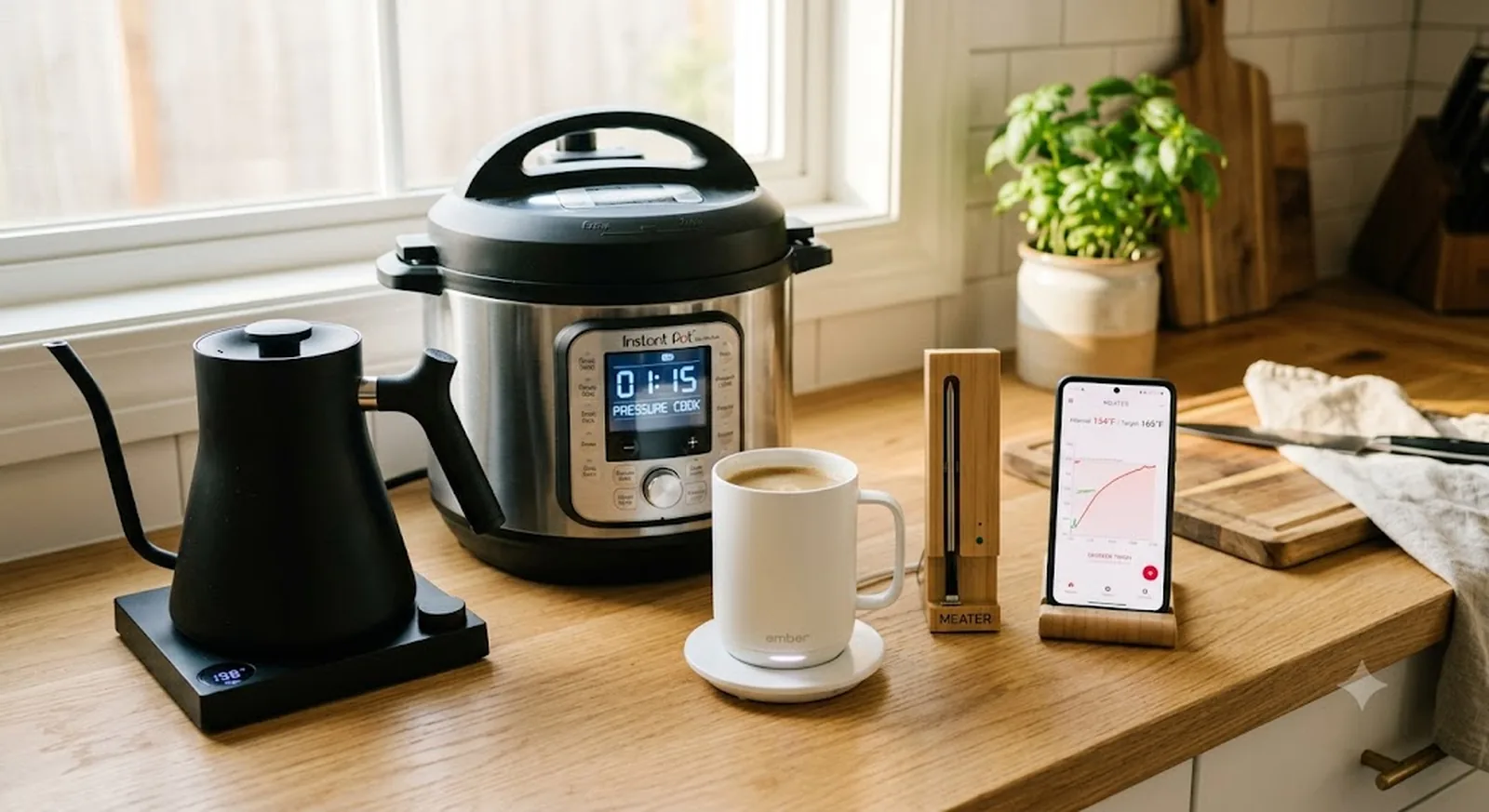
If I could hand every home cook one smart gadget, it’s this. The MEATER Plus is a fully wireless probe — no cable snaking out of your oven door — that reads internal and ambient temperature simultaneously and feeds both to your phone. The app estimates when your roast will actually hit target, which turns “hover and poke” cooking into “go fold laundry” cooking. Owners report using theirs across years of briskets, Thanksgiving turkeys, and weeknight pork tenderloins, and reviewers consistently single out the guided cook flow in the app as the rare companion app that earns its install.
It passes the dumb-gadget test too: the wooden charging block keeps it topped up, and the 165-foot Bluetooth range covers most kitchen-to-porch or kitchen-to-yard distances with room to spare. If you already own a good instant-read (my favorites are in my meat thermometers under $30 roundup), this isn’t a replacement — it’s the set-and-walk-away companion for long cooks.
The genuine con: the probe is thicker than a wired probe, so it leaves a visible channel in delicate cuts like a pork loin, and it’s simply too big for thin proteins — don’t buy it for chicken breasts and salmon fillets. Bluetooth (not Wi-Fi) also means no checking your brisket from the grocery store unless you add MEATER’s link features via a second phone or their cloud workarounds.
2. Anova Precision Cooker 3.0 (Wi-Fi) — Best for Hands-Off Weeknight Dinners

Price tier: mid-range | Connection: Wi-Fi + app | Best for: perfectly cooked proteins with a five-minute active effort, meal preppers, steak people
Sous vide is the category where Wi-Fi stops being a gimmick and becomes the whole point. The Anova 3.0 pushes 1,100 watts, holds its bath temperature rock-steady, and — this is the feature reviewers call out most — lets you start or adjust a cook remotely. Chicken thighs go into the water bath before the school run; a tap on the app starts the cook from the parking lot; dinner is precisely 165°F by the time anyone’s home. Few other cooking methods survive a packed schedule that gracefully.
The 3.0 generation also added a crisp on-device display and physical controls, so it works perfectly well as a dumb circulator when your router is sulking. That’s exactly the resilience I want in a connected tool — the app adds convenience, but the gadget doesn’t need permission from the cloud to cook.
The genuine con: sous vide itself has a learning curve of patience — a “quick” steak is still an hour-plus before searing, and you’ll want a big container and a lid to stop evaporation on long cooks. And unless you finish everything with a screaming-hot pan (my cast iron notes in the kitchen upgrade guide apply here), results can look pale and sad before that final sear.
3. Instant Pot Pro Plus 10-in-1 — Best Smart Multi-Cooker

Price tier: mid-range | Connection: Wi-Fi + app with 800 recipes | Best for: batch cooking, beans and stocks, one-pot weeknight dinners, small kitchens replacing five appliances
I was skeptical that a pressure cooker needed an app — and the Pro Plus is the rare case where the reviews back the app up. The 6-quart Pro Plus runs ten functions (pressure cook, slow cook, rice, steam, sauté, sous vide, yogurt, and more), and the app’s step-by-step recipes push settings straight to the cooker. What wins buyers over isn’t remote control; it’s that the app turns multi-stage recipes into a sequence the pot executes on its own while the rest of dinner (or homework) gets handled. A progress bar that answers “how long until the release finishes” from across the room is a small feature reviewers mention again and again.
It also collapses counter clutter the way I recommended in my gadgets that actually save time test: one footprint, five retired appliances. For a small kitchen, that math matters more than any single function.
The genuine con: the lid’s sous vide and yogurt modes are fine-not-great (an immersion circulator like the Anova above is meaningfully better), and if you never cook from the app, you’re paying the connected premium for a very good — but not unique — pressure cooker. Buy the non-connected Pro in that case and pocket the difference.
4. Govee Smart Gooseneck Kettle — Best Budget Smart Buy

Price tier: budget | Connection: Wi-Fi + Alexa | Best for: pour-over coffee, tea drinkers who care about degrees, small-batch bakers proofing yeast
Most smart kettles fail my markup question spectacularly. This Govee is the exception because the “smart” features ride on top of a legitimately good kettle: 1,200 watts, a real gooseneck spout with a controlled pour, all-stainless interior, and to-the-degree temperature control — the feature that actually matters, because 205°F water for a light-roast pour-over and 175°F for green tea are different drinks. The scheduling feature that reviewers rave about most is having water at temperature before you’ve spoken to anyone in the morning — a correct amount of morning interaction.
If you’re building a coffee corner on a budget, this pairs beautifully with the setups in my pour-over setups under $100 guide — and the variable-temp function replaces the thermometer-and-guesswork dance entirely.
The genuine con: the 0.8-liter capacity is pour-over sized, not family sized — two big mugs and it’s empty. And Govee’s app, while reliable, really wants to enroll you in an ecosystem of lights and sensors; expect some notification housekeeping after setup.
5. Etekcity Smart Nutrition Scale — Best for Meal Preppers

Price tier: budget | Connection: Bluetooth app | Best for: meal preppers, bakers who weigh flour (all bakers should weigh flour), macro trackers
A kitchen scale is already the most underrated tool in home cooking — bread stops being a coin flip the moment you weigh flour instead of scooping it. The Etekcity adds a genuinely useful layer: weigh an ingredient, tag it in the app, and it logs nutrition data across 19 nutrients with an 11-pound capacity and the accuracy you’d want for both a brisket and a quarter-teaspoon of yeast. For meal preppers portioning five identical lunches, the app’s running totals per container remove a whole spreadsheet from your Sunday.
Crucially, it aces question two of my test: with the app closed, it’s still an excellent stainless scale with grams-and-ounces precision. The smart layer is optional, which is exactly how smart should work at this price tier.
The genuine con: logging every ingredient through the app is fiddly — search, tag, confirm — and it’s a pattern that shows up in review after review: buyers use the smart features for two enthusiastic weeks and then never again if they’re not actually tracking nutrition. Buy it as a great scale first; treat the app as a bonus.
6. Ember Smart Mug 2 — The Luxury Pick I’d Still Defend

Price tier: premium | Connection: app-controlled | Best for: slow sippers, desk workers, the person on your gift list who reheats coffee three times a morning
Let me be honest about what this is: a heated 10-ounce mug that holds your coffee at your preferred temperature — most owners settle around 135°F — until the battery runs out. That’s it. That’s the product. And it earns its defenders, because it turns out “coffee that never goes lukewarm” is a small luxury a lot of desk workers say they feel every single morning. The app lets you dial the temperature once and then never open it again, which per my test framework is the best kind of app.
The genuine con: the listed battery life is about 80 minutes off the coaster — fine for a desk session, hopeless for a long morning of errands — and it’s hand-wash-preferred, which fights the “just another mug” convenience story. It’s also unapologetically premium-priced for a mug. If the recipient wouldn’t describe coffee temperature as a personality trait, skip it.
The Smart Gadgets I’d Skip in 2026
The flip side of my three-question test is a list of categories where the smart version keeps failing it. Save your money on these:
- Smart toasters and smart coffee makers with app scheduling. The connected premium on these small appliances is real, and the feature you’re paying for — scheduling — dies the first time you forget to load bread or grounds the night before. A manual pour-over setup makes better coffee for less.
- Refrigerators with touchscreens. The screen ages like a phone; the compressor ages like a fridge. You’re welding a three-year gadget onto a fifteen-year appliance, at a hefty connected markup, and the “see inside from the store” camera works right up until someone puts the milk in front of it.
- App-dependent air fryer “remote cooking.” Most manufacturers (sensibly) won’t let you start an empty appliance remotely for safety reasons, so the app is reduced to a glorified timer. The air fryer itself can still be a great buy — my air fryer vs. convection oven test covers when — just don’t pay extra for the Wi-Fi badge.
- Anything that only works through the app. No physical controls means a discontinued app is a paperweight. This is my hard line, and it’s disqualified more gadgets than any spec ever has.
When the Smart Version Is Worth the Markup
Zoom out and a pattern emerges from the six winners above. The smart premium pays off when the connection does one of three jobs: it removes waiting (the Anova starting dinner from the parking lot, the Govee heating before you wake), it removes monitoring (the MEATER letting a brisket cook unwatched), or it removes recording (the Etekcity logging what you’d otherwise type into a spreadsheet). Those are real jobs with real minutes attached.
When the connection just relocates a button from the device to your phone — toaster apps, fridge screens, remote preheat you can’t legally use unattended — you’re paying the smart tax for a demo, not a tool. Spend that money on fundamentals instead: my best kitchen gadgets pillar is full of $20 tools that will outlast every app on this page.
FAQ: Smart Kitchen Gadgets in 2026
Are smart kitchen gadgets actually worth it?
A minority are. The connected version is worth it when it removes waiting, monitoring, or manual logging from a routine you already have — think wireless thermometers, Wi-Fi sous vide circulators, and app-guided multi-cookers. When the app merely duplicates a button, the non-smart version is the better buy.
Do smart kitchen gadgets work without Wi-Fi?
The good ones do. Every pick in this guide functions as a normal appliance with its physical controls if your network is down — that was a requirement, not a coincidence. Before buying any connected gadget, check for on-device controls; if it’s app-only, treat that as a warning sign.
What happens if the company shuts down the app?
With app-only gadgets, you can lose features or the whole device — it’s happened repeatedly in the smart-home world. That’s why I only recommend connected kitchen tools that work standalone. The MEATER, Anova, Instant Pot, Govee kettle, and Etekcity scale all keep doing their core job even if their apps vanished tomorrow.
Which smart kitchen gadget should I buy first?
Match it to your biggest friction. If you cook roasts or grill: the MEATER Plus. If you want weeknight dinners with five minutes of effort: the Anova 3.0. If your mornings run on precise coffee or tea: the Govee kettle is the lowest-risk way to test whether “smart” fits your kitchen at all.
The Bottom Line
Smart kitchen gadgets in 2026 have quietly split into two species: tools that use connectivity to give you time back, and toys that use it to justify a markup. The six above are firmly in the first camp — the pattern holds up across verified buyer reviews, spec sheets, and price comparisons, flaws included, and I’d still recommend buying them. Start with the one that matches a friction you felt this week, apply the three questions to everything else, and let the graveyard drawer stay someone else’s problem.