Best Mandoline Slicers: Tested for Precision and Safety
A mandoline is the fastest way to get restaurant-thin, perfectly even slices at home — and the fastest way to nick a fingertip if you get careless with it. I dug into hundreds of verified-purchase reviews on five current models, comparing slice consistency, hand-guard design, and price tier, and I have strong opinions about which ones slice cleanly and which ones actually keep your hands safe. Disclosure: Kitchaneers is reader-supported. If you buy through links on this page I may earn a small commission at no extra cost to you. I only recommend gear I’d use myself.
This is a precision-and-safety roundup, not a spec sheet. I cared about two things above all: how thin and consistent buyers say the slices come out, and how confidently reviewers say they can use the thing without watching their knuckles the whole time. Here are my picks, organized by what you actually need.
My quick picks at a glance
- Best overall / most adjustable: OXO Good Grips Chef’s Mandoline Slicer 2.0
- Best for precision: Benriner Super Slicer (Japanese blades)
- Best value (gloves included): Gramercy Adjustable Mandoline
- Best for safety: ONCE FOR ALL Safe Mandoline Slicer Plus
- Best for cleanup & storage: Fullstar All-in-One
If a mandoline feels like overkill, it’s worth remembering how much hand-slicing it replaces — it earned its drawer space faster than most tools in my guide to kitchen gadgets that are actually worth buying.
How I evaluated these
For each slicer, I worked through hundreds of verified-purchase reviews looking for recurring patterns: complaints about uneven or ragged slices on foods like potato, cucumber, and carrot; praise or complaints about the hand guard’s grip and whether the blade locks at a defined thickness; and mentions of how exposed the blade stays during storage. I cross-checked those patterns against the specs and price tier of each model, and weighed in reports on setup and cleanup, because a mandoline people dread washing is a mandoline they stop using — the opposite of the time-savers in my gadgets that actually save time roundup.
OXO Good Grips Chef’s Mandoline Slicer 2.0 — Most Adjustable

This is the one I’d reach for when slice quality matters more than anything. A dial steps you through 21 thickness settings, and reviewers consistently describe the change as genuinely fine-grained — going from translucent potato chips to a sturdy gratin slice without guessing. The straight blade comes up again and again in reviews as tracking dead-level across potato, cucumber, and carrot, and the fold-flat legs and angled body make it the most comfortable to use of the group by most accounts. The runner-up wins here too: it doubles as a julienne and crinkle cutter without separate inserts to lose.
The con: it’s easily the priciest pick, and the bulky body eats more drawer space than a folding model. A recurring complaint in reviews is that the food holder grips small or round items (a shallot, a lime) less securely, and buyers often finish those by hand. If precision is your priority and budget isn’t, though, nothing else here matches its consistency in the reviews.
Benriner Super Slicer — Best for Precision

The Benriner is the slicer a lot of professional kitchens quietly rely on, and the reviews make clear why. Buyers consistently describe the Japanese stainless blade as scary sharp out of the box, and it’s the one model reviewers single out for truly translucent cucumber slices without dragging or tearing the skin. It comes with four blades (flat plus three julienne widths) and a screw on the underside to micro-adjust thickness, so your control is limited mainly by patience.
The con: that sharpness is exactly why this one demands respect — the included hand guard is small and basic, and I would not use this Benriner barehanded. The thickness adjustment is also fiddly compared with OXO’s dial. Pair it with a cut-resistant glove and it’s the precision champion of the group.
Gramercy Adjustable Mandoline — Best Value

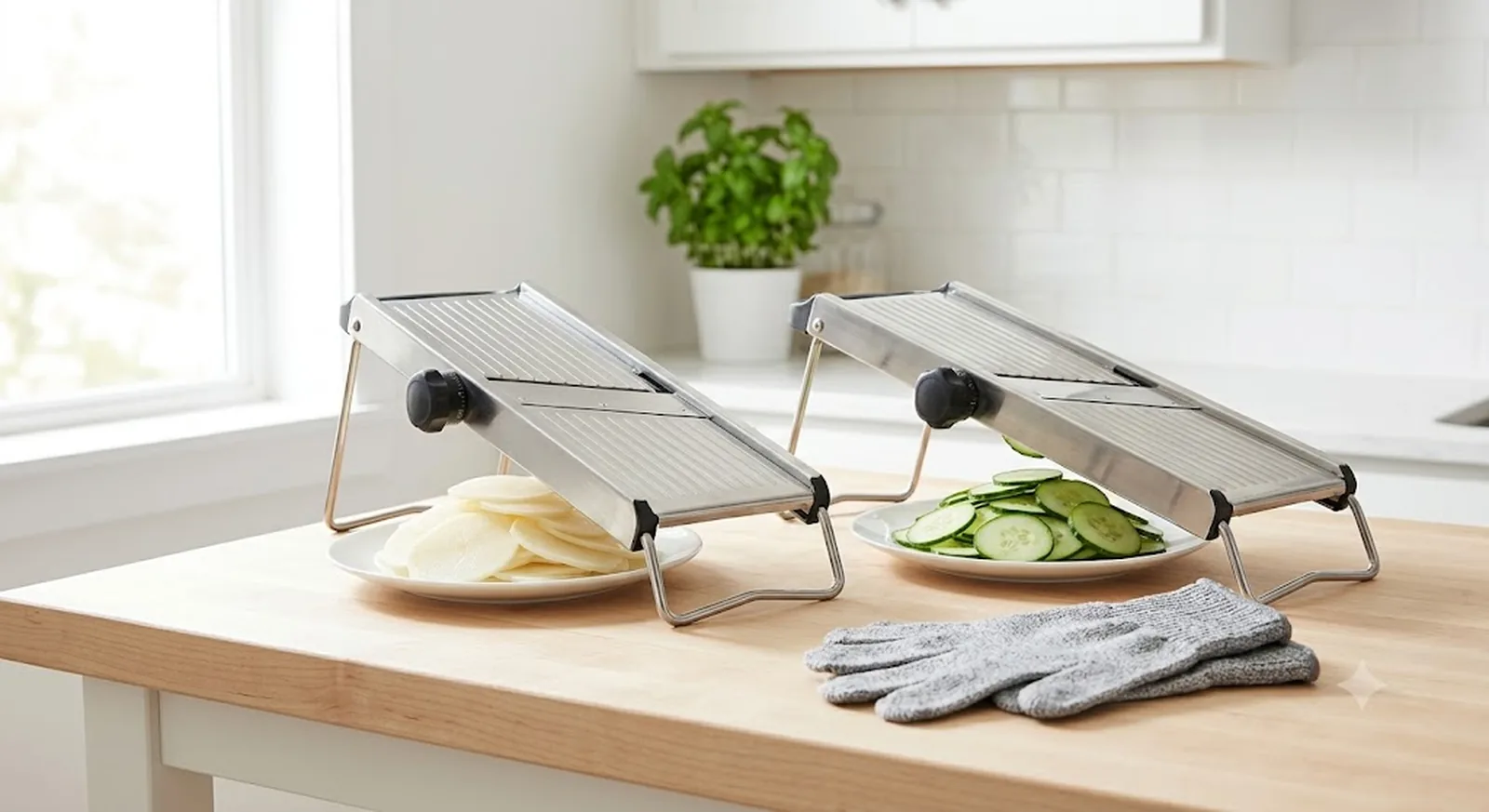
For most home cooks, this is the sweet spot. The Gramercy gives you a stainless V-blade, a dial with several useful thickness stops, and — the part I love — a pair of cut-resistant gloves in the box. That single inclusion does more for everyday safety than any clever guard, and it tells me the brand actually thought about how people get hurt. Reviewers rate slice quality on potato and carrot as genuinely close to the pricier models; the cucumber is the one food that draws occasional complaints about extra drag.
The con: the plastic frame flexes slightly under hard pressure on dense vegetables, so you feel less planted than with the OXO. It’s a reassurance issue, not a performance one — the slices still came out even. At this price, with gloves included, it’s the easiest pick to recommend.
ONCE FOR ALL Safe Mandoline Slicer Plus — Best for Safety
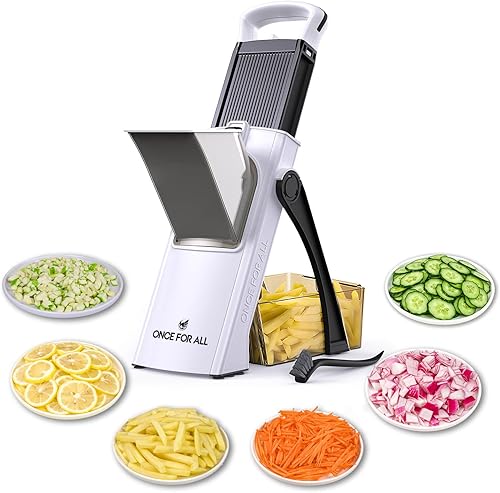
If a previous mandoline scared you off the whole category, start here. The design is built around a deep, claw-style hand guard that keeps your fingers well above the blade, and the larger food bed means you’re not crowding your hand toward the edge to push small items through. It’s the model I’d hand to a nervous first-timer or a teenager without a second thought. Precision is perfectly good for everyday slaws, fries, and gratins.
The con: all that protective hardware makes it the bulkiest to clean, with more nooks where pulp hides, and the thickness range is narrower than the OXO or Benriner — it tops out before true deli-paper thinness. You trade a little finesse for a lot of peace of mind, and for many people that’s the right trade.
Fullstar All-in-One Vegetable Chopper & Mandoline — Best for Cleanup & Storage

This is the practical pick for a small kitchen. The mandoline blade sits over a catch container, so slices drop straight into the bin instead of all over the counter, and the whole thing — plus its chopper inserts — nests into one storage box. For weeknight slaw or quick pickle prep, reviewers consistently point to the contained workflow as a real cleanup-time saver. It also overlaps nicely with the affordable workhorses in my best budget kitchen gadgets list.
The con: it’s a jack-of-all-trades, so the mandoline blade isn’t as razor-fine as the dedicated slicers — several reviewers note the cucumber rounds come out a touch thicker than expected. And with the most parts of any pick here, there’s the most to rinse and the most to misplace. But for catching slices and disappearing into a cabinet, nothing else came close.
Mandoline safety: how to never lose a fingertip
Every mandoline injury reported in customer reviews follows the same pattern: someone skipped the guard “for the last few slices.” Don’t. The non-negotiables are simple. Always use the hand guard, even when it’s slower. Better yet, wear a cut-resistant glove on your guiding hand — it’s the cheapest insurance in cooking, and it’s why the Gramercy’s included pair matters. Lock or sheath the blade the moment you’re done, because a mandoline left blade-up in a soapy sink is how most cuts actually happen. And keep the blade sharp: a dull blade makes you push harder and slip, the same principle behind safe knife handling I cover in my kitchen tool care guide.
How to choose the right one for you
Match the tool to your priority. If you want the finest, most consistent slices and you’ll respect the blade, get the Benriner for pure precision or the OXO if you’d rather pay more for comfort and an easy dial. If you’re price-conscious but still want even results, the Gramercy with its bundled gloves is the value play. If the very idea of a mandoline makes you nervous, the ONCE FOR ALL’s deep guard removes most of the fear. And if counter mess and cabinet space are your real enemies, the Fullstar’s catch-container design wins. There’s no single “best” — there’s the best for how cautious you are and how much you’ll actually use it.
Frequently asked questions
Are mandoline slicers worth it?
If you regularly make slaws, gratins, chips, or anything that needs uniform slices, yes — a mandoline does in seconds what careful knife work takes minutes to match, and far more evenly. If you slice vegetables only occasionally, a good knife is enough.
Are cut-resistant gloves necessary?
They’re the single best safety upgrade you can make. The hand guard handles most of the work, but a glove protects you in the exact moments people get careless — the last few slices and the cleanup. I recommend one with every mandoline regardless of which guard it ships with.
Plastic or stainless steel frame?
The frame matters less than the blade and the stability. Plastic-bodied models like the Gramercy and Fullstar get consistently good marks for clean slicing in buyer reviews; they just flex a bit more under heavy pressure. What you never want to compromise on is blade sharpness and a guard you’ll actually use.
The bottom line
For the cleanest, most consistent slices, the Benriner and the OXO Chef’s Mandoline 2.0 are in a class of their own — pick the Benriner for precision on a budget, the OXO for comfort and adjustability. For most home cooks, the Gramercy hits the right balance of price, performance, and safety, especially with its included gloves. And whichever you choose, buy the glove, use the guard, and sheath the blade — a mandoline is one of the most useful tools in a kitchen right up until the moment you get casual with it.