Ninja vs. Instant Pot Air Fryer: The Definitive 2026 Verdict
We may earn a commission from qualifying purchases made through links on this page.
The ninja vs instant pot air fryer debate comes up constantly — and most comparisons dodge it with a non-answer. “It depends on your needs” is not a verdict. We compared the Ninja Foodi DualZone DZ201 and the Instant Vortex VersaZone 9-Qt by digging into verified-purchase buyer reviews, spec sheets, and pricing — and we have actual opinions. Here they are.
In brief: The Ninja DZ201 wins for families cooking two different things at the same time. The Instant Vortex VersaZone wins when you need maximum capacity for large batches. For most households cooking for 1–3 people, neither is the right first buy — the Cosori Pro LE is.
How we compared the Ninja and Instant Pot air fryers
We compared both the Ninja Foodi DualZone DZ201 ($169.99) and the Instant Vortex VersaZone 9-Qt ($119.99) side by side, using verified-purchase buyer reviews, published specs, and price data — focusing on what owners say about crisping results on wings, fries, salmon, and roasted vegetables, plus preheat time, noise level, basket cleanup, and countertop footprint.
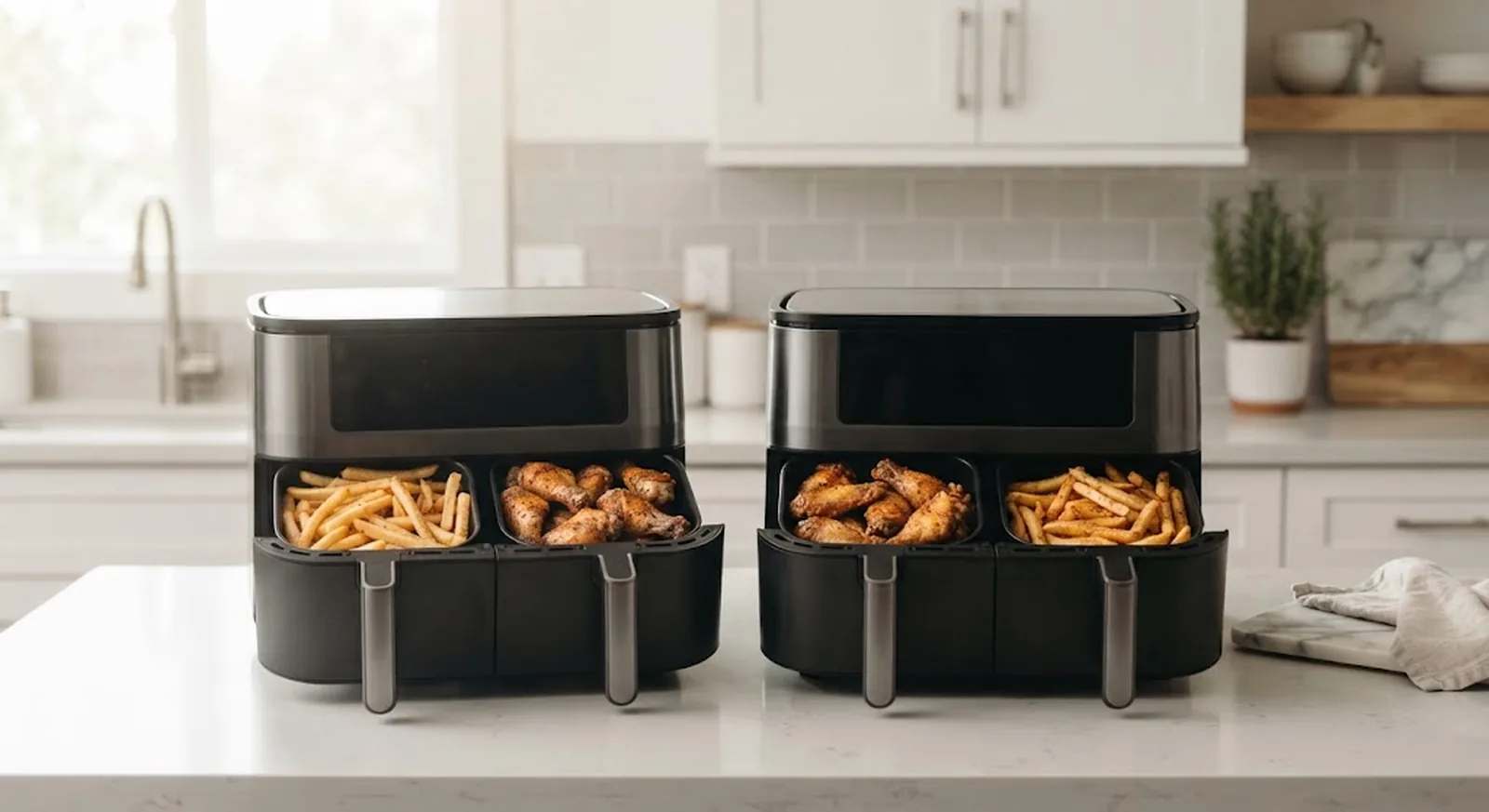
Both are dual-zone air fryers aimed at households of 4+. Here’s how they split.
Ninja Foodi DualZone DZ201 — what it does well

The Ninja DZ201’s defining feature is two genuinely independent heating zones. Each 4-quart basket has its own heating element and fan — not a shared element with a divider, but a truly separate cooking environment. This means you can run chicken wings at 400°F in one basket and roasted broccoli at 375°F in the other, and the Smart Finish feature syncs both to finish at the same time.
In practice, that’s a real weeknight upgrade. You stop cooking two ingredients sequentially — one holds while the other finishes — and start plating everything at once. For households that regularly cook proteins and vegetables at different temperatures, the Ninja DZ201 does something the Instant Vortex simply cannot match.
Temperature accuracy on the DZ201 is widely described by owners as close to the set temperature and predictable once you know the offset — not class-leading, but consistent. Noise runs higher than the Cosori Pro LE, since two independent fans operate simultaneously, though reviewers rarely describe it as disruptive during normal dinner prep.
The genuine weaknesses: it’s large and heavy (approximately 20 pounds). If you don’t have permanent counter space for it, it won’t get used. The baskets are dishwasher-safe, but two baskets plus two crisper plates means more to wash after every meal.
Instant Vortex VersaZone 9-Qt — what it does well
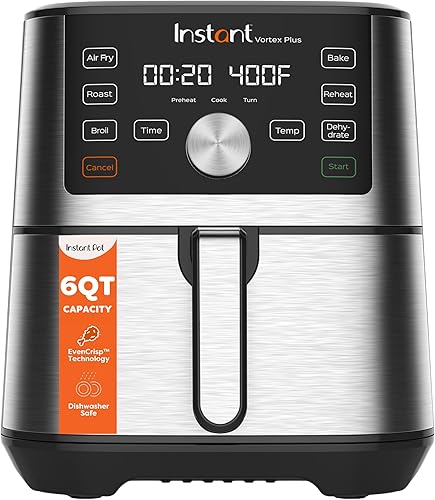
The Instant Vortex VersaZone takes a different approach: one large 9-quart chamber with a removable divider. Pull the divider out and you get a single 9-quart cooking space — large enough for a whole chicken, a full rack of ribs, or a sheet-sized batch of wings. Insert the divider and you get two 4.5-quart zones running at different temperatures.
That flexibility is the VersaZone’s real advantage. The Ninja DZ201 is always two separate 4-quart baskets — you can’t combine them into one large cooking space. If your household sometimes needs to cook one very large item (whole chicken, big roast, party-sized batch of fries), only the Instant Vortex can do that.
Capacity wins over the Ninja on paper and in practice: 9 quarts versus 8 total quarts, and the unobstructed single-chamber mode is meaningfully different from two separate 4-quart baskets. Price is also lower — typically $40–$50 cheaper than the Ninja DZ201.
The weaknesses: reviewers frequently flag a plastic-aftertaste issue during the first three to four uses on the Instant Vortex line. The commonly recommended fix is a burn-in protocol (empty at max temp for 10–15 minutes, twice) before cooking food — buyers report it resolves within the first several uses. Temperature accuracy gets good marks overall, though reviewers describe it as slightly less consistent than the Ninja.
Ninja vs. Instant Pot air fryer: head-to-head comparison
| Feature | Ninja DZ201 | Instant Vortex VersaZone |
|---|---|---|
| Total capacity | 8 qt (2 × 4) | 9 qt (1 × 9 or 2 × 4.5) |
| Independent zones | ✅ True independent elements | ✅ Divider-based zones |
| Single large chamber | ❌ | ✅ Remove divider |
| Smart Finish (sync finish time) | ✅ | ❌ |
| Temperature accuracy (per reviews) | Consistent | Slightly less consistent |
| Burn-in odor | Minimal | Noticeable at first (fades with use, per reviews) |
| Typical price | ~$170 | ~$120–130 |
| Dishwasher-safe basket | ✅ Both baskets | ✅ Basket + divider |
Winner on dual-zone cooking: Ninja DZ201 — independent elements mean true temperature isolation.
Winner on max capacity: Instant Vortex VersaZone — 9-qt single chamber is a different tool.
Winner on price: Instant Vortex VersaZone — typically $40–50 cheaper.
Which air fryer should you buy?
The ninja vs instant pot air fryer question has a clean answer once you know your use case.
Buy the Ninja DZ201 if: you cook for 4+ people regularly, you frequently need two ingredients at different temperatures finishing simultaneously, and you have permanent counter space for a 20-lb appliance. The Smart Finish feature alone justifies the price premium for households that use it every week.
Buy the Instant Vortex VersaZone if: you sometimes need to cook one large item (a whole chicken, a big roast, a party batch of wings) AND sometimes need two separate zones. The removable divider gives you more flexibility for less money. Also the right call if budget is a constraint.
Neither, if: you’re cooking for 1–3 people. At that household size, an 8–9 quart dual-zone air fryer is overkill. For smaller households, the Cosori Pro LE 5-Qt from our best air fryers guide is the better buy — quieter, more accurate, and half the counter footprint.
Who should skip both and look elsewhere
Three situations where neither the Ninja DZ201 nor the Instant Vortex VersaZone is the right answer:
Small kitchen or limited counter space. Both are large appliances. If you don’t have a permanent spot for a 20-lb dual-zone air fryer, it will end up in a cabinet — and the cabinet is the air-fryer graveyard. Go smaller.
Cooking for one or two. A 4-quart single-basket air fryer handles everything a 1–2 person household needs at a fraction of the footprint. The dual-zone features only earn their keep when you’re regularly cooking two separate dishes simultaneously for multiple people.
Already own a good convection toaster oven. A quality convection toaster oven air-fries, bakes, broils, and toasts — its cavity handles large items naturally. Adding a dual-basket air fryer to your counter is usually redundant. For the full appliance picture, see our guide to the best small kitchen appliances.
Key takeaways
- The ninja vs instant pot air fryer choice comes down to one question: true independent dual zones (Ninja) or maximum single-chamber capacity (Instant Vortex)?
- Ninja DZ201 wins on temperature isolation, Smart Finish sync, and cooking accuracy — at a higher price.
- Instant Vortex VersaZone wins on max capacity, price, and flexibility via the removable divider.
- For households of 1–3, neither is the right starting point — a 5-qt single-basket air fryer is better.
- Both require a permanent counter spot to earn their keep. If you’ll store it in a cabinet, save the money.
Prices current at time of publishing. Amazon prices change frequently — check current price before purchasing.
And if it’s the pressure-cooking side of these multi-cookers you’re really after rather than the air-fryer lid, start with my guide to the best pressure cookers for beginners — it covers stovetop models too.