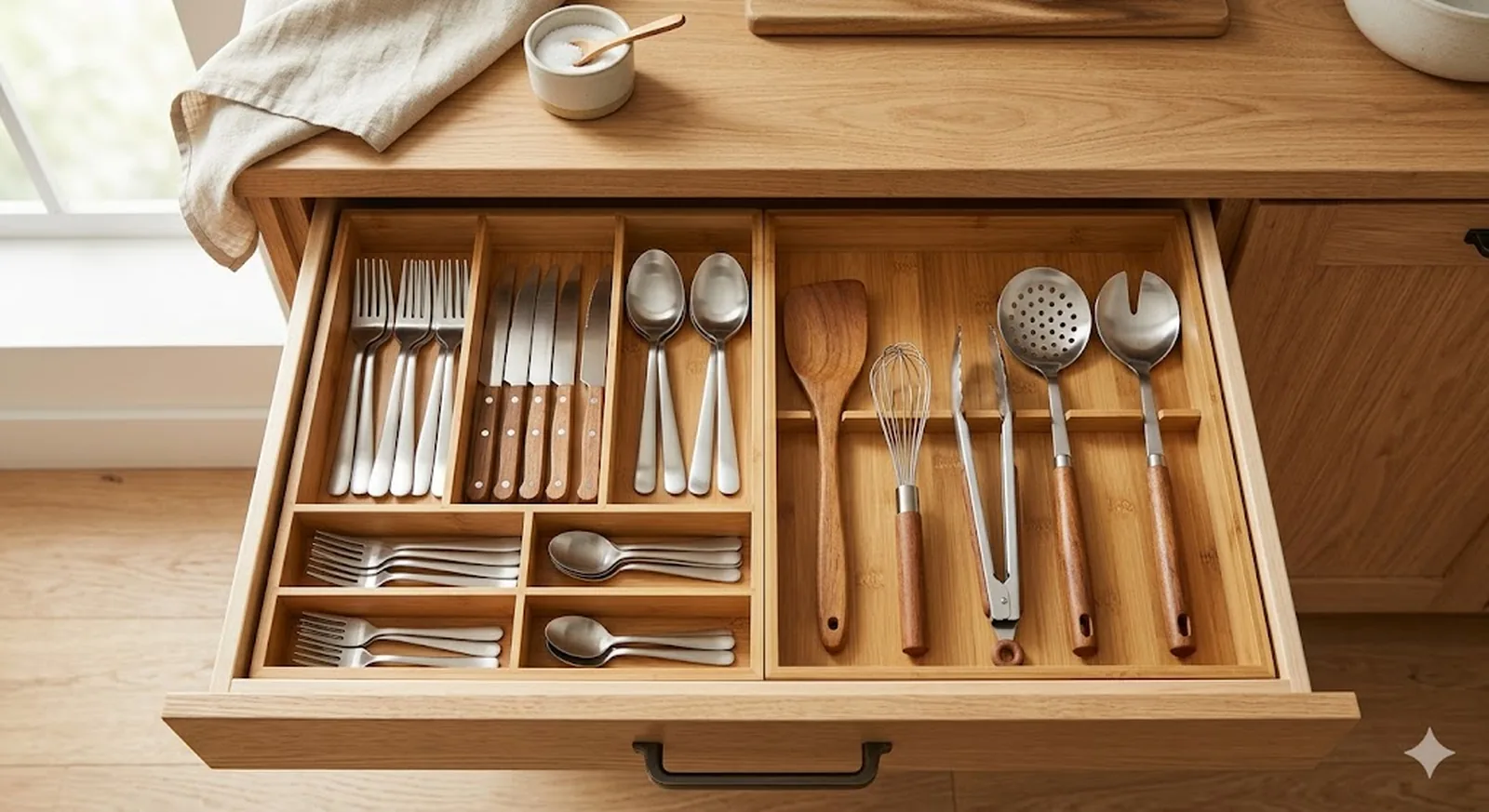
Best Kitchen Drawer Organizers: Tested for Fit and Durability
A messy utensil drawer is the kind of small daily friction that wears you down: you reach for the vegetable peeler and come back with the can opener, a skewer, and a rubber band. Five popular drawer organizers are compared below across the drawer types where it matters most — the deep utensil drawer, the shallow flatware drawer, and the catch-all “junk” drawer by the back door — judged on the two things that actually matter once the novelty wears off: how well it fits a real drawer and how it holds up to being opened and slammed a dozen times a day. Disclosure: this post contains affiliate links. If you buy through them I may earn a small commission at no extra cost to you. Recommendations here are based on verified-purchase buyer reviews, spec comparisons, and price comparisons, not just marketing claims.
Below are the organizers that stood out, what each one is genuinely good at, and the trade-off you should know before you buy. If you are organizing the whole kitchen, not just one drawer, start with my kitchen organization ideas guide and the companion piece on small kitchen storage ideas.
How these organizers were evaluated for fit and durability
Fit is where most drawer organizers fail. A standard kitchen drawer interior runs anywhere from about 13 to 22 inches wide and 2 to 4 inches deep, and “one size” almost never does. Measure your drawer first — interior width, depth, and the front-to-back run — then compare that against each organizer’s listed dimensions and buyer feedback on whether it expands smoothly, sits flush, and stops sliding around when the drawer moves. For durability, verified-purchase reviews point to the same recurring failure points: bamboo that splinters at the joints after a few months, expandable rails that lose tension, and plastic that cracks at the corners. Here is what earned a spot.
Pipishell Bamboo Expandable Silverware Drawer Organizer (Best Overall)

This is the top overall pick. The Pipishell expands from roughly 13 to 19 inches via a center slider, so it fills a flatware drawer without leaving the dead space that fixed trays always seem to create. The bamboo is sanded smooth, the slots are deep enough that forks do not climb over the dividers, and buyers consistently report that the expansion track holds its position over months of daily use instead of creeping closed every time the drawer is opened.
The con: the expandable gap in the middle is open underneath, so smaller items like bag clips or chopstick rests can occasionally slip into the channel. Keep tiny odds and ends in a different compartment and it is a non-issue. Like all bamboo, it also needs to be wiped, not soaked — a rule I cover in detail in my organization guide.
madesmart Classic Large Silverware Tray (Best Value)

If you want something inexpensive that just works, this is it. The madesmart tray is the plastic workhorse I recommend to anyone furnishing a first kitchen — it shows up in my first-apartment essentials list for a reason. The soft-grip lining in each compartment keeps utensils from rattling, and the rubber feet underneath genuinely stop the tray from sliding, which is the single most common complaint with cheap organizers. It is dishwasher-safe, so cleanup is trivial.
The con: it is a fixed size (about 14.5 inches wide), so it will not expand to fill a wider drawer — measure before you order. In a too-wide drawer it slides front-to-back unless you butt it against a wall.
Utoplike Bamboo Drawer Dividers, 4-Pack (Best for Deep Drawers)

Trays are great for flatware, but a deep utensil drawer needs something taller. These spring-loaded bamboo dividers tension against the drawer walls and let you carve a deep drawer into custom sections — one for spatulas, one for whisks, one for the ladle that never had a home. At roughly 2.5 inches tall they actually contain tall tools instead of letting them flop over. Buyers report reconfiguring the layout easily as storage needs change, and reviews note the bamboo holds up well to repeated adjustment.
The con: the spring tension relies on smooth, hard drawer walls. In a drawer with a soft liner or textured laminate, the dividers can shift when you slam it shut. On bare wood or melamine they lock in fine.
ROYAL CRAFT WOOD Luxury Bamboo Drawer Organizer (Premium Pick)

When you want the drawer to look as good as it functions, this is the upgrade. The ROYAL CRAFT WOOD tray has nine slots, including a long angled compartment for serving pieces, and the bamboo is noticeably thicker and better finished than the budget trays — the kind of piece you do not mind having on open shelving. It feels solid, and verified-purchase reviews consistently note no joinery separation, even after extended use.
The con: it is a fixed footprint and costs several times what the madesmart does. You are paying for looks and build quality, not flexibility — so confirm the dimensions match your drawer before splurging.
BAMEOS Bamboo Expandable Drawer Dividers (Best Adjustable Fit)
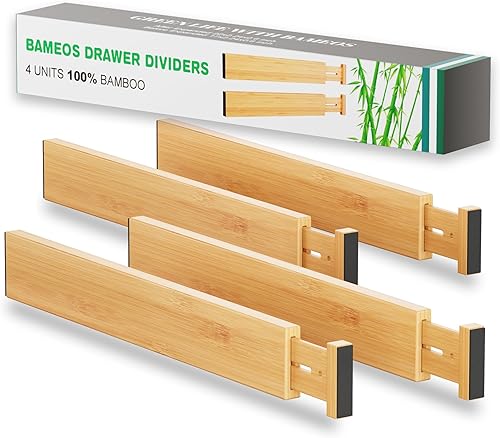
For odd-width drawers, these expandable dividers are among the most adaptable options compared here. Each one telescopes to fit drawers from about 16.6 to 22 inches and spring-loads into place, so you can drop them into a wide or oddly sized drawer and dial in the exact compartments you want. At 2 inches tall they are lower-profile than the Utoplike set, which makes them a better match for shallow drawers and bathroom or office overflow if you organize beyond the kitchen.
The con: the lower 2-inch height that makes them so versatile also means tall utensils can tip over the top. For a dedicated tool drawer I would reach for the taller Utoplike dividers instead.
How to choose the right drawer organizer
Measure first, always. Pull the drawer out and measure the usable interior — width, depth, and front-to-back — not the cabinet face. A half-inch of overhang is the difference between a tray that drops in and one that you end up trimming or returning.
Match the format to the job. Use a slotted tray (Pipishell, madesmart, ROYAL CRAFT WOOD) for flatware and small utensils where you want defined compartments. Use dividers (Utoplike, BAMEOS) for deep or wide drawers where you want to create your own zones for bulky tools. Expandable options earn their keep in non-standard drawers; fixed trays are simpler and usually cheaper when the size lines up.
Bamboo vs. plastic. Bamboo looks better and feels sturdier but needs to be wiped dry, never soaked, or it can warp and splinter over time. Plastic is dishwasher-safe and cheaper, and quality versions like the madesmart hold up fine — it just will not have the same warm look. For more on keeping wooden kitchen gear alive, see my notes in the budget kitchen gadgets roundup.
Frequently asked questions
How do I stop a drawer organizer from sliding around?
Choose one with rubber feet or non-slip lining (the madesmart has both), use an expandable model that braces against the drawer walls, or add a thin non-slip drawer liner underneath a fixed tray. The sliding problem is almost always a fit problem — a tray sized to the drawer barely moves.
Are bamboo organizers worth it over plastic?
If you like the look and will take 30 seconds to wipe them dry, yes — good bamboo feels more substantial and ages well. If you want zero maintenance and the lowest price, a quality plastic tray is the smarter buy. Both can last for years; the deciding factor is upkeep and aesthetics, not durability.
What size drawer organizer do I need?
Measure the interior width and depth of your drawer before buying. If it falls between common sizes, go with an expandable tray or adjustable dividers rather than forcing a fixed tray that will either jam or float.
The bottom line
For most kitchens, the Pipishell expandable bamboo organizer is the one to buy — it adapts to the drawer and stays put. If you are on a budget, the madesmart tray punches well above its price. And for deep or oddly sized drawers, a set of adjustable dividers does what no tray can. Whichever you pick, measure your drawer first — that one step prevents the vast majority of returns. Next, tackle the rest of the kitchen with my full organization ideas guide.