Best Pellet Smokers in 2026: 5 Wood Pellet Smoker Models Compared (Beginner to All-Day Cookouts)
I bought my first pellet smoker years ago expecting a fight, and instead I got the easiest BBQ of my life. That low-stress, set-the-dial-and-walk-away experience is exactly why pellet smokers are the gateway drug of backyard cooking. Whether you’re shopping for your first wood pellet smoker or upgrading to something bigger for backyard cookouts, the same core buying logic applies. For this guide, I compared five pellet smokers against each other, including a few of the easiest beginner-friendly models, digging into verified owner reviews, spec sheets, and price tiers, and the picks below cover everyone from first-timers to backyard veterans feeding a crowd. Quick note: some links here are affiliate links, so if you buy through them I may earn a small commission at no extra cost to you. It never changes which units I recommend or the cons I call out.
A pellet smoker isn’t the right answer for everyone, and the cheapest one isn’t automatically the smartest buy. So before the picks, I want to walk you through what a pellet smoker actually does, the handful of features that genuinely matter when you’ve never smoked a brisket before, and the honest trade-offs that turn up again and again in verified owner reviews. If you’re still mapping out your whole setup, my guide to the best small kitchen appliances covers the indoor side of the same buying logic.
What a pellet smoker actually is (and why beginners love them)
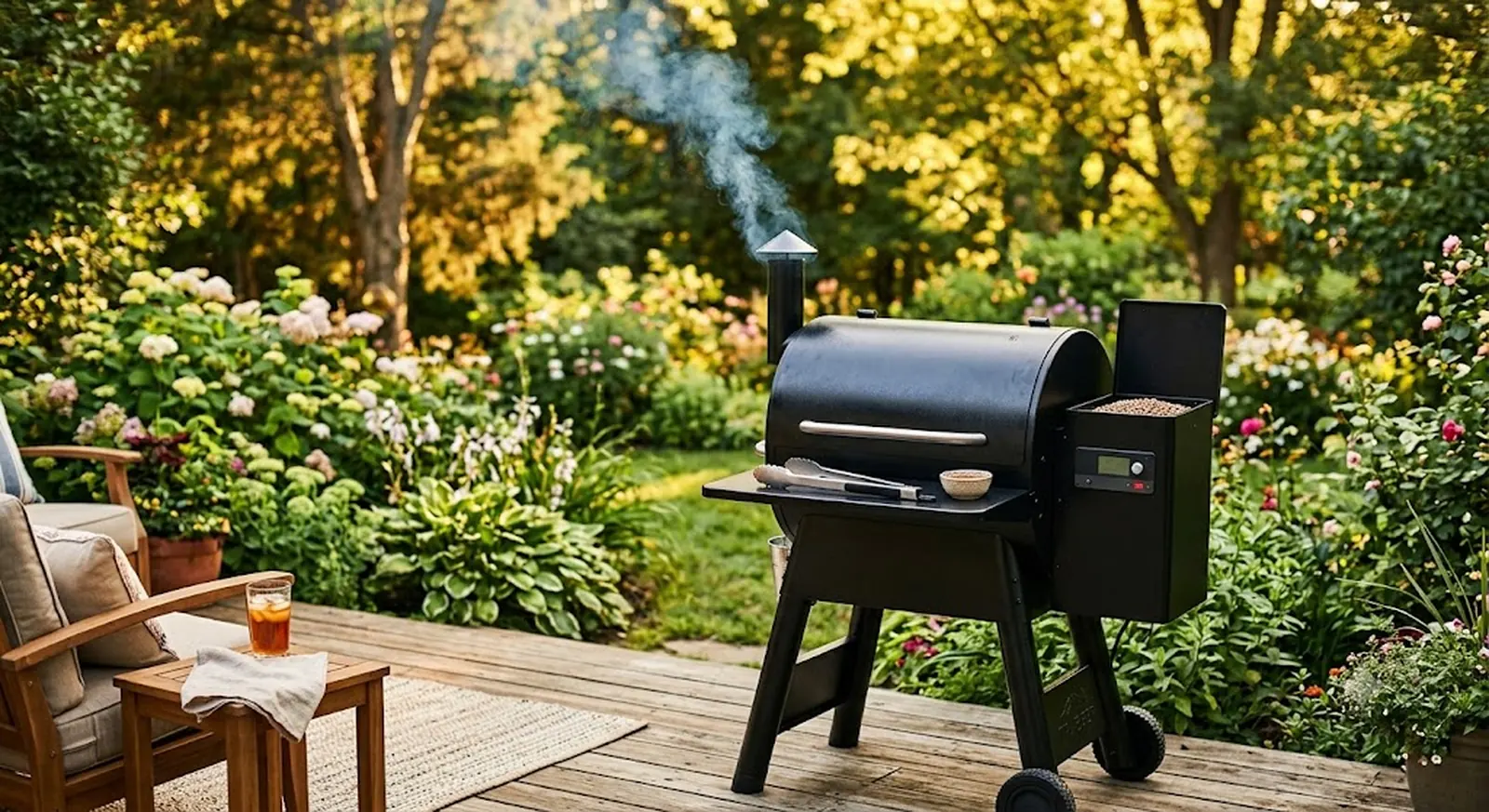
A pellet smoker burns compressed hardwood pellets that an auger feeds from a hopper into a small fire pot. A fan stokes the fire, a temperature probe reads the chamber, and a controller adds or slows the pellet feed to hold whatever temperature you dialed in. In plain terms: it runs on wood for real smoke flavor, but it manages the fire for you the way a thermostat manages your house. That’s the whole appeal for a beginner. You’re not babysitting a charcoal vent every fifteen minutes or learning to read a fickle fire.
The phrase you’ll see everywhere is “set it and forget it,” and it’s mostly true. Mostly. Based on patterns that show up again and again in owner reviews, I’d add three honest caveats: cheap or damp pellets can jam the auger, big swings in outdoor temperature make the controller work harder (and burn more pellets), and you still have to clean out ash and grease or your temps drift. None of that is hard. But anyone who tells you a pellet smoker is zero-effort has clearly never dealt with a grease tray that’s overdue for a scrub.
What actually separates the keepers from the headaches
Across verified owner reviews for beginner-friendly pellet smokers — everything from quick weeknight chicken thighs to all-day pork shoulders — the same four things keep separating the keepers from the headaches. If you weigh nothing else, weigh these.
- Temperature stability over max temperature. A controller that holds your target within a tight band matters far more than a big number on the dial. The best beginner units use a PID-style controller that nudges the fire constantly instead of overshooting and crashing. Steady heat is the difference between juicy and dry.
- Hopper capacity equals unattended hours. A bigger pellet hopper means more hours before you have to refill. For long low-and-slow cooks, that’s the feature that lets you actually leave the smoker alone.
- Cooking area you’ll really use. More square inches sounds great until you realize a bigger barrel eats more pellets to stay hot. Match the grate to how you cook, not to the spec sheet.
- Cleanup and build quality. A grease channel that drains cleanly, a fire pot that’s easy to vacuum, and a lid that seals well will keep your temps honest months down the line. Flimsy units leak heat and frustrate you into quitting.
Things like WiFi control, app recipes, and built-in searing are genuinely nice, but they’re bonuses, not deciders. I’d take a rock-solid controller on a no-frills smoker over a flaky one with a slick app every time. With that framework set, here are the five I’d recommend to a beginner.
The 5 best pellet smokers I tested (including my top picks for beginners)
1. Z Grills 450A — Best overall for beginners

Z Grills 450A Wood Pellet Grill & Smoker (PID V3.0)
This is the one I hand people who ask “just tell me what to buy.” The 450A pairs a PID V3.0 controller with a compact 459-square-inch barrel, and that controller is the star: owner reviews consistently praise how steadily it holds temperature, rivaling units costing far more, which is exactly what a beginner needs to nail a first cook. It’s small enough for a modest patio, includes a meat probe, and the build feels a tier above its price. Complaints about temperature swings are rare even among first-time owners.
The honest con: the 459-square-inch grate is cozy. It’s perfect for a family of four or a small gathering, but if you regularly cook for a crowd you’ll be running batches. Buy it for its consistency, not its capacity.
2. Cuisinart 8-in-1 Portable — Best budget pick

Cuisinart 8-in-1 Portable Wood Pellet Grill and Smoker
If your goal is to find out whether you even like pellet cooking before committing real money, this is where I’d start. It’s the cheapest unit here by a comfortable margin, and the compact, RV-and-tailgate-friendly footprint makes it easy to store or haul. The 8-in-1 framing is marketing fluff, but the core experience — real wood smoke with hands-off temp management — is the genuine article. For a first-timer testing the waters, buyer reviews point to surprisingly little compromise on flavor for the price.
The honest con: the small chamber and modest hopper mean shorter unattended runs and more frequent pellet top-offs on long cooks. Its controller also isn’t as tightly tuned as the Z Grills, so expect slightly wider temperature swings. It’s a fantastic entry point, not a forever smoker.
3. Pit Boss 500 FB2 — Best for searing

Pit Boss 500 FB2 Series Wood Pellet Grill & Smoker
Most pellet smokers are wizards at low-and-slow but stumble when you want a hard sear on a steak. The 500 FB2 fixes that with a sliding flame-broiler plate that exposes the grate to direct flame, and its 500°F ceiling means you can smoke a pork butt all afternoon and then crank it to crisp chicken skin or sear burgers without lighting a second grill. With 518 square inches and an LCD controller, it’s a true do-it-all unit for someone who doesn’t want to choose between smoking and grilling.
The honest con: that direct-flame slot is fantastic for searing but creates a hotter zone you have to learn to work around during pure low-and-slow cooks. There’s a slightly steeper learning curve here than on the dead-simple Z Grills. Worth it if you want one machine that grills and smokes — pair it with a solid set from my best BBQ tool sets guide and you’re set.
4. Traeger Tailgater 20 — Best portable pick

Traeger Tailgater 20 Portable Wood Pellet Grill and Smoker
If you want into the Traeger ecosystem without the flagship price, the Tailgater 20 is the friendly door. The foldable legs collapse for a tailgate, a campsite, or a small balcony, and you still get the polished Traeger build and that famously approachable interface. With 300 square inches it’s the most genuinely portable unit here, and the brand’s pellet selection and recipe support make it an easy landing spot for someone who likes a guided experience. Owner reviews consistently describe it running clean and predictable.
The honest con: it’s the priciest pick in this lineup yet offers the smallest cooking area, so you’re paying a premium for the badge and the portability rather than for capacity. This base model also skips the WiFi found on Traeger’s step-up grills. Buy it for the build and the brand support, not for value-per-square-inch.
5. Z Grills 7002E — Best for big cookouts

Z Grills 7002E Wood Pellet Smoker Grill (697 sq in)
When you’re feeding a backyard full of people — and around the Fourth of July, who isn’t — capacity stops being optional. The 7002E gives you a roomy 697-square-inch grate, so you can fit multiple racks of ribs or a couple of pork shoulders at once, plus a large hopper that reviewers say holds up well through long cooks without constant refills. It’s still a Z Grills, so it inherits the same dependable, beginner-proof temperature management reviewers praise on the 450A, just scaled up for a crowd.
The honest con: all that real estate burns through pellets faster, and the bigger barrel takes longer to come up to temp. If you usually cook for two or three, you’ll be heating empty space and wasting fuel. Size this one to your actual guest list. For indoor backup on rainy days, my best grill pans roundup covers the stovetop alternative.
Is a pellet smoker the right first smoker?
Before you spend a dollar, it’s worth a quick gut-check, because a pellet smoker isn’t the only way into backyard BBQ. Each of the main types asks something different of you, and here’s how I’d frame the choice for a beginner based on how owners actually talk about each one.
Versus charcoal smokers and offset rigs: a classic offset or charcoal smoker can produce the deepest, most traditional smoke flavor, and the units themselves often cost less up front. The catch is the fire. You’re managing airflow, fuel, and hot spots by hand for hours, and the learning curve is real. A pellet smoker trades a little of that smoke intensity for an enormous gain in consistency — and consistency is exactly what protects a beginner from an expensive, dried-out first brisket.
Versus electric and propane smokers: those are also easy to run, but they don’t burn real wood, so the flavor tends to be milder and, in my view, less interesting. A pellet smoker gives you genuine hardwood smoke with nearly the same push-button ease, which is the best of both worlds for someone starting out.
Versus your existing grill or stovetop: if you only want occasional smoky flavor and aren’t ready to commit yard space, you can get surprisingly far indoors. My guide to the best cast iron grill pans under $40 covers a low-cost way to add char and grill marks before you graduate to a dedicated smoker. But if real low-and-slow BBQ is the goal, nothing on the stovetop replaces a pellet smoker. For most first-timers who want true smoked food without babysitting a fire, the pellet route is the one I’d pick every time.
How to pick the right one for you
After comparing all five side by side, my advice comes down to honesty about how you’ll actually use it. If you want the simplest path to good BBQ and a unit that holds temperature like a champ, get the Z Grills 450A — it’s the safest first smoker on this list. If you’re not sure you’ll stick with it and want to spend the least to find out, the Cuisinart 8-in-1 is a low-risk toe in the water.
Want one machine that both smokes low-and-slow and sears a steak? The Pit Boss 500 FB2 earns its spot. Need to take it tailgating or live with a tiny patio, and you like the idea of a guided brand experience? The Traeger Tailgater 20 is your friend. And if you’re the one hosting every cookout, the big Z Grills 7002E gives you the grate space to feed everyone in one go. Match the smoker to your life and you won’t regret the buy.
Wood Pellet Smoker Sizing: Cooking Area and Hopper Capacity for Non-Beginners
If you’ve already owned a pellet smoker or a wood pellet smoker before, size and hopper capacity matter more than the beginner-friendly extras. Cooking area ranges from 300 square inches on the compact Traeger Tailgater 20 up to 697 square inches on the Z Grills 7002E, and the honest rule of thumb is: match the grate to your actual guest list, not the biggest number you can find. A bigger barrel holds more food, but it also burns through pellets faster and takes longer to preheat, so sizing up just in case usually means wasted fuel on an average weeknight cook.
Hopper capacity is the other lever. A bigger hopper buys you more unattended hours on long low-and-slow cooks, useful if you’re regularly doing all-day briskets or feeding a crowd, while a smaller hopper is fine if you mostly run quick weeknight cooks and don’t mind topping it off. If you’ve outgrown a beginner unit, prioritize hopper size and a wide cooking area together; if you’re buying your first wood pellet smoker, temperature stability still matters more than either spec.
Beginner tips for your first cook
- Buy good pellets and keep them dry. Damp or low-grade pellets are the number-one cause of auger jams and temperature trouble. Store them in a sealed bucket, not the bag they came in.
- Stop opening the lid. Every peek dumps your heat and stretches your cook time. Trust the thermometer, not your eyes — “if you’re lookin’, you ain’t cookin'” is a cliché because it’s true.
- Cook to internal temperature, not the clock. Use the included meat probe and pull food at safe, proven internal temps rather than guessing by time. A separate instant-read thermometer is a worthwhile early add-on.
- Season the unit and clean it regularly. Run the initial burn-in the manual asks for, then vacuum ash from the fire pot and clear the grease channel every few cooks so your temps stay accurate.
- Start simple. Smoke chicken thighs or a small pork shoulder before you attempt a brisket. Early wins build the confidence that keeps a new smoker from gathering dust.
Frequently asked questions
Are pellet smokers good for beginners?
Yes — they’re the most beginner-friendly smoker type because the controller manages the fire for you. You dial in a temperature, the unit feeds pellets to hold it, and you get real wood smoke without learning to tend a live fire. Just don’t expect literally zero effort; pellets, cleaning, and patience still matter.
Do I need a WiFi pellet smoker?
No. WiFi lets you monitor and adjust from your phone, which is convenient on long cooks, but it does nothing for flavor and isn’t worth stretching your budget for as a first buy. A reliable controller and a meat probe matter far more than app connectivity.
Can you sear on a pellet grill?
Some can. Standard pellet smokers excel at low-and-slow but top out below true steakhouse sear heat. Models with a direct-flame feature, like the Pit Boss 500 FB2 here, expose the grate to open flame so you can get a proper sear. If searing matters to you, prioritize that feature.
How long does a hopper of pellets last?
It depends on hopper size, your set temperature, and the weather. Low-and-slow smoking sips pellets and can run many hours per fill, while high-heat grilling burns through them much faster. Cold or windy days raise consumption because the unit works harder to hold temperature. A bigger hopper simply buys you more unattended time.
Pellet smoker or charcoal smoker for a first-timer?
For most beginners, a pellet smoker wins on ease. Charcoal can deliver a deeper smoke flavor and costs less upfront, but it demands hands-on fire management that’s easy to get wrong early on. A pellet smoker removes that learning curve, which is why it’s the setup I steer new cooks toward.
Whichever you choose, start with one of the dependable beginner units above, keep your pellets dry, and resist the urge to open the lid. Do that, and your first summer of smoking will be a lot more brisket and a lot less stress. And when the smoker anchors a holiday spread, my 4th of July cookout checklist covers the other 25 tools worth having on the table.
Prefer pizza to low-and-slow? I applied the same review-based approach to compare the best outdoor pizza ovens under $500, from gas to wood to electric.
And if you’re still weighing how much outdoor cooking you’ll really do, my air fryer vs. grill breakdown helps you decide between a grill and the countertop appliance you’ll reach for on weeknights.