Best Bread Makers Under $150 (Rated for Crust and Crumb)
There’s a specific kind of disappointment that comes from a bad bread machine: you measure everything carefully, you wait four hours, and you lift the lid to a pale, gummy brick with a crater in the bottom. I’ve seen that exact complaint over and over in bread maker reviews. So when people ask me which bread maker to buy without spending Zojirushi money, I don’t guess — I go back to what actual owners report after running these machines week after week.
This guide covers the best bread makers under $150, based on close analysis of verified-purchase reviews, recurring complaint and praise patterns, and spec-and-price comparisons — not a single lab bake. Disclosure: Kitchaneers is reader-supported. I earn a small commission from qualifying Amazon purchases made through links on this page, at no extra cost to you. I only recommend gear I’d want on my own counter.
The good news after digging through hundreds of owner reviews across this bracket: you do not need to spend $300+ to bake a genuinely good loaf. The sub-$150 bracket has gotten far better, especially with ceramic pans and dual heaters trickling down from premium models. The catch is that the cheap machines fail in specific, predictable ways — and knowing those failure modes is how you pick the right one.
How I evaluated these bread makers
For each machine, I looked at how owners report it performing across the same rotation: a basic white loaf, a whole-wheat loaf, dough-only use for hand-shaping and oven baking, and at least one specialty cycle — gluten-free or a sweet enriched dough. I also weighed recurring feedback about cold-kitchen performance, since owners in cooler climates often note that a weak machine still needs to land a proper rise even when a cold morning slows the yeast down.
The things I weighed: how owners describe crust color across the light/medium/dark settings, whether loaves dome evenly or sink, how loud the knead cycle runs (some owners say these walk across the counter), how deep the paddle hole ends up in the finished loaf, and how easy the pan is to clean. I also tracked the smaller recurring complaints that show up in longer-term reviews — sticky lids, confusing beep codes, and pans that lose their coating early. Every machine below earned its spot based on that pattern of feedback, and every one has at least one honest drawback I’ll call out.
Quick picks at a glance
- Best overall: Cuisinart Bread Maker Machine (CBK-110) — the most consistent loaf of the group
- Best value / most versatile: KBS Pro 17-in-1 — ceramic pan and a nut dispenser well under $150
- Best for even, hands-off baking: Neretva 20-in-1 Dual Heater — top-and-bottom heat for a browner crust
- Best for gluten-free and small loaves: Elite Gourmet Programmable — three loaf sizes and a dedicated gluten-free preset
- Best budget: Amazon Basics Programmable Bread Maker — a no-drama first machine at the lowest price here
Cuisinart Bread Maker Machine (CBK-110) — Best overall

Cuisinart Bread Maker Machine (CBK-110) is the one owners consistently point to when they just want a loaf to work. Across 12 programs and up to a 2-pound loaf, it earns the most consistent praise of anything here — reviewers describe the same reliable medium-crust white loaf bake after bake, with an even dome and a tight crumb rather than the big open holes that cheaper machines leave near the paddle.
The stainless housing feels a step above the plastic-bodied budget machines, and owners note it stays put during kneading instead of vibrating toward the edge of the counter. The three crust settings are actually distinct — the dark setting produces a real deep-golden crust, not just a slightly-less-pale one. Reviewers who lean on the dough cycle to shape rolls and finish in the oven report the machine handles a stiff whole-wheat dough without straining.
The honest con: the kneading paddle bakes into the bottom of the loaf and leaves a sizable hole when you remove it — normal for the category, but the CBK-110’s paddle is on the larger side, so plan on a bit of surgery to fish it out. There’s also no interior light or viewing window worth mentioning, so checking on the dough means opening the lid and briefly interrupting the bake.
KBS Pro 17-in-1 — Best value and most versatile
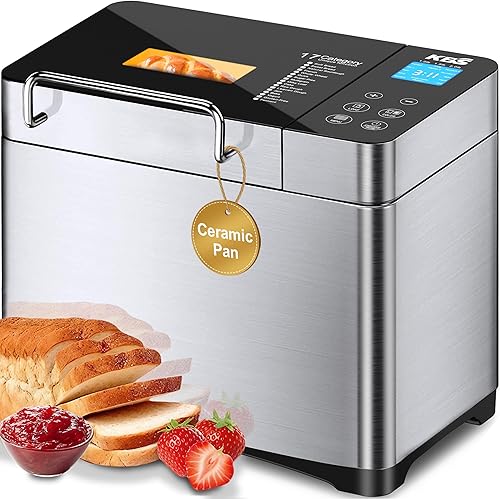
KBS Pro 710W 17-in-1 Bread Maker packs the most features per dollar of anything in this lineup. It has 17 programs — including sourdough, yogurt, cake, and jam — plus a genuinely useful automatic fruit-and-nut dispenser that drops in mix-ins at the right moment so you’re not standing over the machine waiting for the beep.
The standout is the ceramic non-stick pan. Across owner reviews it releases loaves more cleanly than the PTFE-coated pans on cheaper machines and, more importantly, tends to hold up longer — scratched, flaking coatings are the number-one reason budget bread pans die early, based on how often that complaint shows up for lesser pans in this price bracket. The 710-watt heater is also associated with a strong, even rise on whole-wheat in owner reports, where lower-wattage machines sometimes struggle in a cool kitchen. This is the machine I’d recommend to someone who wants to grow into bread-making rather than outgrow their machine in a year.
The honest con: it’s a big, tall unit with a real countertop footprint — if you store appliances in a cabinet, measure first. The 17 presets also come with a learning curve; the manual is functional but terse, and several reviewers mention it takes a few loaves to dial in which program maps to the bread they actually wanted.
Neretva 20-in-1 Dual Heater — Best for even, hands-off baking
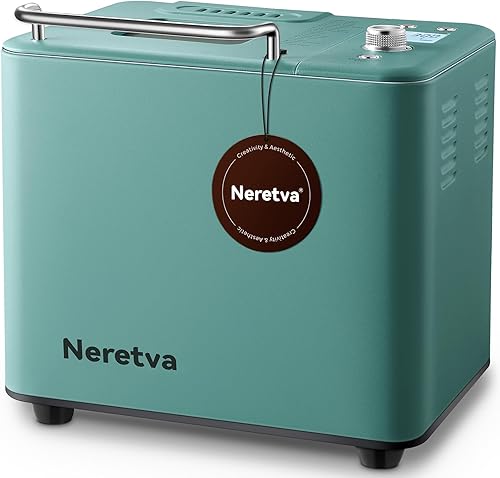
Neretva 20-in-1 Dual Heater Bread Maker solves the single most common complaint about cheap bread machines: pale, undercooked-looking tops. Most machines in this bracket heat only from the bottom, so the crown of the loaf never really browns. The Neretva adds a top heating element, and the difference shows up clearly in owner photos and reviews — loaves come out with an even color all the way around instead of a golden bottom and a beige top.
It also uses a ceramic pan, carries a generous 15-hour delay timer for waking up to fresh bread, and offers a full 20 programs. For someone who wants to load the machine, walk away, and get a bakery-looking loaf without babysitting the crust setting, this is the model reviewers most consistently praise for looks without babysitting. It’s the machine I’d pick if presentation matters — sandwiches, gifts, a loaf you’re proud to put on the table.
The honest con: the documentation is thin and a little rough in translation, so first-time bakers may need to lean on a couple of online recipes to get their bearings. The end-of-cycle beeper is also louder and more insistent than reviewers would like — not a problem by day, but noticeable if you run the delay timer to finish overnight.
Elite Gourmet Programmable — Best for gluten-free and small loaves

Elite Gourmet Programmable Bread Maker is the machine I recommend to smaller households and to anyone baking gluten-free. It offers three loaf sizes — including a 1-pound loaf that’s rare in this price bracket — so you’re not committed to baking a full 2-pound loaf you can’t finish before it goes stale. There are 19 presets, and the dedicated gluten-free program gets consistent praise in reviews for handling a rice-flour blend well, with a proper rise instead of the dense hockey puck gluten-free loaves often become.
It’s also the friendliest interface here for a true beginner — clearly labeled presets, a simple display, and a jam setting that’s genuinely fun for a Saturday morning. If you want to test the waters on bread-making without a big commitment, this is a low-risk on-ramp.
The honest con: it’s a lightweight, plastic-bodied machine, and multiple reviewers mention that during a vigorous knead on stiff dough it wanders across the counter enough that they keep a hand nearby or park it against a backsplash. Pushed to its full 2-pound loaf, results reportedly get less consistent than the Cuisinart — it’s happiest in the 1 to 1.5-pound range.
Amazon Basics Programmable Bread Maker — Best budget

Amazon Basics Programmable Bread Maker is the least expensive machine on this list, and it does the fundamentals without fuss. With 14 settings and up to a 2-pound loaf, it covers basic white, whole-wheat, dough, and a couple of specialty cycles. For a first machine — or a low-stakes way to find out whether you’ll actually use one — it’s hard to argue with the value.
In owner reviews, a straightforward white loaf on the medium setting comes out reliably well: good rise, soft crumb, nothing to complain about for everyday sandwich bread. It’s simple to operate, the controls are self-explanatory, and cleanup is quick.
The honest con: the pan coating and overall build feel thinner than the ceramic-pan machines, and the non-stick likely needs gentler handling to last. The crust also runs paler than the dual-heater Neretva even on the dark setting, so if a deep, crackly crust is your priority, this isn’t the machine. It’s a capable everyday loaf-maker, not a showpiece.
What to look for in a bread maker under $150
Once you know what actually matters, the choice gets simpler. These are the specs I’d weigh, roughly in order of how much they show up in owner feedback.
- Pan coating: a ceramic pan is the single upgrade most worth chasing under $150. It releases loaves cleanly and tends to survive longer than standard PTFE non-stick, which flakes with age and is the usual cause of a machine dying young.
- Heating design: most budget machines heat only from the bottom. A dual heater (top and bottom) browns the crown of the loaf, which is the difference between a bakery look and a pale top.
- Loaf sizes and crust settings: at minimum you want light/medium/dark crust control that’s actually distinct. Multiple loaf sizes matter a lot for small households — a 1-pound option keeps you from wasting bread.
- Gluten-free program: if you need it, look for a dedicated cycle rather than a generic one. Gluten-free dough behaves differently and benefits from a purpose-built knead-and-rise timing.
- Dough-only mode: even if you love machine loaves, a dough cycle lets you make pizza dough, rolls, and hand-shaped loaves — the machine does the kneading and first rise, and you finish in the oven.
- Footprint and noise: these machines are tall and can be loud during kneading. If you store it in a cabinet or bake early while others sleep, check dimensions and read the noise notes.
A bread maker is only one piece of a well-equipped kitchen. If you’re still building out the basics, my guide to the best small kitchen appliances puts a machine like this in context with the other countertop tools worth the space.
Bread maker vs. stand mixer for bread
This is the question I get most often, so it’s worth a straight answer. A bread machine is a hands-off, all-in-one device: it kneads, proofs, and bakes inside one sealed bucket, which is why it’s so forgiving for beginners and so convenient on a busy weeknight. The trade-off is that you’re locked into a tall, cylindrical loaf with a paddle hole in the bottom.
A quality stand mixer with a dough hook gives you far more control — any loaf shape you want, artisan boules, braided challah, big double batches — but you’re doing the shaping, proofing, and oven-baking yourself. If you want fresh sandwich bread with almost no effort, buy the machine. If you want to actually learn to bake and shape bread by hand, the mixer (paired with a good oven) is the better long-term tool. Plenty of people keep both. A capable food processor can also knead certain doughs in seconds if counter space is at a premium.
Who should (and shouldn’t) buy a bread maker
I try to talk people out of gear they won’t use, so here’s the honest cut. A bread machine is a great buy if you eat sandwich bread regularly and hate paying bakery prices, if you want the smell of fresh bread on a delay timer in the morning, if you have dietary needs (gluten-free, low-sodium, controlled ingredients) that store bread doesn’t meet, or if you simply find the ritual relaxing. It also pays for itself surprisingly fast if you’re currently buying specialty loaves.
Skip it if you only bake bread a few times a year — a sheet pan and a no-knead recipe will do the job for free. Skip it too if you’re chasing true artisan, open-crumb, crusty sourdough as your main goal; a machine’s sealed bucket can’t replicate a hot Dutch oven, and you’ll be happier with a mixer or hand-kneading. And if counter and cabinet space is genuinely tight, be realistic — these are big machines, and a bread maker you have to wrestle out of a cupboard is a bread maker you won’t use. If you do decide it earns its footprint, the loaf pairs nicely with soups and stews from my weeknight Instant Pot recipes.
Frequently asked questions
Can you make good bread in a machine under $150?
Yes. For everyday sandwich bread, whole-wheat, and enriched loaves, the machines in this bracket bake genuinely good results — especially the ceramic-pan and dual-heater models. Where they fall short of a $300 machine is refinement: crust depth, mixing consistency, and long-term build quality. For most home cooks, a good sub-$150 machine is all you need.
Why does my bread machine loaf have a hole in the bottom?
That’s the kneading paddle. It stays in the pan through baking, so it leaves a hole when you remove the loaf. It’s normal for every machine in this category. Some models let you remove the paddle before the final rise to shrink the hole, but on most budget machines you just live with it — or slice around it.
Are ceramic bread pans better than non-stick?
Based on owner reviews and spec comparisons, yes. Ceramic pans release loaves cleanly and tend to hold up better over time than standard PTFE non-stick coatings, which scratch and flake with age. Since a worn-out pan is the most common reason a budget machine gets retired, a ceramic pan is one of the best value upgrades you can get under $150.
How long does a bread maker take to bake a loaf?
A standard cycle runs roughly three to four hours from start to finish, including kneading, rising, and baking. Most machines also have a “rapid” or “express” cycle that finishes in about an hour and a half, though the texture and rise won’t be quite as good. The delay timer lets you load ingredients the night before and wake up to a finished loaf.
The bottom line
If you want one machine that just works, the Cuisinart CBK-110 is the most consistently recommended loaf-maker under $150. If you’d rather have the most features and a longer-lasting ceramic pan for the money, the KBS Pro 17-in-1 is the value pick. Want the best-looking crust with zero babysitting? The dual-heater Neretva. Baking gluten-free or small loaves, the Elite Gourmet. And on the tightest budget, the Amazon Basics covers the fundamentals without drama. Any of the five will get you out of the store-bread rut — pick the one whose strengths match how you actually bake.