Back-to-College Kitchen Starter Pack: A $150 Budget That Actually Works
Packing for college means making a hundred small decisions, and the kitchen is where most starter lists fall apart. They either hand you a 40-item spreadsheet you will never finish buying, or they skip the things that actually make food happen. I wanted to fix that, so I built one tight kit — six items — that fits a roughly $150 budget and covers real cooking in a dorm or a first shared apartment.
Quick disclosure: some links below are affiliate links, which means I may earn a small commission if you buy through them, at no extra cost to you. That never decides what makes my list. I built this list by digging through verified-purchase reviews for every product here — what buyers praise, what they complain about again and again, and how the specs and price hold up against the alternatives — and I will tell you exactly where each one falls short. This is a starter pack for someone who wants to eat well without turning their tiny room into a full test kitchen.
The $150 kit at a glance
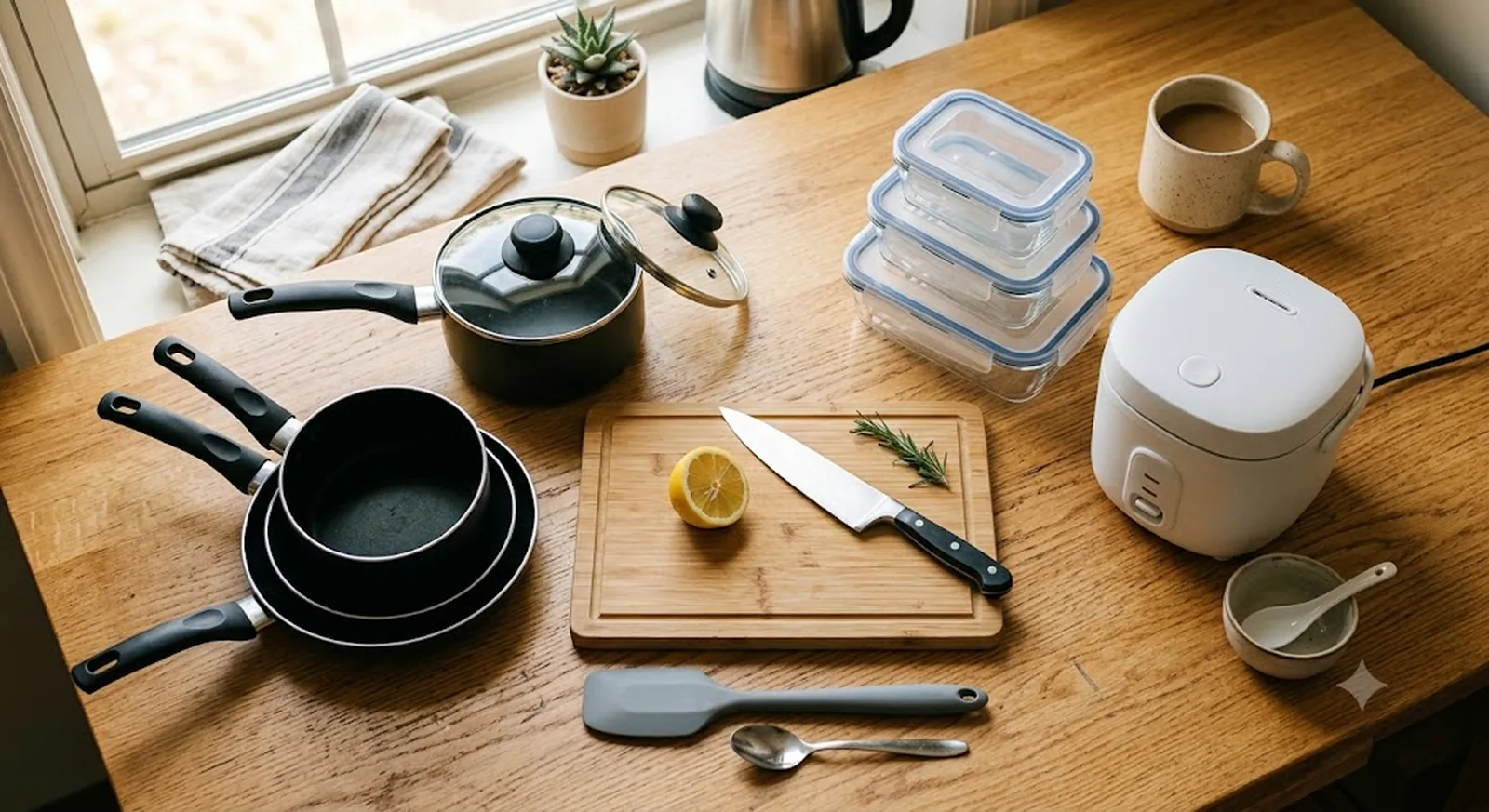
Here is the whole list in one breath. Six pieces, one budget, no filler:
- A non-stick cookware set — your pots and pans in one box
- One real chef’s knife — the single tool worth spending on
- A bamboo cutting board — a safe surface for that knife
- A silicone spatula set — heat-safe tools that will not scratch the pans
- Glass storage containers — for leftovers and grab-and-go meals
- A mini rice cooker — the one dorm-legal appliance that cooks a full meal
Buy those six and you can cook actual dinners, store the leftovers, and pack lunch for a 9 a.m. lecture. Everything below explains why each one earned its spot, and where I would spend more later once the budget loosens up.
How I built a $150 kit: the splurge-versus-save logic
A budget this tight only works if you are honest about where quality matters. My rule is simple: spend on the two tools your hands touch every single time you cook, and save everywhere the difference is mostly marketing. In practice that means the knife gets the biggest slice of the budget, the cookware set gets the second-biggest, and the other four pieces are chosen to be cheap without being disposable.
Why the knife? Because a dull, badly balanced blade is the fastest way to give up on cooking. A student who dreads chopping an onion orders takeout instead. A good knife makes prep feel quick, which is the whole game when you have twenty minutes between classes. The cookware set matters next because non-stick is what lets a beginner cook eggs, pasta, and stir-fries without a disaster stuck to the bottom of the pan. Everything else — the board, the spatulas, the storage, the little cooker — is supporting cast, and supporting cast should be affordable. If you want the fuller reasoning behind a minimalist build, I laid it all out in the only kitchen tools you actually need.
The dorm-rules reality check (read this before you buy an appliance)
Before you get excited about a hot plate or a two-burner induction cooktop, check your housing contract. Most dorms ban open heating elements and anything with an exposed coil, because those are a genuine fire risk in a small shared building. What is almost always allowed: a microwave (often provided) and a single enclosed, cool-touch countertop appliance like a rice cooker or an electric kettle. That restriction is exactly why my sixth pick is a covered mini cooker and not a portable stove. If your room doesn’t come with a microwave, my best microwaves under $100 for small kitchens showdown picks one that fits a dorm’s worth of counter. And for the other move-in staple, I put five compact refrigerators through a noise-and-capacity showdown in my dorm mini fridge guide.
If you are moving into a first apartment instead of a dorm, you have a real stove, and the math changes a little. You can lean harder on the cookware set and skip or upgrade the mini cooker. I cover that fuller apartment build, tier by tier, in my kitchen essentials for your first apartment guide, which is the natural next step once you outgrow this six-piece kit.
The 6 essentials, one by one
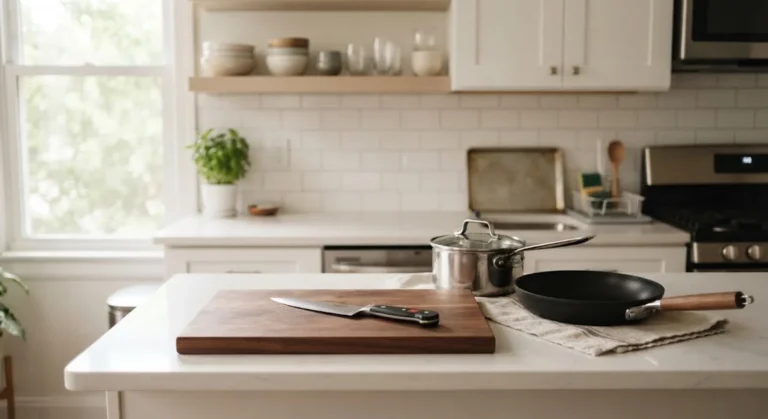
Amazon Basics 15-Piece Non-Stick Cookware Set — your pots and pans in one box

This is the workhorse of the kit. One box gives you a saucepan, a couple of frying pans, a stockpot, lids, and a few starter utensils — basically everything a beginner needs to make eggs in the morning and pasta at night. Across the verified-purchase reviews, the non-stick surface comes up again and again as genuinely forgiving: eggs slide, cleanup is a rinse, and the stay-cool handles mean you are not hunting for a towel every time you move a pan. For a student who has never owned cookware, the fact that it all arrives together and matches is worth a lot of decision fatigue saved.
The honest con: non-stick coating is a consumable, not a lifetime purchase. Use this set with metal utensils or crank it to high heat under an empty pan and the coating will wear within a year or two. It is also not induction-compatible, so if your apartment has an induction cooktop, it will not work. For a dorm hot-plate-free life or a standard electric or gas stove, though, it is the right amount of pan for the money. When you are ready to trade up to something that lasts a decade, my best budget cookware sets under $100 roundup is where I would start.
Victorinox Fibrox Pro 8-Inch Chef’s Knife — the one tool worth spending on

If you buy nothing else on this list at full quality, buy this. The Victorinox Fibrox is the knife I recommend to every beginner because it punches so far above its price that professional kitchens use it too. It is Swiss-made, holds a keen edge, and the grippy handle stays secure even when your hands are wet. Reviewers who have owned one for years report it still takes an edge in seconds, even after seasons of onions, squash, and chicken. One genuinely good knife replaces an entire drawer of flimsy ones, which is exactly the kind of consolidation a small space rewards.
The honest con: it is plain. The molded plastic handle looks utilitarian next to prettier forged knives, and there is no matching block or gift-box presentation. It is also labeled dishwasher safe, but I would ignore that — hand-wash and dry it to protect both the edge and the handle. Looks and marketing aside, nothing at this price cuts better. Pair it with the board below and you have a real prep station.
Hiware 18″ x 12″ Bamboo Cutting Board — a safe surface for that knife

A good knife needs a good surface, and cutting straight on a dorm desk or a cheap flexible mat is how edges get chipped and fingers get nicked. This bamboo board gives you a large, stable, sturdy area with a juice groove that catches the runoff from a tomato or a cooked roast, which keeps your counter clean. Bamboo is dense and naturally water-resistant, so it holds up to daily use far better than a thin plastic sheet. Buyers who size up to a board this large consistently say the extra real estate means they are not constantly clearing chopped onion to make room.
The honest con: it is big and it is heavy. In a shoebox dorm cabinet, an 18-inch board eats shelf space, and you will need to hand-wash it and re-oil it occasionally rather than tossing it in a dishwasher. Bamboo is also slightly harder on a blade than a soft end-grain wood board, so your knife needs a touch-up a little sooner. For durability and price, though, it is the board I would hand a new cook.
DI ORO Silicone Spatula Set — heat-safe tools that will not scratch the pans

Here is where the non-stick set and the spatulas work as a team. If you stir eggs or scrape a pan with a metal fork, you will gouge the coating and shorten its life. This three-piece silicone set solves that: the heads are soft enough to protect the pans but firm enough to fold, scrape, and serve. They handle high heat without melting, they are one solid piece so food does not get trapped in a seam, and they wipe clean in seconds. For a beginner, having the right tool sitting next to the stove is what keeps the cookware alive.
The honest con: an all-silicone head flexes, so when you are trying to pry a stuck, browned bit off the bottom of a pan, a stiff turner would do it faster. And a three-piece set does not include a slotted metal-free turner for flipping a burger or a fish fillet, so you may add one later. As a first set that protects your pans, though, it covers the daily jobs well. These pair naturally with the budget gadgets I rounded up in my best kitchen gadgets under $30 guide if you want to round out the drawer.
Pyrex Simply Store 12-Piece Glass Container Set — leftovers and grab-and-go meals

Cooking on a student schedule means cooking once and eating three times, and that only works if you can store food safely. This Pyrex set gives you nested glass containers in three useful sizes, and glass is the right call here for one big reason: you can reheat straight in it. No transferring a portion to a bowl, no melted-plastic worry in the microwave. Long-term owners consistently report that the glass shrugs off tomato sauce, reheated curry, and freezer time without staining or holding odors the way cheap plastic does. For a dorm, being able to batch a pot of chili and portion it out for the week is a quiet superpower.
The honest con: glass is heavy and it can chip or crack if you drop a container on a hard floor, which happens in a busy shared kitchen. The plastic lids also seal well but are not fully leakproof for thin liquids, so I would not toss a soup-filled one loose in a backpack. If you want a deeper look at leak-tested options for commuting, I compared several in my best reusable food storage containers guide. For everyday fridge-to-microwave duty, this set is the safe, sensible pick.
Dash Mini Rice Cooker — the one dorm-legal appliance that cooks a full meal

This is the piece that turns a microwave-only room into a place you can actually cook. A mini rice cooker is enclosed and cool-touch, which keeps it on the right side of most dorm rules, and it does far more than rice. Owners report using cookers like this for oatmeal, quinoa, steamed grains, and even a quick single-serve soup — add ingredients, press one button, and walk away to study. The removable ceramic non-stick pot rinses clean, and the keep-warm function means dinner is ready whenever you close the textbook. For one person, this is the most useful appliance you can own that will not violate a housing contract.
The honest con: it is small — a two-cup capacity is built for one, so it will not feed a study group, and if you overfill it with starchy rice it can bubble over the rim. There are no smart presets or fancy timers either; it is a one-switch machine. But that simplicity is the point in a dorm, and if you later want a bigger, more capable countertop lineup, my best small kitchen appliances guide covers the upgrades worth saving for.
What to skip (and why)
The fastest way to blow a $150 budget is to buy things that look essential in a store aisle but sit unused in a cabinet all semester. Based on the recurring complaints in the reviews, these are the categories I would leave off a first college list entirely.
- Knife block sets. A 15-piece block looks impressive, but most of those blades are thin filler, and the set costs more than one great knife. Buy the Victorinox above and add a small serrated knife later if you bake bread.
- Full-size stand mixers or big multi-cookers. They are wonderful and they are enormous. A dorm has no room and often no legal outlet load for them. Save that money for after graduation.
- Single-use novelty gadgets. Avocado slicers, banana cutters, quesadilla makers — they each do one thing your chef’s knife already does. They are clutter with a price tag.
- Cheap dinnerware sets you will replace. A single microwave-safe bowl, plate, and mug from a discount store covers you until you know your real space. No need to buy service for eight.
Skipping these four categories is usually what keeps the whole kit inside the $150 line. The goal is not to own the most kitchen stuff on your floor; it is to own the pieces you will reach for every day.
How the kit grows: dorm to first apartment
Think of these six pieces as the foundation, not the finish line. The knife, board, spatulas, and storage all move with you into a real apartment unchanged — they are the tools you keep for a decade. What changes is the cooking surface: once you have a full stove and a little more counter, you trade up the non-stick set for something more durable and add a couple of appliances that were off-limits in the dorm. That is a natural, budget-friendly progression, and it means nothing on this list is money wasted.
When you hit that stage, my first-apartment kitchen essentials guide breaks the next build into $100, $200, and $500 tiers so you can grow at your own pace. Start here, cook real meals this semester, and upgrade the pieces that earn it.
Frequently asked questions
Can you really cook in a dorm without a stove?
Yes, more than you would think. Between a microwave and one enclosed appliance like the mini rice cooker in this kit, you can make grains, oatmeal, steamed vegetables, eggs, pasta, and simple soups. The trick is choosing recipes built around those two tools instead of trying to fake a full range. Meal prepping on a weekend and reheating in the glass containers stretches that even further. For twenty specific meals built around exactly this kind of five-tool, no-stove setup, see my dorm cooking 101 guide.
Is one good knife really worth it over a cheap set?
Every time. A cheap ten-piece set gives you ten dull, poorly balanced blades that make cooking a chore. One well-made chef’s knife handles almost every task — chopping, slicing, dicing, mincing — and it does each one better and more safely. A sharp knife is actually safer than a dull one, because it goes where you aim it instead of slipping. For a beginner, the single knife is the higher-confidence buy.
How do I fit all of this in a tiny kitchen?
Nest what you can and store vertically. The cookware set stacks with its own lids, the glass containers nest inside each other, and the board can stand on its edge in a cabinet or beside the fridge. Keep the knife on a magnetic strip or in an in-drawer guard so the edge stays protected. The mini cooker is small enough to live on a shelf and only come out at mealtime.
What should I add first once I have more money?
A small cutting-and-prep upgrade goes furthest early on: a second smaller knife, a few budget gadgets you actually reach for, and a sturdier pan or two. After that, an appliance that fits your cooking style — an air fryer, a blender, or a larger multi-cooker — is the next real jump. Let how you actually cook, not the store display, decide the order.
The bottom line
A great college kitchen is not about owning the most gear; it is about owning the right six things and knowing how to use them. Spend on the knife and the cookware, keep the board, spatulas, storage, and mini cooker affordable, and skip the novelty clutter. Do that and roughly $150 buys a setup that will carry you from a first dorm all the way into a real apartment — cooking actual food the whole way. Start with these six, and build from there as your space and your skills grow.
Packing lunches for class days? Round out the starter pack with one of the best bento-style lunch containers for adults — five review-vetted picks that survive backpack commutes.