Slow Cookers vs. Multi-Cookers in 2026: Which One Belongs on Your Counter?
Two appliances get shoved into the same “set it and forget it” drawer of kitchen advice, and that mix-up costs people real money every year. A slow cooker and a multi-cooker overlap on maybe a third of what they actually do, and buying the wrong one means either an appliance that can’t finish half your recipe list, or one so over-built for your habits it never leaves the box. As an Amazon Associate, I earn from qualifying purchases — this costs you nothing extra, and it’s how I fund comparing gear against real buyer-review data instead of press releases.
In brief: buy a dedicated slow cooker if you want the cheapest, simplest path to a done-by-dinner braise and don’t mind a 6-to-10-hour wait. Buy a multi-cooker (a pressure-and-slow-cook combo like the Instant Pot Duo or Ninja PossibleCooker) if you want the slow-cook option on lazy Sundays and a 45-minute weeknight rescue on the nights you don’t. The rest of this guide is about which of those two nights describes your week more often.
What actually separates a slow cooker from a multi-cooker
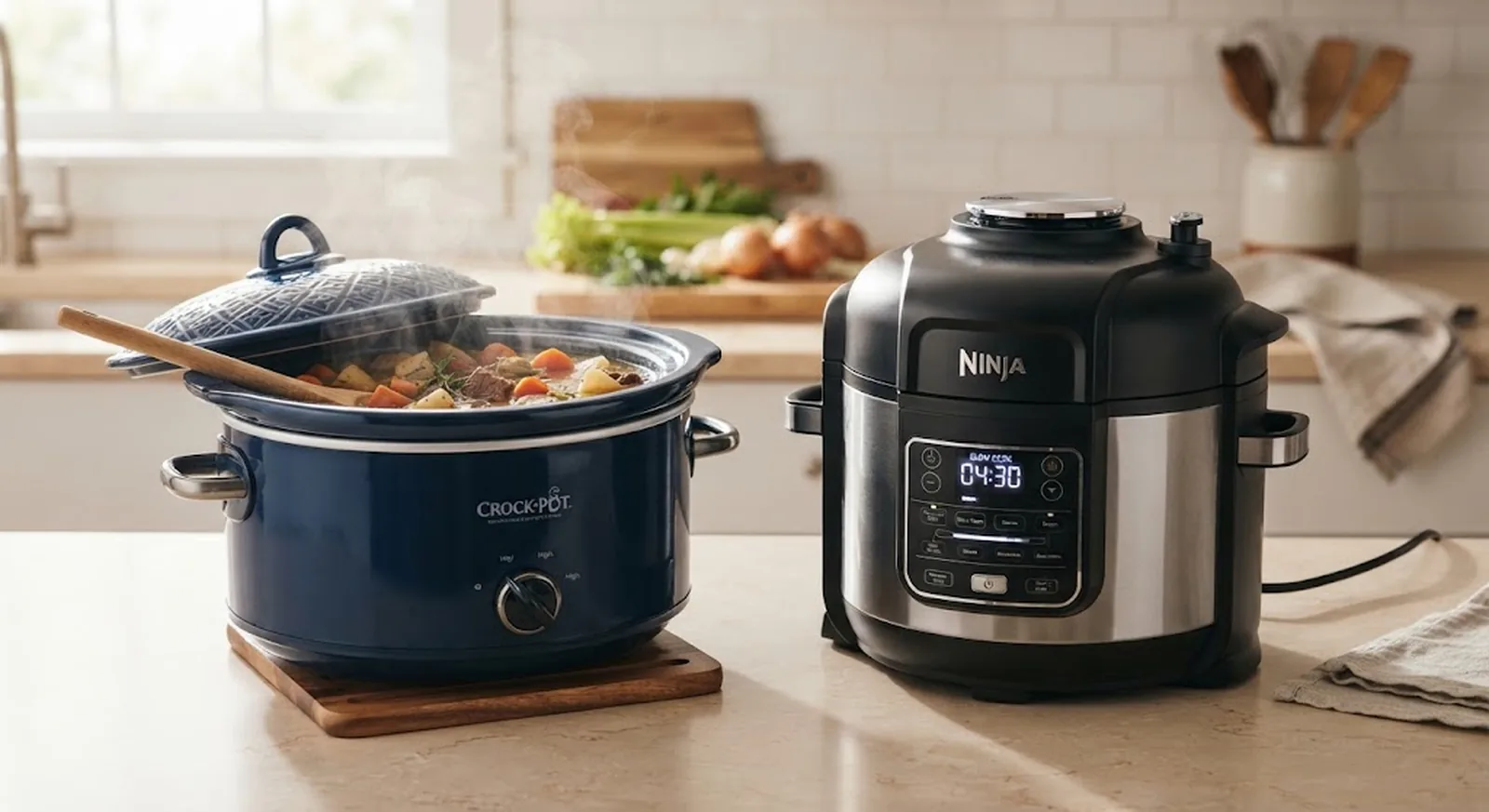
A slow cooker is a simple machine: a low-wattage heating element wrapped around a ceramic or stoneware insert, cooking food gently through steady, indirect heat over many hours. There’s no seal, no pressure, and often no more than a dial with Low, High, and Warm. It’s the appliance equivalent of a slow, patient friend.
A multi-cooker is a countertop pressure cooker that grew extra jobs. At its core is a locking lid and a sealed inner pot that traps steam to cook under pressure, which is what makes a 90-minute pot roast possible in 35 minutes. But nearly every modern multi-cooker — the Instant Pot and Ninja PossibleCooker among them — also includes a slow-cook setting, a sauté/searing function, rice, steam, and often yogurt. That overlap in features is exactly why buyers keep asking whether they need one appliance or both.
If you already own a dedicated pressure cooker and want the deeper stovetop-vs-electric breakdown, I cover that separately in my guide to the best pressure cookers for beginners. This guide is about the broader, more common decision: slow cooker, multi-cooker, or do you actually need both.
The difference between a slow cooker and a multi-cooker, side by side
The cleanest way to see the difference between a slow cooker and a multi-cooker is to line them up on the things people actually complain and rave about in verified-purchase reviews: how long dinner really takes, how much attention the pot needs, and what else it can replace on your counter.
| Factor | Slow Cooker | Multi-Cooker |
|---|---|---|
| Typical cook time | 6–10 hrs Low, 3–5 hrs High | 8–60 min at pressure + 10–20 min ramp/release |
| Attention required | None — walk away for the day | Some — venting and pressure-release steps to learn |
| Browning/searing | Weak or absent on most models | Built-in sauté mode on the same pot |
| What it replaces | Just itself | Pressure cooker + rice cooker + steamer, often + slow cooker |
| Learning curve | Near zero — a dial and a lid | Moderate — pressure release intimidates first-timers |
| Typical price | $25–$75 | $70–$180 |
| Best for | Unattended all-day cooking, tough cheap cuts, gifts | Weeknight speed, small kitchens, one-appliance versatility |
Notice what the table doesn’t say: neither appliance is objectively “better.” A slow cooker and a multi-cooker are solving for opposite constraints — one trades time for zero effort, the other trades a little bit of a learning curve for getting your evening back.
The one thing a dedicated slow cooker still does better
Buyer reviews on both slow cookers and multi-cookers converge on the same point once you dig past the star ratings: a dedicated slow cooker’s wide, shallow ceramic insert and low, steady wattage produce a genuinely gentler heat than a multi-cooker’s narrower pot running its slow-cook setting. That matters most on the appliance’s signature move — an 8-hour, walk-out-the-door pork shoulder or a whole chicken that falls off the bone. Slow cookers also win on simplicity for anyone who finds a sealed, pressurized lid intimidating; there’s no valve to check, no “Burn” warning to troubleshoot, and cleanup is usually just the removable stoneware crock in the dishwasher.
Price reinforces this. A perfectly capable manual slow cooker costs less than a mid-tier multi-cooker’s accessory kit, which is a real reason it’s still the appliance recommended for first apartments, dorm-adjacent kitchens, and gifts to a relative who wants dinner to happen without touching a manual.
Where a multi-cooker wins
A multi-cooker earns its higher price on two fronts: speed and counter consolidation. Because it cooks under pressure, a multi-cooker turns a 6-hour braise into a 35-to-45-minute one, which is the entire reason the Instant Pot became a weeknight staple rather than a weekend-only tool. It also does its own browning — sauté aromatics and meat right in the same pot before pressure cooking, instead of dirtying a skillet first — something almost no slow cooker manages well. And because most models also include a slow-cook setting, rice function, and a steam basket, a single multi-cooker can replace three or four single-purpose gadgets in a kitchen that’s short on counter space. If you’re building out a rotation of dinners around one, my Instant Pot recipes for weeknight dinners is the practical next stop.
Energy use, noise, and running cost
It’s easy to assume the appliance that finishes faster also costs more to run, but that’s not quite how it plays out. A slow cooker draws very little power — typically 150 to 270 watts, similar to a couple of light bulbs — but it draws that power for 6 to 10 hours straight. A multi-cooker’s heating element pulls considerably more wattage while it’s building pressure, but the whole job is usually done in well under an hour. Run the math over a full cook, and the two often land within pennies of each other; neither is the budget-wrecking choice some kitchen forums make it out to be.
Noise is the more noticeable difference day to day. A slow cooker is silent — there’s no fan, no valve, nothing to hear. A multi-cooker announces itself: a rising hum while it comes to pressure, and then a sharp hiss (or a loud, sustained whistle on quick release) that catches first-time owners off guard. If you’re cooking around a sleeping baby or a home office on a video call, that’s worth factoring in alongside cook time.
Can a multi-cooker replace a slow cooker entirely?
Partially. For a weeknight-sized batch — a pot of chili, a few chicken thighs in sauce, a pound of beans — the slow-cook setting on an Instant Pot or Ninja PossibleCooker does the job well enough that most owners never miss a dedicated pot. But recurring patterns in verified-purchase reviews for both machines point the same direction: the slow-cook mode on a multi-cooker tends to run hotter and less evenly than a purpose-built slow cooker’s wide, low-wattage element, because the pot itself was engineered around pressure-sealing, not gentle simmering. For a whole pork shoulder, an 8-pound roast, or anything that benefits from the wide, shallow shape of a true oval crock, buyers consistently report better, more even results from a dedicated slow cooker. The honest answer: a multi-cooker replaces a slow cooker for most weeknight cooking, but not for the biggest, most forgiving all-day braises.
Best slow cookers and multi-cookers, compared against real buyer reviews
These four were chosen by cross-referencing thousands of verified-purchase reviews for each model against listed capacity, price, and feature set. For every pick, I looked at the same signals: recurring complaints or praise about how evenly the pot heats, how the stated “quart” capacity holds up once you apply the two-thirds fill rule, and — for the multi-cookers — how owners describe the pressure-release and sauté functions after months of regular use, not just the unboxing week.
Crock-Pot 7-Quart Manual Slow Cooker — Best Budget Slow Cooker

This is the model that shows up in more American kitchens than any other slow cooker, and with over 62,000 ratings holding a 4.6-star average, it’s also the one every other slow cooker gets measured against. Three dial settings — Low, High, Warm — and a removable stoneware insert that goes straight into the dishwasher. The 7-quart size fits a 7-pound roast with room to spare, which covers Sunday dinner for a full table.
The honest con: it’s manual only — no programmable timer or auto-shift to Warm — so if you’re not home when the cook time ends, food sits on High until you get there. For anyone gone more than the recipe’s cook window, that’s a real limitation, not a minor one.
Crock-Pot 6-Quart Cook & Carry Programmable — Best Programmable Slow Cooker

This is the fix for the manual model’s biggest complaint: a digital timer that automatically drops to Warm when the cook time ends, so a 6-hour recipe doesn’t turn into an 11-hour one because you got stuck in traffic. Over 30,000 ratings hold a 4.6-star average, and the locking lid and carry handle are genuinely useful for potlucks and holidays — reviewers consistently mention transporting it fully assembled without a spill.
The honest con: the digital control panel is one more thing that can fail outside the stoneware’s lifespan — a small but recurring complaint theme is the display or timer button becoming unresponsive after a couple of years of regular use, while the crock itself outlives it.
Instant Pot Duo 7-in-1, 6 Qt — Best Multi-Cooker for Pressure + Slow Cook

The Instant Pot Duo is the multi-cooker that made the category mainstream, and with more than 170,000 ratings averaging 4.7 stars, it’s the model most online recipes — including my own weeknight Instant Pot recipes — are written for. Pressure cook, slow cook, rice, steam, sauté, yogurt, and warm all live behind labeled buttons, and the pressure-first design is what turns a 6-hour chili into a 35-minute one. The slow-cook setting is there when you want it, but the pot’s real strength is speed.
The honest con: the sauté function runs cooler than a real stovetop burner, so browning meat takes longer and won’t develop quite the crust a skillet would, and its slow-cook mode runs hotter than a dedicated crock’s — fine for a weeknight stew, not the pick for an 8-hour pork shoulder.
Ninja PossibleCooker PLUS 12-in-1, 8.5-Qt — Best Multi-Cooker for Slow-Cook-First Cooking

The PossibleCooker flips the usual multi-cooker priority: it’s built around slow-cooking a large, wide pot rather than a pressure-first cylinder, then adds sear, steam, sous vide, proof, and oven-safe-to-500°F functions on top — the nonstick pot goes straight from the cooker to the table. At 8.5 quarts with a 4.6-star average across nearly 7,000 ratings, reviewers specifically call out that its slow-cook results taste closer to a dedicated crock than a typical pressure-first multi-cooker’s does, because the wider pot and glass lid were designed around low, even simmering first.
The honest con: it does not pressure-cook, so it won’t give you the Instant Pot’s 35-minute chili — you’re trading pressure speed for a better slow-cook and searing experience. It’s also priced well into the premium multi-cooker tier, above a basic slow cooker’s entire cost, for a machine that’s really solving a different problem than the Instant Pot.
Which should you actually buy?
- You want the cheapest, simplest path to a done-by-dinner roast: a manual slow cooker like the Crock-Pot 7-Quart. Nothing to learn, nothing to break.
- You’re gone more than 8 hours some days: the programmable Crock-Pot Cook & Carry, so dinner shifts to Warm instead of overcooking while you’re stuck in traffic.
- Weeknights are the problem, not Sundays: a pressure-first multi-cooker like the Instant Pot Duo — that’s the appliance that turns a 6-hour recipe into a 35-minute one.
- You want one pot that slow-cooks as well as a dedicated crock but also sears and steams: the Ninja PossibleCooker, accepting that you’re giving up pressure-cook speed to get it.
- You already own one and are wondering about the other: most people who add a multi-cooker to a slow-cooker kitchen keep both — the crock for the all-day braise, the multi-cooker for the Tuesday-night rescue.
Frequently asked questions
Is a multi-cooker the same thing as a slow cooker?
No. A multi-cooker is built around a sealed, pressurized pot and usually adds a slow-cook setting as one of several functions. A dedicated slow cooker only slow-cooks, using a wider, lower-wattage design that most buyer reviews describe as gentler and more even for very long cooks.
Can a multi-cooker replace a slow cooker?
For weeknight-sized meals, yes — most owners never miss a separate pot. For an 8-hour pork shoulder or a whole chicken, a dedicated slow cooker’s wide, even heat still tends to win in verified-purchase comparisons.
Which is safer to leave running while I’m at work?
Both are designed for unattended cooking, but a programmable slow cooker that auto-shifts to Warm is the safer bet for a long, unpredictable day, since it won’t keep cooking past the recipe’s window the way a manual dial model will.
What size slow cooker or multi-cooker should I buy?
6 quarts covers most households of two to five and fits a 4-to-6-pound roast. Go up to 7–8 quarts only if you regularly cook for a crowd or batch-cook for the freezer; a smaller 3-quart pot suits one or two people and takes up a third of the counter space.
Do multi-cookers cook food differently than dedicated slow cookers, even on the same setting?
Often, yes. Because a multi-cooker’s pot is engineered to seal and hold pressure, its “slow cook” setting frequently runs a bit hotter and less evenly than a dedicated crock’s wide, low-wattage element — a pattern that shows up repeatedly in owner reviews for both the Instant Pot and Ninja PossibleCooker.
Is a Crock-Pot the same thing as a slow cooker?
“Crock-Pot” is a brand name that became shorthand for the whole category, the same way “Instant Pot” is often used loosely for any electric multi-cooker. Every Crock-Pot is a slow cooker, but plenty of slow cookers — from Hamilton Beach, BLACK+DECKER, and others — aren’t Crock-Pots.
Do multi-cookers use more electricity than slow cookers?
Not meaningfully. A multi-cooker’s element draws more power during the ramp-up to pressure, but for a much shorter total run time than a slow cooker’s many hours on low wattage. Measured per meal, the two typically end up close enough that running cost shouldn’t be the deciding factor.
The bottom line
A slow cooker and a multi-cooker aren’t really competing for the same job — one buys you zero-effort hours, the other buys back your weeknight. If your week is mostly Sunday-plan-ahead cooking, start with a dedicated crock like the Crock-Pot 7-Quart. If Tuesday-at-6-with-nothing-defrosted is your actual problem, the Instant Pot Duo earns its counter space fast. For where either fits alongside everything else you’re considering, see my guide to the best small kitchen appliances, and if a pressure cooker specifically is still the open question, my beginner’s guide to pressure cookers walks through stovetop versus electric in more depth.