How Long Does Non-Stick Coating Last? The Honest Answer (And 5 Signs Yours Is Done)
As an Amazon Associate, Kitchaneers may earn from qualifying purchases made through links in this post, at no extra cost to you.
There’s a myth I hear constantly: “If you take care of a good non-stick pan, it should last forever.” Here’s the truth nobody printing “lifetime warranty” on a box wants to say out loud: non-stick coating is a consumable. It wears out the way tires wear out — slower if you treat it well, faster if you don’t, but it always wears out.
So how long does non-stick coating last? For most pans, two to five years. Budget ceramic pans can fade in under a year of daily cooking. A well-made, multi-layer PTFE pan that’s babied can push past five. But “forever” isn’t on the menu, and pretending it is leads people to keep cooking on pans that stopped doing their job years ago.
Here’s exactly how long each type lasts, the 5 signs your coating is done, and the habits that genuinely double a pan’s life.
The Myth: “A Good Non-Stick Pan Should Last Forever”
The myth survives because it’s half true. The pan — the aluminum or stainless body — can last decades. The coating can’t. Non-stick coatings are microscopically thin layers (PTFE is typically applied at 20–40 microns; that’s roughly half the width of a human hair), and every wash, every spatula pass, and every heat cycle wears them down a little.
Industry sources are surprisingly honest about this when you dig: the Cookware and Bakeware Alliance puts a quality multi-layer coating at five to seven years under normal home use, while most mainstream testing (including America’s Test Kitchen) lands on a more conservative two to five. Ceramic-type coatings degrade faster — one to two years of regular use is typical, because the silica-based surface loses its slick layer to heat rather than abrasion.
Notice what’s not in that range: forever. Not even close.
Part of the confusion is warranty language. “Lifetime warranty” on a non-stick pan covers the pan body and manufacturing defects — not coating wear. Read the fine print on almost any brand and you’ll find coating degradation listed as normal wear and tear, excluded from coverage. The manufacturers themselves are telling you the coating is a consumable; the marketing just says it more quietly than the front of the box.
This is exactly why we evaluate pans by coating-per-dollar over their realistic lifespan rather than by warranty promises — the warranty covers warping and loose handles, not the part that actually wears out.
How Long Non-Stick Coating Really Lasts (By Type and Usage)
| Coating type | Daily cooking | 2–3× per week | Occasional use |
|---|---|---|---|
| Budget single-layer PTFE | 6–18 months | 1–2 years | 2–3 years |
| Quality multi-layer PTFE | 2–3 years | 3–5 years | 5+ years |
| Ceramic (sol-gel) | 6–12 months | 1–2 years | 2–3 years |
| Hard-anodized + PTFE | 2–4 years | 3–5 years | 5–7 years |
Two things jump out from that table. First, usage frequency matters as much as coating quality — a $25 pan used twice a week outlives a $90 pan used every day. Second, ceramic’s “healthier and newer” marketing hides the shortest lifespan in the category. (Whether ceramic or PTFE is the better buy is its own debate — I’m keeping that for a separate deep-dive.)
5 Signs Your Non-Stick Coating Is Done
1. The egg test fails
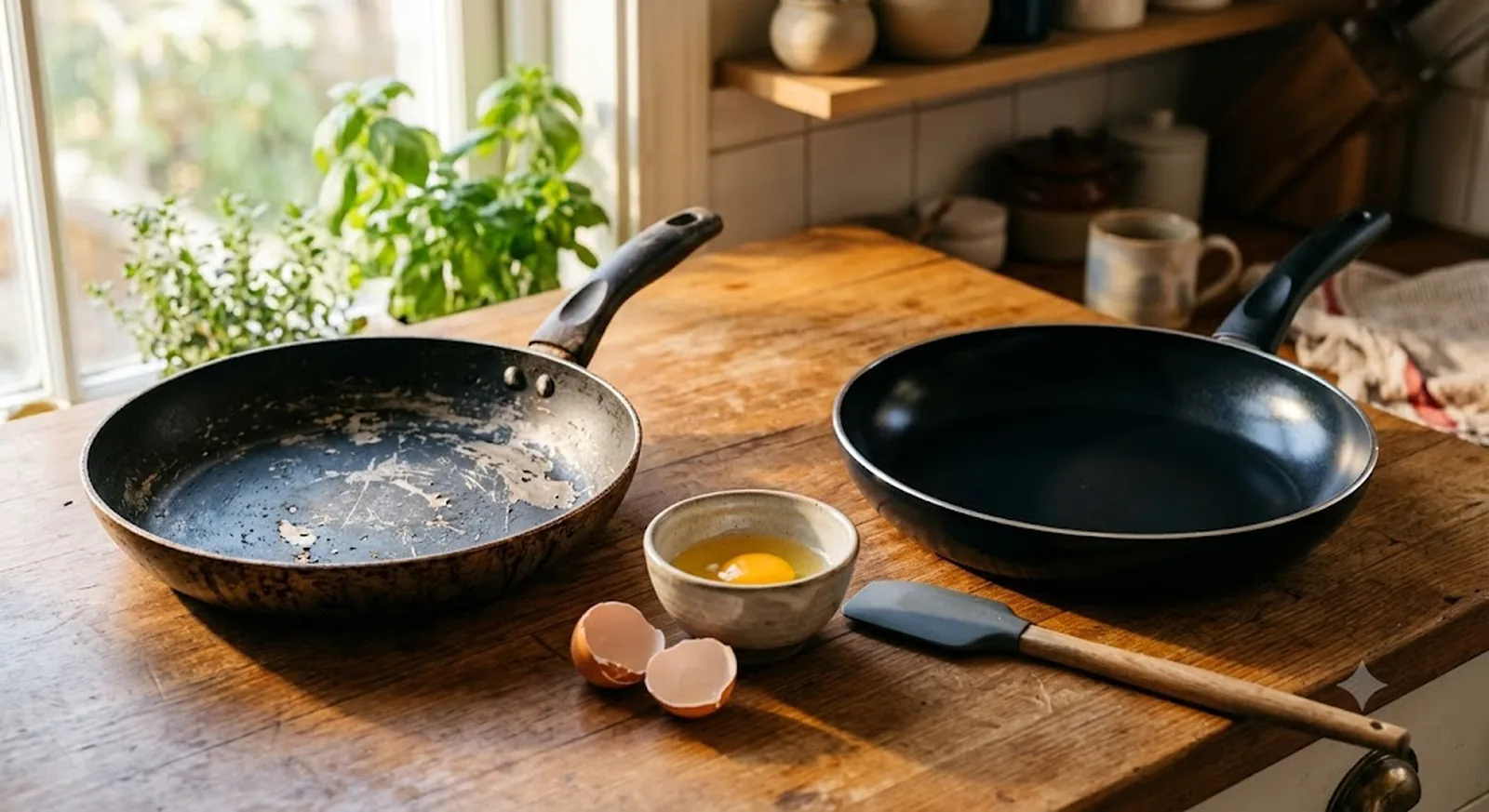
Crack an egg into the dry pan over medium heat — no oil, no butter. A healthy coating releases the egg with a gentle nudge. If it grabs, tears, or leaves a skin behind, the coating has lost its release layer. It’s the single most reliable at-home check you can run yourself.
2. Visible scratches or flaking
Fine surface scuffs are cosmetic. But if you can feel a scratch with your fingernail, or you see flecks of coating missing — especially in the center where your spatula lives — the coating is breaking down. On the safety question, the science is calmer than the internet: modern PTFE is chemically inert, and the PFOA processing chemical that caused the original scare was phased out of US cookware manufacturing by 2013. A flaked pan isn’t dangerous so much as finished — the exposed aluminum underneath can react with acidic sauces and turn them metallic-tasting.
3. Dark stains that won’t wash off
That brown, lacquered ring around the pan wall is carbonized oil — polymerized fat baked into the coating by high heat. Once it builds up, it’s rougher than the coating underneath, food sticks to it, and scrubbing hard enough to remove it takes coating with it. If a baking-soda paste and a soft sponge won’t lift it, the pan is on borrowed time.
4. Warping
Set the pan on a flat counter. If it rocks or spins, it’s warped — usually from thermal shock (hot pan straight under cold tap water). A warped pan heats unevenly, which cooks the coating in hot spots and accelerates breakdown. There’s no fixing this one.
5. It’s a pre-2013 pan
If a non-stick pan has been in your cabinet since the Obama first term, replace it regardless of how it looks. It predates the PFOA phase-out, and honestly, no coating that old has meaningful release left anyway.
What Actually Kills Non-Stick Coating (It’s Not Just Metal Utensils)
Everyone knows about metal spatulas. These three habits do more damage, faster:
High heat is killer number one. PTFE starts degrading above roughly 500°F — and an empty pan on high heat can blast past that in under three minutes. Every overheat permanently ages the coating, even if it looks fine afterward. Non-stick is a low-and-medium-heat tool, full stop. I covered this in my kitchen myths post — “preheat it on high like cast iron” is one of the fastest ways to ruin a pan.
Cooking spray is a slow poison. Aerosol sprays contain lecithin, which polymerizes into a sticky varnish at temperatures below the coating’s tolerance. It builds up in a layer that no normal washing removes. Use a teaspoon of oil or a refillable pump instead.
Thermal shock and the dishwasher. Rinsing a hot pan under cold water flexes the metal and micro-cracks the coating. Dishwasher detergent is abrasive and alkaline — even “dishwasher-safe” coatings age visibly faster in there. Thirty seconds of hand-washing buys you months of extra life.
How to Double the Life of Your Next Pan
The math on care is compelling. A $30 pan that dies in 18 months costs you $20 a year. The same pan treated well lasts three years — $10 a year. The same math holds up across full cookware sets, not just single pans, as covered in our breakdown of the real cost of cheap cookware. Here’s the routine that gets you there (the full version lives in our kitchen tool care guide):
- Medium heat maximum, and never preheat empty
- Silicone or wood utensils only
- Hand wash with a soft sponge once the pan has cooled
- Store with pan protectors (or a paper towel) between stacked pans
- Save non-stick for eggs, fish, and pancakes — use cast iron or stainless for searing (if you’d rather move that work to a pan that does last decades, here’s how to season a cast iron skillet)
When Replacement Beats Rescue: What I’d Buy
Once the egg test fails, no amount of care brings a coating back. These are the replacements and protection tools we recommend — all four selected based on durability testing and verified owner reviews.
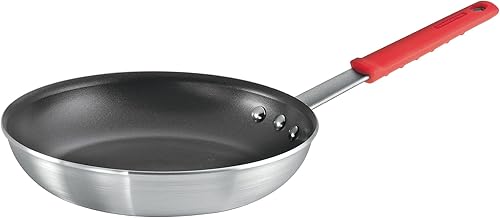
Tramontina Professional 10-Inch Non-Stick Fry Pan
A frequent top pick in non-stick durability testing and reviews — a heavy-gauge aluminum pan with a reinforced coating that reviewers report is still releasing eggs cleanly after a year of daily use. Restaurant kitchens buy these by the case, which tells you something. The con: the riveted red handle is comfortable but bulky, and it’s oven-safe only to 400°F — lower than the hard-anodized competition.

OXO Good Grips Non-Stick Pro 10″ & 12″ Set
The upgrade path if you’re replacing more than one pan: hard-anodized bodies, a three-layer coating that holds up well against scratching in durability testing, and some of the most comfortable handles in the category. The con: they’re heavier than the Tramontina, and the 12-inch is genuinely hefty with a full pan of food — cooks with wrist issues should size down.

DI ORO Silicone Spatula Set
The cheapest insurance for a new coating — 600°F-rated silicone heads on rigid cores, so they flip and scrape without scoring the surface. Owners consistently report the heads holding up for years without tearing or staining. The con: the flat spatula is stiffer than a classic thin turner, so sliding under delicate fried eggs takes a slightly steeper angle.

BOYAN Pot and Pan Protectors (Set of 12)
Stacking bare pans is the silent coating killer in small kitchens. These felt pads come in three sizes, and twelve of them are enough to cover a full set of pots and pans. The con: they’re thin felt, not padded neoprene — protection from stacking contact, not from tossing pans around in a moving box.
FAQ
Is a scratched non-stick pan safe to use? Small PTFE flakes are chemically inert and pass through the body without being absorbed — the practical problem is the exposed aluminum underneath reacting with acidic food and the pan simply not releasing anymore. Scratched means replace soon, not panic.
Can you re-coat a non-stick pan? Industrial re-coating exists for commercial cookware, but for home pans the cost exceeds a new pan. The “non-stick repair sprays” sold online are temporary waxes — they wash away within weeks. Replacement is the honest answer.
Does the dishwasher really ruin non-stick? Yes, gradually. Hot alkaline detergent dulls the release layer over months, even on “dishwasher-safe” pans. Hand washing is the single easiest life-extender.
How do I know if my pan is pre-2013? If you can’t remember buying it, treat it as pre-2013. The PFOA phase-out finished in 2013 in US manufacturing, so anything newer from a major brand is made without it.
How often should most people expect to replace a non-stick pan? Cooking daily on a mid-range pan: every 2–3 years. The egg test tells you when — the calendar is just a guideline.