What 90 Days of Kitchaneers Testing Taught Us: A Reader’s Recap
This post contains affiliate links. As an Amazon Associate, Kitchaneers earns from qualifying purchases — at no extra cost to you.
Kitchaneers has been live for a little over three months now, and in that time we’ve published dozens of buying guides, comparisons, and how-tos across appliances, cookware, gadgets, and kitchen organization. Enough readers have asked “so what have you actually learned?” that it felt like the right moment to step back and answer honestly.
This isn’t a highlight reel. It’s a recap of the patterns that kept showing up across our review analysis, the calls we’d make differently today, and a map of where to start if you’re new here. Every recommendation on this site is grounded in an analysis of real buyer reviews — verified-purchase feedback, recurring complaint and praise patterns, and how products actually hold up across price tiers — not a single household’s diary of what got used this week. That distinction matters, and it’s worth explaining before we get into what we found.
How We Actually Evaluate Kitchen Gear
Every roundup on Kitchaneers starts the same way: we pull the review data for every serious contender in a category — hundreds or thousands of verified purchases per product in the bigger categories — and look for the patterns that only show up at scale. A single five-star review tells you almost nothing. A recurring one-star complaint about a specific failure mode after four to six months of normal use tells you a lot.
We weight recent reviews more heavily than old ones, because manufacturers change suppliers and cut corners without changing the listing. We separate “this arrived damaged” complaints (a shipping problem, not a product problem) from “this stopped working after light use” complaints (a real signal). And we specifically look for the disagreements — the products with a loud, happy majority and a smaller, consistent minority describing the same failure — because that’s usually the most useful information in the whole review set for someone trying to decide if a product fits their specific use case.
That’s also why nearly every roundup includes at least one honest downside for every product we recommend, even the ones we rank first. If a page reads like every pick is flawless, that’s a sign the analysis wasn’t done carefully enough, not a sign the products are unusually good.
This approach has limits worth naming rather than glossing over. Review data skews toward people motivated enough to write something — usually the very happy or the very frustrated — and it says little about the quiet middle who bought a product, found it fine, and moved on. Newer products also simply have less data to work with than something that’s been on the market for three years, which is part of why we lean toward established models with a long review history when the evidence between two similar products is otherwise close. None of that makes the method wrong; it just means “grounded in buyer-review analysis” is a claim about how a recommendation was reached, not a guarantee that it’s the only right answer for every kitchen.
By the Numbers: Three Months at a Glance
Kitchen appliances and cookware make up the largest share of what we’ve published so far, which tracks with where the highest-stakes buying decisions — and the most affiliate-relevant purchases — tend to cluster. Buying guides, kitchen gadgets, and kitchen tips round out the rest, with a smaller but growing recipes section built around the appliances we’ve already covered in depth, like Instant Pot and cast-iron cooking. A handful of the earliest guides have already been revisited at least once as new review data came in, which is the pattern we expect to continue rather than a one-time cleanup.
The Categories Where Buyers Are Consistently Happiest
A few categories stood out over the last three months for having an unusually high ratio of praise to complaint, once you strip out the shipping-damage noise.
Vegetable choppers and prep tools are a good example. When we dug into our vegetable chopper comparison, the review data split cleanly along a line most buyers don’t think to check upfront: manual versus electric. Manual chopper buyers who complained almost always turned out to be trying to process large batches that the tool was never designed for; electric chopper buyers who complained were almost always frustrated by cleanup, not performance. Once you match the tool to the actual use case — small daily prep versus weekly batch cooking — satisfaction jumps noticeably in the review data.
Non-stick pans told a similarly clear story, but a more useful one. Digging into the coating-degradation complaints for our non-stick pan roundup, we found that most “this stopped being non-stick” reviews landed in a predictable window — and it correlated far more with metal-utensil use and dishwasher habits than with the specific pan people bought. That’s a case where the buying decision matters less than most readers assume, and the care routine matters more. We ended up folding a month-by-month degradation section directly into that guide because of it.
Blenders were the single biggest surprise. We didn’t expect a page about blenders to become one of the most-read pages on the site, but once we expanded our blender guide to properly separate use cases — smoothies, hot soups, nut butters, and frozen drinks each stress a blender differently — it was obvious the original version had been trying to answer four different questions with one answer. Motor wattage and jar material turned out to matter far less than which of those four jobs you’re actually buying for.
Salad spinners were the quiet standout of the whole recap. It’s a low-drama category with almost no marketing noise, and the review data reflects that: complaints are rare, specific (usually about a cracked bowl after being dropped, not a design flaw), and easy to sort by size once you know your own kitchen’s storage constraints. Expanding our salad spinner comparison into a proper size guide made the buying decision almost mechanical: match the capacity to your household size and shelf height, and satisfaction follows.
Where We Changed Our Mind
Not every page held up on a second, more skeptical pass, and we think that’s worth saying out loud rather than quietly editing around.
Our original pellet smoker guide was scoped entirely around “beginners,” which felt like the right angle when we wrote it. Looking at what people were actually searching for and reading around that page, it became clear the framing was too narrow — plenty of readers wanted a straightforward comparison of pellet smokers generally, with beginner guidance as one part of that, not the entire premise. We broadened that guide to serve both audiences instead of picking one and leaving the other underserved.
The bigger reconsideration was our original kitchen gadgets pillar page. It was structured as a single long list, which is a reasonable format for a lot of buying guides — but for a page meant to help someone quickly figure out what’s actually worth owning versus what’s a novelty item destined for a drawer, a flat list undersells the “worth it” judgment call that’s the entire point of the page. We restructured the gadgets guide around price tiers and added a curated “buy these first” shortlist, because burying the actual recommendation under 25 roughly-equal entries wasn’t serving anyone trying to make a decision in five minutes.
Neither of those changes happened because something was factually wrong the first time. They happened because reviewing our own work with the same scrutiny we apply to product reviews turned up gaps — and we’d rather fix a page than leave it as a monument to how we first approached it.
The Kitchen Upgrades Readers Ask About Most
A handful of categories generate a disproportionate share of reader questions, and they’re worth calling out directly if you’re deciding what to prioritize.
Grilling season questions consistently point back to grilling tool sets — specifically, whether a bundled set is worth it versus buying pieces individually. The review pattern here is consistent: bundled sets are worth it if you’re missing more than two or three of the core pieces, and not worth it if you already own a decent set of tongs and a thermometer and just want one more gadget.
Cookware upgrades cluster around two questions we get constantly: whether an enameled Dutch oven under $100 can actually compete with the premium brands, and whether a stand mixer under $300 holds up for regular baking or is a false economy. Both categories have a similar answer: yes, with a caveat. The budget options in both categories perform well for the first one to two years of normal home use; the gap versus premium options shows up mainly in long-term durability and warranty support, which matters more if you bake or braise multiple times a week than if it’s an occasional-weekend habit.
Coffee is its own category of reader question, usually some version of “what’s actually worth buying versus what’s marketing.” Our home-barista coffee guide breaks this down by brew style rather than by price, because the review data made it clear that satisfaction tracks much more closely with “did this match how you actually want to make coffee” than with how much people spent.
And a smaller but consistent thread of questions comes from people wondering if a specific splurge is worth it at all — the most common version being whether a name-brand stand mixer is worth the premium over a budget alternative, which we addressed directly and honestly in a dedicated piece rather than burying the answer in a roundup.
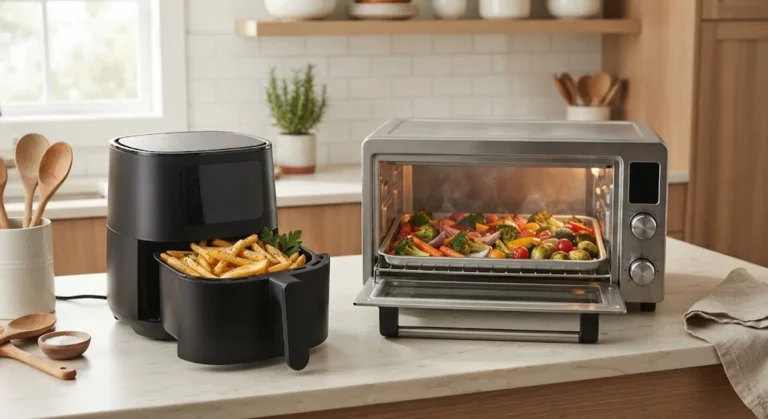
One more pattern worth calling out: the “which one do I actually need” comparison format keeps outperforming straight roundups by almost every measure we track. Our air fryer versus grill comparison is the clearest example — readers don’t want to be told “here are seven air fryers,” they want to know whether an air fryer or a grill is the right appliance for the way they actually cook, and a side-by-side answer to that question turns out to be far more useful than another ranked list. That’s shaped how we’ve approached newer guides across the site, and it’s a big part of why you’ll see more direct comparisons going forward instead of longer roundups.
What We’d Tell a Reader Starting From Zero
If you’re setting up a kitchen from scratch, the temptation is to buy everything at once. Our review analysis consistently argues against that. The complaint pattern across nearly every appliance category includes some version of “I bought this because it was on a list and never really use it” — and that’s not a product failure, it’s a planning failure.
Our original first-apartment kitchen essentials guide exists specifically to break that habit: it’s built around three budget tiers so you can see what a genuinely functional kitchen looks like at $100, $200, and $500, instead of defaulting to “buy the biggest list you can afford.” The small appliances pillar guide is the natural next stop once you know your budget tier, since it covers the handful of appliances — air fryer, a decent blender, a stand mixer if you bake — that show up across nearly every kitchen’s actual daily-use pattern, as opposed to the ones that show up mostly in gift guides.
The short version of three months of buyer-review analysis, if you only take one thing from this recap: buy fewer things, buy the ones that match how you actually cook, and expect to replace exactly one category of item — usually a non-stick pan or a cheap gadget — well before anything else in your kitchen wears out.
What’s Next for Kitchaneers
This site is going to keep getting reviewed the same way we review products: honestly, and with a willingness to change course when the evidence says we should. Over the next stretch, that means continuing to revisit older guides as review data accumulates, filling in comparison pieces for the “which one do I actually need” questions readers keep asking, and being upfront on the site itself about what’s been updated and why, rather than quietly rewriting pages.
If there’s a specific comparison or category you’d like to see covered, or a Kitchaneers recommendation that didn’t match your own experience, that feedback is exactly what shapes which pages get revisited next.
Frequently Asked Questions
How does Kitchaneers actually test products?
We don’t run a physical test lab. Every recommendation comes from a structured analysis of verified-purchase reviews for the serious contenders in a category — looking specifically for recurring complaint and praise patterns, how products hold up over time, and how satisfaction varies across price tiers and use cases.
Does Maya Sterling personally use every product on the site?
No individual can personally own and long-term test every product across dozens of kitchen categories, and we’re not going to pretend otherwise. The value of the site comes from synthesizing what hundreds of real buyers report, not from a single person’s opinion after a week of use.
How often is this recap — or any guide — updated?
Guides get revisited when new review data changes the picture, when a product is discontinued or replaced, or when reader questions make it clear a page’s framing needs to change, as described above with the pellet smoker and kitchen gadgets guides.
What’s the single biggest mistake you see buyers make?
Buying for a “someday” use case instead of a real one — the multi-function gadget bought for a recipe you’ll make twice a year, instead of the plainer tool you’ll actually reach for every week.
Where should I start if I’m new to the site?
Start with the kitchen essentials guide if you’re building a kitchen from scratch, or the small appliances pillar guide if you already have the basics and are deciding what to add next.
Do you ever recommend buying nothing at all?
Regularly, and we’d rather lose an affiliate click than pretend otherwise. Several guides on this site — the vegetable chopper comparison and the kitchen gadgets guide among them — explicitly call out situations where a tool most readers assume they need is a poor fit for how they actually cook, and say so directly rather than defaulting to a recommendation.