7 Kitchen Storage Mistakes That Are Quietly Wasting Your Space
Most cramped kitchens are not actually short on space — they are short on a plan. I’ve looked at hundreds of real kitchen photos and verified-purchase organizer reviews while researching this site, and the same handful of storage mistakes show up over and over, in kitchens of every size. None of them are dramatic. Each one just quietly wastes a few inches or a few minutes a day, and it adds up to a kitchen that feels smaller than it is. Disclosure: this post contains affiliate links. If you buy through them I may earn a small commission at no extra cost to you. Recommendations here are based on verified-purchase buyer reviews, spec comparisons, and price-tier comparisons, not just marketing claims.
Below are the seven mistakes I see most often, why each one happens, and the specific fix for each — including the exact product I’d point you to if you want to solve it this weekend instead of rethinking your whole kitchen. If you are furnishing a kitchen from scratch, start with my kitchen essentials for a first apartment guide first; everything here assumes you already have a working kitchen and just want to use it better.
What all seven have in common is that they’re not really about clutter — they’re about space that exists but was never assigned a job. A cabinet doesn’t announce that it has 4 unused inches above your plate stack, and a deep drawer doesn’t tell you that half of it has been empty for a year. You only notice once you start measuring and looking at the actual shape of the space instead of just the stuff in front of it. That’s the lens I used for every fix below: not “buy more organizers,” but “find the specific inch of dead space and give it a job.”
If you want a fast way to prioritize, do a two-minute walkthrough before reading further: open every upper cabinet and note whether there’s a visible gap above the contents, open every base cabinet and note whether you’ve reached into the very back of it in the last month, and open the pantry and count how many items are still in their original bag or box. Whichever answer bothers you most is the mistake to fix first — there’s no requirement to solve all seven in one weekend.
Mistake #1: Stacking plates and bowls instead of using the cabinet’s full height
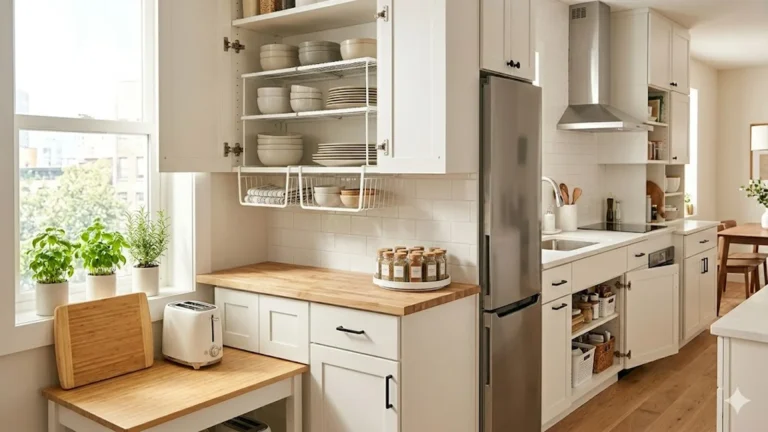
It happens because dish stacks get sized to whatever came in the box, not to the cabinet they live in. You unpack a set of plates, stack them as-is, and never revisit the arrangement again — even though the cabinet above the stack has 3 to 4 inches of dead air that nothing is using. Most upper cabinets have this gap, because dish stacks are sized for the shortest item, not the shelf. That gap is unused vertical storage you are paying rent or mortgage on. The fix is a stackable shelf riser that splits the cabinet into two usable levels instead of one tall one.

The SONGMICS Expandable Cabinet Shelf, Set of 4 is the one I’d grab first. Each riser expands to fit different cabinet widths, holds a second row of plates, mugs, or canned goods, and the metal legs are tall enough to slide a dinner plate underneath without scraping the shelf above it. Buyers consistently report that the legs do not wobble once weighted down, which is the usual failure point with cheaper risers, and several reviewers specifically mention using a set of four to split both an upper cabinet and a pantry shelf in the same order — a sign the design holds up across more than one use case.
The con: at full width extension the legs have slightly more flex, so I would not stack your heaviest stoneware on the top tier of a fully expanded riser. Keep the heavier pieces on the cabinet floor and lighter items up top.
Mistake #2: Keeping spices in whatever drawer or shelf had space
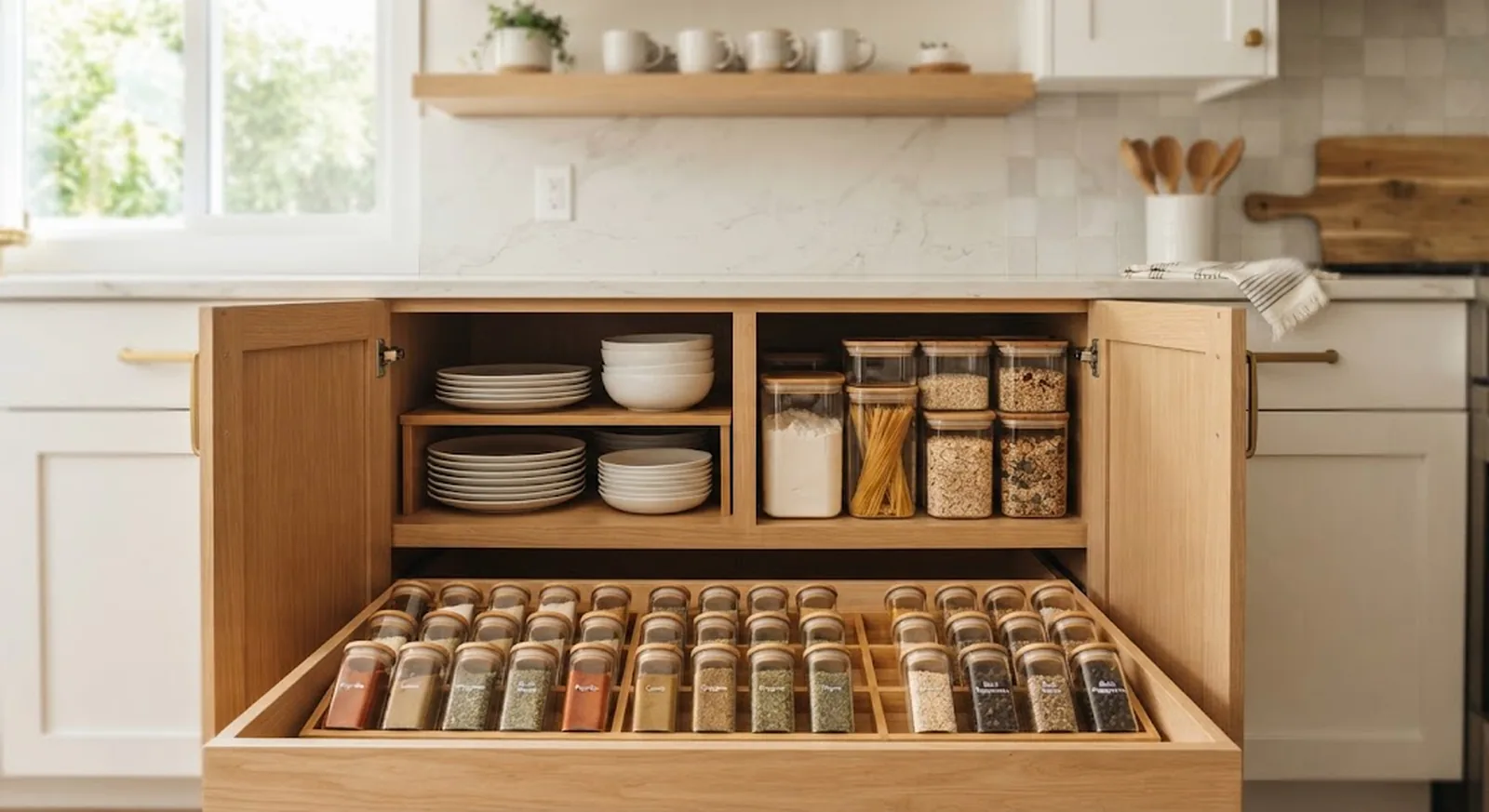
This one happens gradually: you buy a spice, use it twice, and it drifts toward the back of the shelf as new jars arrive in front of it. Spices stored upright in a cabinet get shoved to the back within a month, and once you can’t see a jar, you stop using it and buy a duplicate instead — which is how most kitchens end up with three half-used jars of cinnamon. The actual fix is not a bigger spice collection — it’s storing spices flat and labeled so every jar is visible at a glance, which I cover in more depth in my guide to spice organizers and racks.

The SpaceAid Bamboo Spice Drawer Organizer turns any standard drawer into a flat spice tray, with angled tiers so every label faces up. It’s the single change that stops the “which jar is the cumin” problem, and it fits a standard kitchen drawer without modification. Reviewers who switched from an upright cabinet rack to this flat-drawer layout specifically mention cooking with spices they’d forgotten they owned once everything became visible at once.
The con: it’s sized for standard spice jars (the squat round or square kind) — oversized restaurant-style containers or tall grinders will not sit flush in the tiers. Measure your tallest jar before you buy.
Mistake #3: Using a deep cabinet like it only has one usable row
Deep base cabinets are the biggest storage mistake in most kitchens, and it’s a human-nature problem more than a design one: reaching into the back of a dark, deep cabinet is uncomfortable, so you simply stop doing it. Whatever is in the front row gets used; everything behind it becomes a storage graveyard you dig through with a flashlight twice a year. The fix is a pull-out or slide-out shelf that brings the back row to you instead of asking you to crawl in after it — I go through more deep-cabinet fixes in my kitchen shelf organizers roundup.

The REALINN 2-Tier Pull-Out Slide Shelf, 2-Pack sits inside an existing cabinet shelf and glides forward on its own rails, no drilling required for most cabinet styles. It’s rated to hold cookware and small appliances, not just lightweight pantry goods, which is where cheaper slide trays tend to fail — buyer feedback repeatedly calls out being able to pull out a stack of heavy mixing bowls or a slow cooker without the rails binding, which is the exact complaint lodged against flimsier plastic versions.
The con: it needs a few inches of clearance above the shelf to fully extend without hitting the shelf overhead, so measure the gap in your specific cabinet before ordering — it won’t fit every configuration.
Mistake #4: Letting the utensil drawer become a junk drawer
A drawer with no internal structure is an invitation for everything homeless to land there. Without dividers, a utensil drawer slowly fills with everything that doesn’t have another home — rubber bands, takeout chopsticks, the one skewer you never use. Every time you open it, you’re digging, which is exactly the kind of small daily friction that makes a kitchen feel chaotic even when the rest of it is tidy. I compared several fixes for this in my best kitchen drawer organizers post, and this is the one I still recommend first.

The Pipishell Bamboo Expandable Drawer Organizer expands from roughly 13 to 19 inches via a center slider, so it fills a flatware or utensil drawer without the dead space a fixed tray leaves behind. Every tool gets a defined slot, which is what actually breaks the junk-drawer habit — not willpower.
The con: the open channel under the center slider can let very small items slip through underneath. Keep loose odds and ends in a dedicated small-parts tray instead of this one.
Mistake #5: Leaving pantry staples in their bulky original packaging
Packaging is designed to look good on a store shelf, not to stack efficiently on yours, so most people never question keeping food in it. A half-full bag of flour or a box of pasta is an awkward shape, wastes shelf space because boxes don’t stack cleanly, and lets product go stale faster once the original seal is broken. Decanting dry goods into uniform, stackable containers is one of the highest-impact changes you can make to pantry capacity — I go deeper on sizing and labeling in my posts on storage jars and canisters and budget pantry organization.

The Vtopmart 24-Piece Airtight Container Set covers most pantry staples in uniform rectangular shapes that stack and fit flush against each other, which is where you actually reclaim shelf space — not from any single container but from the uniformity across all of them. Verified-purchase reviews consistently flag the silicone-sealed lids as the detail that separates this set from cheaper look-alikes, keeping flour and rice measurably fresher past the point where a resealed paper bag would already be going stale.
The con: the largest containers in the set hold less than a full 5-pound bag of flour, so you’ll need a second container or a bin for overflow on bulk-buy trips. Check the volume listing against what you actually buy before assuming one container per staple is enough.
Mistake #6: Ignoring the back of every cabinet door
It gets overlooked simply because it’s not a surface you set things on — it’s vertical, so it doesn’t register as storage the way a shelf or drawer does. The inside of a cabinet or pantry door is flat, vertical, usually empty space — and in most kitchens it stays that way forever. It’s one of the easiest wins in a small kitchen because it adds storage without taking any floor or shelf space at all, a theme I return to often in my small kitchen storage ideas guide.
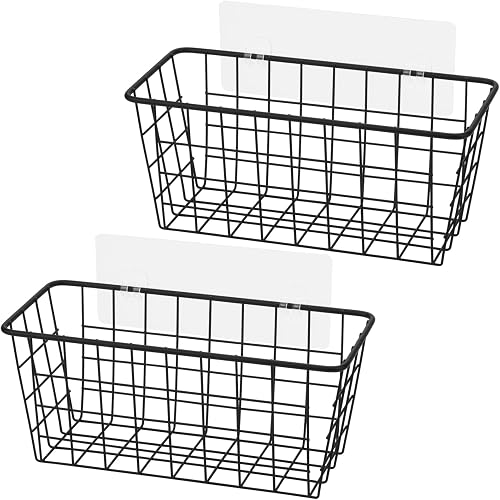
The Toplife No-Drill Door Basket hooks over a standard cabinet or pantry door without any hardware, so it’s fully renter-friendly, and it’s deep enough to hold foil, wraps, cleaning spray bottles, or small snack bags — whatever doesn’t have a home elsewhere. It’s a small enough purchase to use as a test run for door storage generally; if it earns its spot, a second one on an adjacent door is an easy follow-up.
The con: it only works on doors with a lip or edge for the hooks to grip; a perfectly flush, edgeless cabinet door won’t hold it securely. Check your door style before ordering.
Mistake #7: Leaving a corner cabinet as a dead zone
Corner cabinets are the one storage mistake that’s actually a design flaw more than a habit — the geometry of the corner itself works against you. They lose the most usable space of any cabinet in the kitchen, because the back corner is nearly impossible to reach without pulling everything in front of it out first. Most people respond by simply not using the back third of the cabinet at all, which can mean losing a third or more of a cabinet’s total capacity to nothing but geometry. A rotating turntable solves this by bringing the back of the cabinet to the front with a spin instead of a reach.

The Amazon Basics 2-Tier Lazy Susan Turntable is the straightforward fix — two rotating tiers that turn a blind corner into fully accessible storage for bottles, jars, and condiments. It’s inexpensive enough that there’s little reason not to have one in every corner cabinet you own.
The con: taller items on the bottom tier can bump the tier above when you spin it, so sort by height — short jars on the bottom, taller bottles on top — rather than loading it at random. It’s a two-minute fix the first time you notice the collision, but worth doing on day one rather than discovering it mid-spin with a full bottle of oil.
Frequently asked questions
Do I need to fix all seven mistakes at once?
No — pick the one that’s annoying you most right now. The deep-cabinet and utensil-drawer fixes tend to deliver the biggest day-to-day relief for the least money, so I’d start there if you’re only tackling one this month.
What’s the cheapest kitchen storage mistake to fix?
The cabinet-door mistake, by far. A no-drill door basket is one of the lowest-cost fixes on this list and adds storage without touching a single existing shelf or drawer.
Will renovating fix these problems better than organizers?
Usually not. Most of these seven mistakes are about how existing space is used, not how much space exists. I’ve seen tiny rental kitchens outperform much larger ones simply because every inch had a defined job — which is the same philosophy behind my first-apartment kitchen essentials guide. A full renovation can obviously add square footage, but it won’t fix a deep cabinet you’ve never reached into or a drawer with no dividers — those are organization problems, not space problems, and they follow you into a bigger kitchen if you don’t solve them first.
How do I know which mistake is costing me the most space?
Open every cabinet and drawer and ask one question: is there a visible gap, a section I never reach, or an item I’ve bought a duplicate of because I lost track of the original? Any “yes” points to one of these seven mistakes. In my experience the deep-cabinet and pantry-packaging mistakes tend to hide the most reclaimable space, simply because they’re the easiest to stop noticing over time.
The bottom line: none of these seven mistakes are about owning too much stuff — they’re about unused vertical space, invisible pantry items, and dead zones nobody designed for. Fix the one bothering you most this weekend, then work down the list as the others start to grate on you. None of the seven fixes above require tools, a weekend project, or permission from a landlord — the cabinet riser, drawer organizer, door basket, and turntable all install in minutes, and the pull-out shelf is the only one that benefits from double-checking your cabinet’s clearance first. Your kitchen doesn’t need to get bigger; it just needs every inch assigned a job. Once the fixes above are in place, my kitchen essentials guide is a good next stop if you’re still filling in gaps in your core gear. Revisit this list every six months or so, because the mistakes that creep back fastest are the ones tied to daily habits rather than one-time purchases — the junk-drawer problem and the pantry-packaging problem in particular tend to reappear once the novelty of a fresh setup wears off.