Air Fryer Temperature & Time Guide: The Only Cheat Sheet You Need
Kitchaneers is reader-supported. When you buy through links on this page, I may earn an affiliate commission at no extra cost to you.
Every air fryer recipe seems to list a different temperature for the same food, and it’s rarely the same number that’s printed on your machine’s dial. That’s because most air fryer times and temps floating around online were copied from an oven recipe without adjusting for how much faster hot air actually moves in a compact basket. After going through dozens of verified buyer reviews, manufacturer manuals, and recurring complaint threads about “my fries came out soggy” or “my wings were burnt outside, raw inside,” the pattern is consistent: people are using oven numbers in an air fryer, not air fryer numbers.
This guide is the cheat sheet I wish existed before I started cross-referencing recipes: one master chart for the temperatures and times that actually work, broken down by food category, plus the conversion rule for turning any oven recipe into an air fryer one.
Why air fryer temperatures aren’t the same as oven temperatures
An air fryer is a small convection oven with a much stronger fan and a much smaller cooking chamber. That combination means hot air reaches the food faster and more evenly than in a full-size oven, so the same recipe cooks hotter and faster in a basket than it would on a sheet pan. The rule of thumb that shows up consistently across air fryer manufacturer guidance and cooking-community consensus: drop the oven temperature by about 25°F (around 15°C) and cut the cook time by 20–25% when converting a recipe.
That conversion rule is a starting point, not a guarantee — basket size, how full it is, and whether you preheat all change the result. The chart below already has that math built in, so you shouldn’t need to convert anything for the foods listed.
The master air fryer temperature and time chart
Times assume a single layer in the basket (no stacking) and a preheated air fryer at the listed temperature. If your model doesn’t have a preheat function, add 2–3 minutes to the low end of the range.
Vegetables
| Food | Temperature | Time | Notes |
|---|---|---|---|
| Broccoli florets | 375°F | 8–10 min | Toss with oil, shake halfway |
| Brussels sprouts (halved) | 375°F | 12–15 min | Shake halfway |
| Carrots (sliced) | 375°F | 12–15 min | Cut evenly for uniform cooking |
| Potato wedges | 400°F | 18–20 min | Flip at the 10-minute mark |
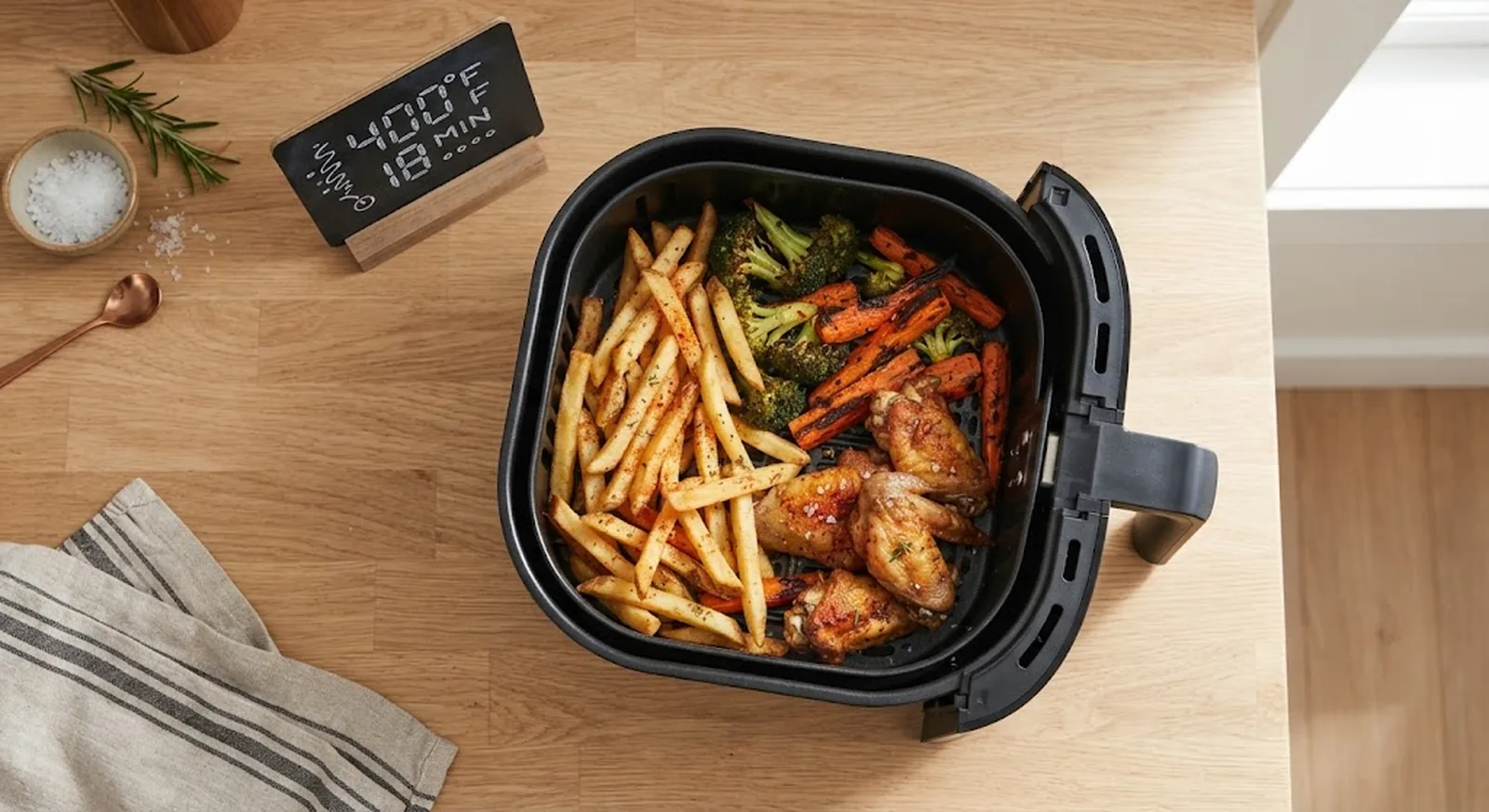
| French fries (frozen) | 400°F | 15–18 min | Shake basket twice |
| Asparagus | 375°F | 7–9 min | Thin spears cook fast — check at 6 min |
| Corn on the cob | 390°F | 10–12 min | Turn once |
Proteins
| Food | Temperature | Time | Internal temp target |
|---|---|---|---|
| Chicken breast (boneless) | 375°F | 18–22 min | 165°F |
| Chicken thighs (bone-in) | 380°F | 22–25 min | 165°F |
| Chicken wings | 380°F | 20–24 min | 165°F, flip halfway |
| Chicken tenders | 380°F | 10–12 min | 165°F |
| Salmon fillet | 390°F | 9–11 min | 125–130°F for medium |
| Pork chops (1-inch) | 375°F | 12–15 min | 145°F |
| Bacon | 350°F | 7–10 min | Check at 6 min — fast burner |
| Steak (1-inch, medium-rare) | 400°F | 9–12 min | 130–135°F, flip halfway |
Internal temperature is the only reliable doneness check for meat and poultry — a basket’s hot spots mean two pieces of chicken can finish a minute or two apart even with identical timers. An instant-read thermometer removes the guesswork; see our meat thermometer picks under $30 if you don’t have one you trust yet.
Frozen foods
| Food | Temperature | Time | Notes |
|---|---|---|---|
| Frozen chicken nuggets | 400°F | 10–12 min | Shake at 6 min |
| Frozen mozzarella sticks | 375°F | 8–10 min | Don’t overcrowd — they’ll leak if touching |
| Frozen dumplings/potstickers | 380°F | 10–12 min | Brush with oil for browning |
| Frozen fish fillets | 390°F | 12–14 min | No flip needed |
| Frozen pizza rolls | 380°F | 8–9 min | Watch closely after 7 min |
| Frozen waffles | 360°F | 5–6 min | No oil needed |
Baked goods and reheating
| Food | Temperature | Time | Notes |
|---|---|---|---|
| Cookies (from dough) | 325°F | 8–10 min | Lower temp prevents burnt bottoms |
| Muffins | 330°F | 12–15 min | Use silicone liners |
| Reheating pizza | 350°F | 3–4 min | Crisps crust better than a microwave |
| Reheating fried chicken | 350°F | 4–6 min | Restores crispy skin |
| Reheating french fries | 360°F | 3–5 min | Shake halfway |
The 3 mistakes that throw off every chart
- Overcrowding the basket. Air needs to circulate around every piece. A single overlapping layer can add 30–50% more cook time and leave food soggy instead of crisp — cook in batches instead.
- Skipping the preheat. Recipes tested from a cold basket consistently run 2–4 minutes longer than the listed time. Most newer models preheat in under 3 minutes, so it’s rarely worth skipping.
- Not shaking or flipping halfway. Air fryers cook from the bottom and the sides more than the top. Shaking the basket (or flipping larger items) redistributes exposure so you don’t end up with one crisp side and one pale side.
- Ignoring moisture content. Wet batter, marinades that haven’t been patted dry, or frozen food straight from an ice-crusted bag all release steam as they cook. That steam competes with the hot air for contact time with the food’s surface, which is why the same “frozen” item often needs a few more minutes than its fresh counterpart even at the same temperature.
How to convert any oven recipe to air fryer settings
If your dish isn’t in the chart above, use this formula as a starting point, then check for doneness a few minutes early the first time you make it:
- Take the oven temperature from the original recipe and subtract 25°F.
- Take the oven time and cut it by about 20%.
- Check for doneness at the reduced time, then add 1–2 minute increments until it’s right.
- Write the final numbers down — once you’ve dialed in a recipe for your specific air fryer model, it’ll be consistent going forward.
More foods people search for
| Food | Temperature | Time | Notes |
|---|---|---|---|
| Shrimp | 380°F | 6–8 min | Pat dry first or it won’t crisp |
| Tofu (cubed, pressed) | 375°F | 15–18 min | Shake twice for even edges |
| Cauliflower florets | 375°F | 12–15 min | Toss in oil and spice before cooking |
| Sweet potato fries | 380°F | 15–18 min | Cook in a thin, even layer — these stick more than regular fries |
| Pork tenderloin | 375°F | 20–25 min | 145°F, rest 3 min before slicing |
| Turkey breast (boneless) | 350°F | 50–60 min | 165°F, check at the 45-minute mark |
| Eggs (whole, in shell) | 270°F | 15–17 min | Lower heat prevents shell cracking; ice bath after for easy peeling |
That egg temperature looks out of place next to everything else in this chart, and that’s the point — delicate, enclosed foods like a whole egg in its shell need a slow, gentle ramp-up instead of the high, fast heat that crisps fries. Cooking eggs at 375°F risks cracked shells and uneven yolks; the lower, longer setting mimics a gentle boil instead of a blast of convection heat.
Does basket size change the chart?
Yes, more than most people expect. A 3-quart basket concentrates heat in a tighter space, so food on the smaller end of a time range usually finishes first — start checking a minute or two early. An 6-quart or 8-quart basket (common on the larger family-size models) spreads hot air across more surface area, which can mean the opposite problem: a single layer of fries might need the higher end of the range, or even an extra minute or two, because the fan has more volume to circulate through. If you’re consistently landing outside the chart’s range in the same direction, that’s less likely a chart problem and more likely a basket-size or wattage difference specific to your unit — note the adjustment once and it’ll hold for future batches.
A worked example: converting an oven recipe
Say a recipe calls for breaded chicken tenders baked at 425°F for 20 minutes. Using the conversion formula from above: subtract 25°F to get 400°F, then cut the time by 20%, which brings 20 minutes down to 16 minutes. In practice, that lines up closely with the 380°F/10–12 minute range already in the protein chart for tenders — the formula and the tested numbers converge, which is a useful way to sanity-check a conversion when you’re working from a recipe that isn’t already in the chart. Start checking at the lower end of your converted time, add increments of 1–2 minutes, and write down what actually worked once you’ve got it — that becomes your personal baseline for that exact recipe going forward. The same approach works in reverse too — if you’ve got a dish that already works well in your air fryer and want to bake it in a regular oven for a dinner-party-sized batch, add roughly 25°F and extend the time by about 20-25%, then watch it closely near the end since oven hot spots behave differently than a fan-driven basket.
Do you need oil for every food in an air fryer?
No, but it changes the result more than most people expect. A light coat of oil (a teaspoon or two, or a few seconds of spray) helps the Maillard browning reaction happen faster and more evenly, which is why oiled vegetables and homemade fries come out a deeper golden color than the same food cooked dry. Naturally fatty foods — bacon, chicken thighs with skin, sausages — render their own fat as they cook and don’t need added oil at all; adding more on top of that can actually cause excess smoking in some baskets. Breaded or battered foods usually benefit from a light spray directly on the coating, since the breading itself doesn’t carry enough fat to crisp on its own. As a rule, lean + dry = add a little oil; fatty + already-moist = skip it.
How wattage affects the numbers on this chart
Most countertop air fryers run somewhere between 1,400 and 1,800 watts, and this chart assumes a unit in that typical range. A lower-wattage model (some compact or budget units run closer to 1,000–1,200 watts) will generally need a few extra minutes at the same temperature to hit the same result, since it’s moving less total heat energy through the basket per minute. A higher-wattage model can sometimes finish slightly ahead of the chart’s low end. This is a different issue from basket size — two air fryers with identical quart capacities can still cook at noticeably different speeds if their wattage differs, which is part of why the “same” recipe gets mixed reviews across different brands and models in the comments section of any recipe site.
One more thing that quietly throws off every chart: a dirty basket
Grease and crumb buildup on the basket and heating element is a recurring theme in long-term owner reviews that complain about “my air fryer doesn’t cook like it used to.” Baked-on residue insulates the basket slightly and can partially block the fan, which means food takes longer to crisp than the same chart promised on day one. Most baskets are dishwasher-safe or wipe clean with hot soapy water — a quick clean after every few uses keeps actual performance matching the numbers above instead of drifting further from them each week.
A reliable air fryer makes the chart easier to trust
These numbers assume a mid-size basket air fryer with reasonably even heat distribution. Models with known hot spots or inconsistent fans (a recurring complaint in budget-tier reviews) will drift from any published chart no matter how carefully it’s built. Among the models I’ve evaluated against hundreds of verified-purchase reviews, the Cosori Air Fryer Pro LE holds up well for chart consistency — reviewers report even browning without constant basket-shaking, which is exactly the kind of feedback that signals a dependable fan and heating element. One real complaint worth knowing before you buy: the digital display can be difficult to read in bright kitchen lighting.

For a longer breakdown of how different air fryer models compare on capacity, noise, and price tier, see my full best air fryers roundup. And if chicken is what you’re cooking most, the air fryer chicken recipes guide pairs the chart above with 15 specific meal ideas. Air fryers are one of several small kitchen appliances worth having on the counter if you cook most weeknights.
FAQ
Do I need to preheat my air fryer every time?
It’s not mandatory, but skipping it means adding 2–4 minutes to most cook times to compensate for the cold start. Since most models preheat in under 3 minutes, it’s rarely worth the inconsistency of skipping it.
Why are my air fryer fries soggy instead of crispy?
The most common cause is overcrowding — fries release steam as they cook, and that steam needs somewhere to escape. A packed basket traps it, which steams the fries instead of crisping them. Cook in batches and shake the basket at least once.
Is 350°F or 400°F better for an air fryer?
Neither is universally “better” — it depends on the food. Delicate items like baked goods and reheated leftovers do better at 325–360°F so they don’t scorch before heating through. Denser foods like fries, wings, and frozen items generally need 375–400°F to crisp properly in a reasonable time.
Can I use the same temperature chart for every air fryer brand?
It’s a reliable starting point across basket-style air fryers, but wattage and fan strength vary by model. If your results consistently run a few minutes faster or slower than the chart, adjust by that same margin going forward — once you know your unit’s tendency, it stays consistent.
Does doubling the batch size mean doubling the cook time?
Not quite. It’s closer to adding 30-50% more time, not a flat doubling, as long as the food still fits in a single layer or close to it. A full second layer that blocks airflow is a bigger problem than the extra volume itself, which is why cooking in two smaller batches usually beats cramming everything into one overloaded basket.
Can I put aluminum foil or parchment paper in an air fryer?
Most manufacturers allow both as long as the liner doesn’t block the fan vents and isn’t loose enough to get pulled up against the heating element – perforated liners made specifically for air fryers are the safer choice over cutting your own. Either way, add the liner after preheating rather than before, so it doesn’t flap around in the fan’s airflow with nothing weighing it down.