Zojirushi vs. Cheap Rice Cookers: Is the Price Jump Worth It?
This post contains affiliate links. As an Amazon Associate, I earn from qualifying purchases at no extra cost to you.
In short: a Zojirushi fuzzy-logic rice cooker earns its splurge-tier price if you cook rice several times a week, eat brown rice or sushi rice regularly, or want leftovers that still taste right after a day in keep-warm. If you cook plain white rice a few times a month and don’t mind the occasional dry edge or stuck-on bottom, a budget-tier basic cooker does the job. There’s also a real middle ground — a mid-range fuzzy-logic model that gets you most of the Zojirushi’s consistency without the Zojirushi price.
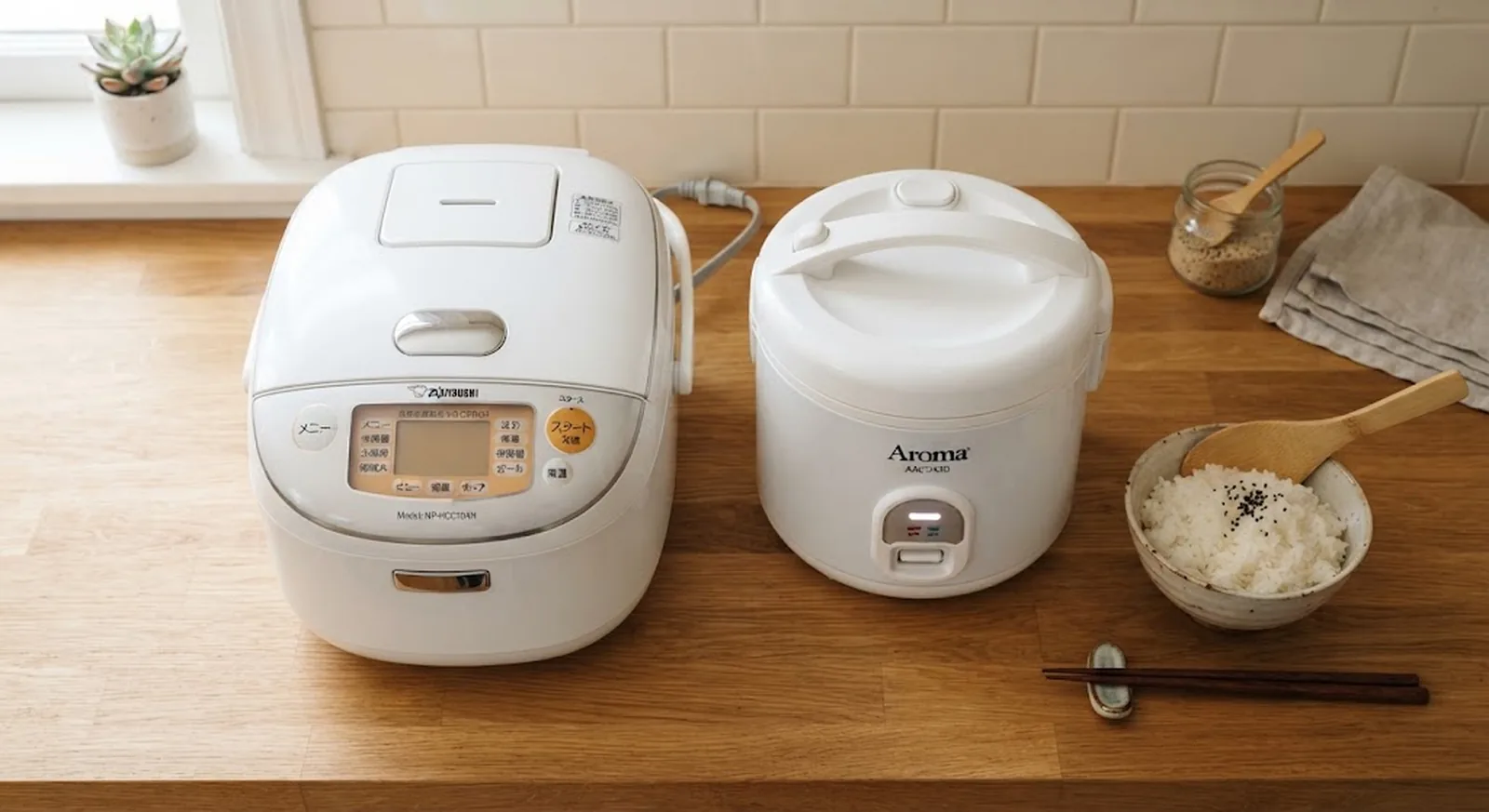
I get some version of “is Zojirushi actually worth it or is that just a brand tax” constantly, usually from someone staring at a splurge-tier rice cooker next to a budget one that looks almost identical on the outside. Based on manufacturer specs and recurring patterns across verified buyer reviews on three rice cookers spanning that exact price range, here’s what the price jump actually buys you — and when it doesn’t matter.
What “Fuzzy Logic” Actually Means
A basic rice cooker runs one job: heat until the water boils off, then a thermostat detects the temperature spike that happens once the pot runs dry, and it clicks over to “keep warm.” That’s it — no adjustment for rice type, altitude, or how much water you actually added. It works fine when your water-to-rice ratio is right and you’re cooking the same white rice every time.
“Fuzzy logic” cookers — Zojirushi’s and a handful of competitors’ — use a microcomputer that monitors temperature changes throughout the cook and adjusts heating time and intensity in real time, rather than following one fixed program. In practice that means the cooker compensates somewhat for an imperfect water ratio, handles the different starch and moisture content of brown rice or sushi rice without you doing the math yourself, and manages the keep-warm cycle more gently so rice doesn’t dry out or turn yellow after a few hours. Reviewers who’ve owned both describe it less as “smarter” rice and more as “more forgiving” rice — fewer failed batches when you’re distracted or measuring by eye.
The catch: fuzzy logic adds real cost. The microcomputer, the more complex heating element, and the multi-setting menu all show up in the price tag, which is why this comparison isn’t really “good cooker vs. bad cooker” — it’s “do you need the forgiveness fuzzy logic buys you.”
How I Compared These Three
I didn’t buy all three and run them side by side in a lab — I don’t claim that kind of testing, and I’d be skeptical of any single-person blog that does for a splurge-tier appliance. What I did instead: pulled the manufacturer spec sheets for cook technology, capacity, and keep-warm behavior, then cross-referenced that against hundreds of verified-purchase reviews for each cooker, looking specifically for recurring patterns rather than one-off complaints. A single review saying “mine broke after a month” tells you almost nothing — a pattern of fifty reviews independently describing the same failure (dried-out keep-warm rice, a cracked inner pot, a thermostat that clicks over too early) tells you something real about the product. That’s the standard I used throughout this comparison, and it’s why I’m calling out patterns rather than individual star ratings.
Price and Specs at a Glance
| Cooker | Technology | Capacity | Price Tier | Rating |
|---|---|---|---|---|
| Zojirushi NS-ZCC10 | Neuro Fuzzy (advanced fuzzy logic) | 5.5 cups cooked | Splurge | 4.7★ |
| Toshiba 6-Cup Digital | Fuzzy logic, 7 presets | 6 cups uncooked | Mid-range | 4.6★ |
| BLACK+DECKER RC506 | Basic thermostat (one-touch) | 6 cups cooked | Budget | 4.4★ |
Prices change often — tap “Check Price on Amazon” under each pick below for today’s actual listing price.
My Picks
Best If You Cook Rice Often: Zojirushi NS-ZCC10
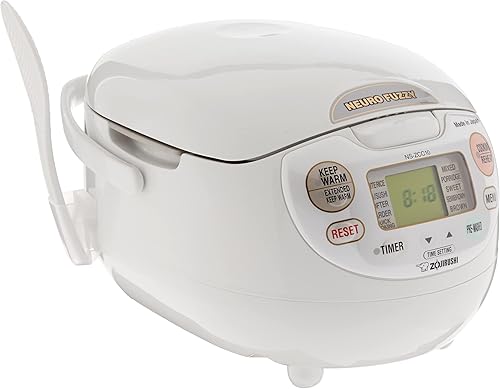
The Zojirushi NS-ZCC10 is the model reviewers and competing roundups point to as the fuzzy-logic benchmark, and the 4.7-star average across a large review base backs that up. It covers white, brown, sushi, and porridge settings with real adjustment behind each one, and owners consistently report rice that’s still good — not dried out, not yellowed — after a full day on keep-warm, which is the single complaint that comes up most about cheaper cookers. The extended steam-reduced lid design also means less condensation dripping back into the pot. The genuine con: it’s a serious splurge-tier investment for a rice cooker, the cook cycle for white rice runs closer to 50 minutes versus the near-instant feel of a pressure cooker, and the 5.5-cup capacity is modest if you regularly cook for a crowd.
The Middle Ground: Toshiba 6-Cup Fuzzy Logic Rice Cooker
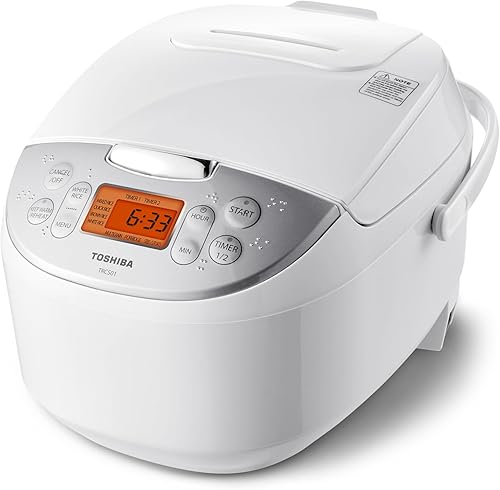
If the Zojirushi’s splurge-tier price is the dealbreaker but a basic cooker feels like a step too far down, the Toshiba 6-Cup Digital Rice Cooker is the cooker I point people toward. It runs genuine fuzzy-logic temperature adjustment across 7 presets, includes two delay timers, and holds a 4.6-star average that tracks closely with the Zojirushi’s — reviewers who downgraded from a Zojirushi for budget reasons report similar rice quality for most everyday cooking, with the Zojirushi’s edge showing up mainly on finicky specialty rice and multi-day keep-warm stretches. The con: the non-stick inner pot isn’t rated to the same longevity as Zojirushi’s, and a handful of reviews mention the coating showing wear after a year or two of daily use — plan to replace the pot eventually rather than expecting Zojirushi-level durability.
Best If You Cook Plain White Rice Occasionally: BLACK+DECKER RC506
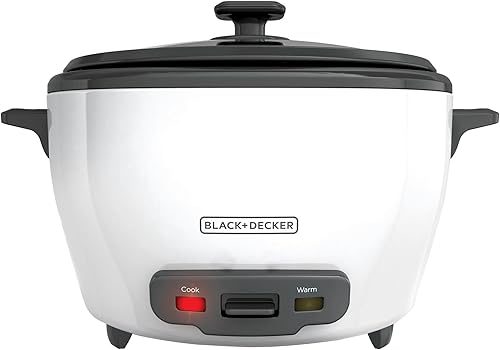
At its budget price point, the BLACK+DECKER RC506 is a one-button cooker with no display and no settings to learn, and its 4.4-star average across tens of thousands of reviews says that simplicity isn’t a dealbreaker for most buyers — plenty of people report consistently fluffy white rice batch after batch. It includes a steaming basket, which is genuinely useful for vegetables while rice cooks underneath. The honest con: it has one program, so brown rice, sushi rice, and anything beyond plain white rice is trial-and-error on timing, and keep-warm quality drops off noticeably after a few hours — reviewers who leave rice in it overnight consistently report it drying out, which is exactly the failure mode fuzzy logic is built to prevent.
When the Zojirushi Is Worth It
The price jump makes sense in a few specific situations, and it’s worth being honest about which one actually describes you before spending splurge-tier money on a rice cooker. If rice is a daily staple in your house — not an occasional side dish — the per-use cost drops fast, and the difference between “good” and “slightly dry” rice compounds over hundreds of meals. If brown rice, sushi rice, or mixed grains show up in your rotation regularly, fuzzy logic genuinely reduces the guesswork; a basic cooker’s single program is tuned for white rice and treats everything else as an approximation. And if you regularly cook a batch in the morning and eat from it through the day, the Zojirushi’s keep-warm performance is the single most-cited reason owners say they’d buy it again — it’s the difference between rice that’s still good at dinner and rice you’re reheating with extra water to fix.
One thing worth being skeptical of: some review sites frame the Zojirushi as having some kind of secret technological edge specific to being “made in Japan.” That’s marketing framing more than a verifiable claim — what you’re actually paying for is the fuzzy-logic sensor and adjustment system, the build quality of the heating element, and a company with a long track record in this specific category, not an unmeasurable manufacturing mystique.
When a Cheap Cooker Is Enough
If you cook rice a few times a month, almost always plain white rice, and you measure water with a steady hand, a basic cooker gets you most of the way to the same result for a fraction of the price. The complaints that show up in reviews for basic cookers — occasional stuck bottoms, drier rice after a few hours on warm — are real, but they’re also avoidable with small habits: fluff and serve within an hour or two rather than leaving rice on warm overnight, rinse rice until the water runs mostly clear to cut down on the starch that causes sticking, and measure with the same cup every time rather than eyeballing it.
A basic cooker is also the more sensible choice if you’re testing whether you’ll actually use a dedicated rice cooker at all, if counter space is tight and you don’t want a large appliance earning its keep for an occasional side dish, or if you already have a reliable method (stovetop, Instant Pot) and just want a backup that frees up a burner. Spending splurge-tier money to solve a problem you have twice a month isn’t a smarter buy than spending budget-tier money — it’s just a more expensive one.
Capacity: Why “5.5 Cups” Doesn’t Mean What You Think
Rice cooker capacity is listed two different ways depending on the brand, and mixing them up is the most common sizing mistake I see in comments and reviews. Zojirushi lists the NS-ZCC10 at 5.5 cups cooked, while the Toshiba lists 6 cups uncooked — and rice roughly doubles to triples in volume once cooked, so the Toshiba’s real cooked yield is closer to 12–15 cups, more than double the Zojirushi’s. The BLACK+DECKER’s “6 cups cooked” puts it closer to the Zojirushi in practical serving size despite costing a fraction as much. Before you compare these three on price alone, check whether the listing is quoting cooked or uncooked capacity — it changes which cooker actually fits a household of two versus a household of five.
For context: 1 cup of uncooked white rice is roughly 2 adult servings once cooked, so a 5.5-cup-cooked cooker comfortably feeds 2–3 people with leftovers, while a cooker with a 12+ cup cooked yield is built more for a family of five or batch-cooking for the week.
Warranty and Expected Lifespan
Price differences this large usually show up in longevity too, and that’s borne out in how owners talk about these three cookers over time. Zojirushi rice cookers routinely show up in reviews and forum comments with owners reporting 10+ years of regular use before any component fails — the brand’s reputation in this category is built on exactly that kind of longevity, backed by a 1-year limited warranty from the manufacturer. The Toshiba’s digital components are newer to the fuzzy-logic category, and while the 1-year warranty matches, the recurring inner-pot-coating complaint noted above suggests a shorter realistic lifespan for the non-stick surface specifically, even if the base unit keeps working. Basic cookers like the BLACK+DECKER typically carry no manufacturer warranty beyond a brief return window, and owner reports cluster around 2–4 years of daily use before the heating element or thermostat starts misbehaving — which, at a budget price point, still works out to a reasonable cost-per-year even if it’s a fraction of the Zojirushi’s expected service life.
Run the math on cost-per-year rather than sticker price alone: the Zojirushi spread across a decade of regular use is actually more competitive with replacing a budget cooker every few years than the upfront price difference suggests, once you factor in the better rice quality and keep-warm performance you’re getting for that difference. It’s not a slam-dunk either way — but it reframes the decision from “splurge vs. budget” to “a bit more per year for meaningfully better rice.”
Getting Better Rice From a Basic Cooker
If you’re sticking with a budget cooker, a few adjustments close most of the gap with fuzzy logic. Rinse white rice 2–3 times before cooking — this removes surface starch that’s the main cause of a sticky, gummy bottom layer on basic cookers. Let the rice rest with the lid on for 10 minutes after the cooker switches to warm, rather than opening it immediately; that resting period lets moisture redistribute evenly, which a fuzzy-logic cooker does automatically but a basic one doesn’t. And if you’re cooking brown rice in a cooker built around white-rice timing, add roughly 15–20% more water and expect a longer cycle — basic cookers don’t know the difference, so you have to compensate manually.
Two more habits worth building in: measure rice and water by volume with the same cup every time rather than switching between a kitchen measuring cup and the cooker’s included scoop (they’re often different sizes, which is a surprisingly common cause of “my rice never comes out right” complaints), and unplug the cooker once rice is served rather than leaving it on warm out of habit — on a basic cooker, that single change does more for rice quality than almost anything else on this list.
FAQ
Is Zojirushi really better, or is it just a brand premium?
The fuzzy-logic sensor and adjustment system are a real, measurable difference in how the cooker responds to rice type and keep-warm duration — it’s not purely brand markup. Whether that difference is worth the price to you depends on how often you cook rice and what kind.
Can a cheap rice cooker handle brown rice?
Yes, but expect to manually adjust water ratio and cook time — most basic cookers are tuned around white rice timing, and brown rice needs more water and a longer cycle to come out fully cooked rather than crunchy.
How long can rice safely sit on keep-warm?
Food safety guidance generally caps keep-warm time around 12 hours, but quality (not safety) is the bigger issue on basic cookers — texture and moisture noticeably decline after 2–4 hours, while fuzzy-logic cookers manage that decline more gradually.
Is the Toshiba a good substitute if I can’t afford the Zojirushi?
Based on the overlap in verified-buyer feedback, yes for most everyday cooking — the gap narrows to specialty rice types and extended keep-warm stretches, where the Zojirushi still has an edge.
Does a more expensive rice cooker actually cook rice faster?
No — if anything, fuzzy-logic cookers often run slightly longer cycles because they’re making real-time adjustments rather than following a fixed timer. The price buys consistency and keep-warm quality, not speed.
Key Takeaways
- Fuzzy logic means the cooker actively adjusts heat and timing instead of running one fixed program — it mainly shows up as more forgiving results and better keep-warm performance.
- The Zojirushi NS-ZCC10 earns its splurge-tier price if you cook rice often, eat brown or sushi rice regularly, or rely on keep-warm for hours at a time.
- The Toshiba 6-Cup is the honest middle ground — genuine fuzzy logic at a noticeably lower price, with a less durable inner pot as the tradeoff.
- A basic cooker like the BLACK+DECKER RC506 is enough for occasional plain white rice — rinse thoroughly and don’t leave rice on warm for hours to close most of the quality gap.
If a 5.5-cup capacity feels too small either way, my best rice cookers under $80 roundup compares five larger-capacity budget and mid-range options side by side. For the rest of your countertop lineup, best small kitchen appliances covers what else earns counter space, and if you’re also deciding between a multi-cooker and a dedicated appliance, my Instant Pot size and tier comparison walks through that same “is the upgrade worth it” question for pressure cooking.