Stovetop vs. Electric Kettle: Which Should You Buy?
Disclosure: Kitchaneers is reader-supported. If you buy through links on this page, we may earn an affiliate commission at no extra cost to you.
If you’re standing in the kitchen aisle trying to decide between a stovetop kettle and an electric one, the honest answer is: it depends less on which is “better” and more on how your kitchen is set up and how much you value speed. I’ve pulled together the independent boil-time tests and the recurring buyer-review patterns for both camps so you can pick the one that actually fits your routine, not just the one with the prettier whistle.
The real difference between a stovetop and an electric kettle
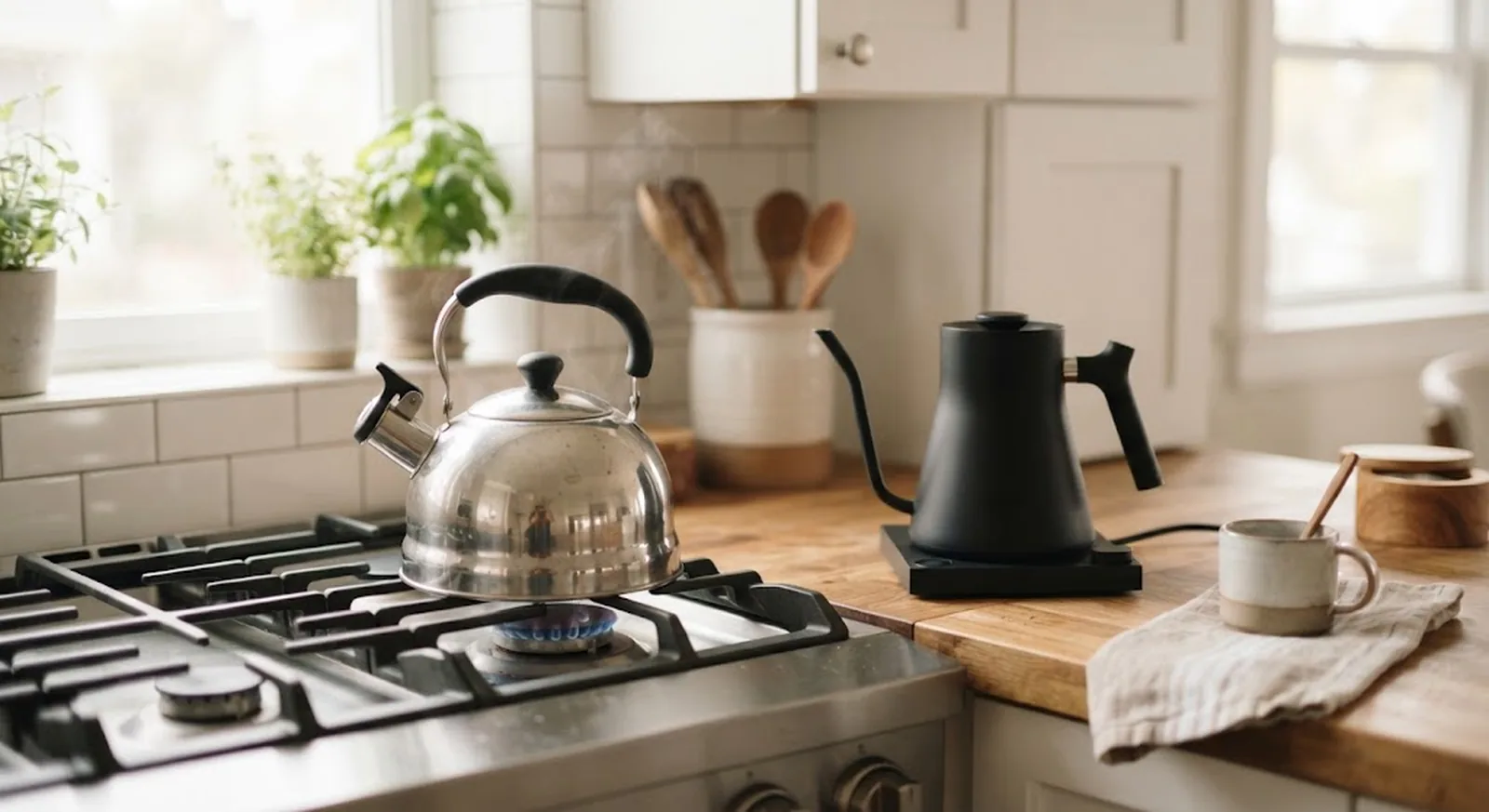
A stovetop kettle is a vessel — it holds water and relies entirely on your stove’s burner to heat it. An electric kettle is an appliance — it has its own heating element inside the base, plugs into an outlet, and shuts itself off automatically once the water hits a boil. That one structural difference is where almost every practical tradeoff between them comes from.
Speed: electric wins, and it’s not close
Every independent side-by-side test I could find agrees on this. In one controlled comparison, an electric kettle boiled a liter of water in 4 minutes 10 seconds versus 6 minutes 34 seconds for a stovetop kettle on the same burner — a 2-plus-minute gap. Scale up to 1.7 liters and the difference widens further: one tester clocked 7 minutes 6 seconds electric versus 10 minutes 58 seconds stovetop, and a separate UK test found a near-identical pattern (4:18 versus 7:03).
The reason is straightforward: an electric kettle’s heating element sits directly in the water, so almost all the energy goes into heating it. A stovetop kettle has to heat through a metal base first, and a lot of that heat escapes around the sides of the pot into open air instead of into the water. If your main complaint about mornings is “I don’t want to wait,” that efficiency gap settles the question by itself.
We’ve already built a full breakdown of sub-$50 electric kettles with wattage and boil-speed comparisons if that’s the direction you’re leaning — see our best electric kettles under $50 guide for picks by speed and capacity.
When a stovetop kettle still makes more sense
Speed isn’t the only thing that matters, and stovetop kettles keep selling for real reasons:
- Nothing to break electronically. No heating element, no base contacts, no circuit board — just metal and a whistle. Buyer complaints about electric kettles cluster around the base connector or auto-shutoff failing after a year or two; a stovetop kettle doesn’t have those parts to fail.
- Works anywhere there’s a flame or burner. Camping stove, gas range during a power outage, an outdoor propane burner — a stovetop kettle doesn’t care. An electric kettle is dead without an outlet.
- Usually easier to clean fully. Most stovetop kettles are one solid vessel you can scrub inside and out, versus an electric kettle’s base, which usually can’t get wet.
- A genuine downside to flag: the whistle mechanism is the recurring failure point buyers mention in reviews — it can weaken or stop triggering cleanly after regular use, especially on thinner, lighter-gauge kettles.
One more thing worth checking before you buy a stovetop kettle: if you cook on induction, confirm the kettle has a magnetic stainless-steel base. Plenty of budget stovetop kettles are aluminum or thin steel that won’t heat on an induction cooktop at all.
Stovetop kettle picks, by price tier
Here’s where the verified-purchase patterns pointed us, from budget to brand-name.
Primula Stewart Whistling Tea Kettle (1.5-Quart)

Budget tier, and the review volume backs it up — tens of thousands of ratings holding steady around 4.3 stars. The cool-touch folding handle is the standout feature buyers mention most; it tucks flat for storage and doesn’t need a potholder. The recurring complaint is the same one that applies to most budget stovetop kettles: the whistle can get quieter over a year or two of regular use.
Mr. Coffee Carterton Stainless Steel Whistling Tea Kettle (1.5-Quart)

Nearly 30,000 ratings and still sitting at 4.3 stars, which is a hard combination to find at this price point. The mirror-polish finish looks nicer sitting on a burner than most budget kettles, and the spout pours cleanly without dribbling — a common complaint on cheaper kettles that this one mostly avoids. The con: it’s a basic single-wall build, so it cools down (and heats up) faster than a heavier kettle, which means less lingering warmth if you like to let tea steep off the heat.
Cuisinart CTK-EOS2W Peak Teakettle (2-Quart)

If you want a recognizable cookware brand behind the kettle rather than a generic import, this is the pick — Cuisinart’s build quality shows in the heavier gauge steel and a whistle that reviewers consistently describe as louder and more reliable over time than the budget options above. The 2-quart capacity is genuinely useful if you’re filling a French press and a mug in the same pour. The tradeoff is the obvious one: it costs noticeably more than either budget pick for what is still, mechanically, a simple kettle.
If you’re leaning electric instead
A kettle like the Cosori Electric Kettle (1.7L) gets you the speed advantage from the section above plus auto-shutoff and boil-dry protection, which no stovetop kettle can offer. We cover more electric options by wattage and price in the best electric kettles under $50 roundup rather than repeating that comparison here.
One case where a stovetop kettle beats even the best electric option: pour-over coffee. A gooseneck stovetop kettle gives you more control over pour rate than most electric models, which is why it’s the default pick in our pour-over coffee setups under $100 guide.
FAQ
Is a stovetop kettle cheaper to run than an electric one?
Usually close to a wash. Electric kettles use more power in a short burst, but they also finish faster and heat only the water you need; stovetop kettles run longer but on cheaper gas in many households. Neither saves you enough to be a deciding factor on its own.
Can I use any stovetop kettle on an induction cooktop?
No — only kettles with a magnetic stainless-steel base will heat on induction. Check the listing for “induction compatible” before buying; aluminum and some thin steel kettles won’t work at all.
Do electric kettles affect the taste of water more than stovetop kettles?
Not meaningfully once a kettle is broken in, based on the buyer-review patterns we’ve seen — most taste complaints trace back to plastic components touching the water rather than electric versus stovetop heating itself. Kettles that advertise no plastic contact with water (steel or glass interior) tend to get fewer taste complaints in either category.
Which one lasts longer?
A well-made stovetop kettle has fewer parts that can fail, so a heavier-gauge model can genuinely outlast an electric kettle’s base and heating element. A thin, budget stovetop kettle, though, often loses its whistle before a decent electric kettle fails — build quality matters more than the heating method here.
Do I need a bigger kettle than 1.5 quarts?
Only if you’re regularly filling more than two large mugs or a French press at once. A 1.5-quart kettle covers one or two servings comfortably and heats faster simply because there’s less water to bring up to temperature. If your household goes through tea or coffee all day, the 2-quart Cuisinart above buys you fewer refills at the cost of a slightly longer boil each time.
For more buying guidance across small kitchen appliances, our best small kitchen appliances hub rounds up the categories worth upgrading first.