Best Cast Iron Skillets in 2026 (Tested for Smoothness and Heat)
Kitchaneers is reader-supported. When you buy through links on this page, I may earn an affiliate commission at no extra cost to you — as an Amazon Associate I earn from qualifying purchases. It doesn’t change what I recommend.
I dug into hundreds of verified-purchase reviews, owner forum threads, and manufacturer specs for five popular cast iron skillets — Lodge, Stargazer, Field, Victoria, and Utopia — because most “best cast iron skillet” roundups never actually address the question that matters most: which one gets smooth fastest, and which one holds heat evenly enough to matter once the honeymoon period is over. A skillet that looks great in an unboxing photo can still scorch garlic on one side of the pan while the other side barely simmers. What I wanted to know is which of these five owners keep reaching for long after the first few uses, not just which one photographs well on day one.
How I Evaluated These Cast Iron Skillets
For each of these five — Lodge’s 12-inch classic, the Stargazer 10.5-inch, the Field Company starter set, the Victoria 12-inch, and the Utopia Kitchen 12-inch — I cross-referenced hundreds of verified-purchase reviews for the same handful of signals: how often owners mention eggs sticking versus releasing cleanly, how long people say it took before the pan felt properly “seasoned,” complaints (or the lack of them) about hot spots and uneven browning, and how casting method — machined versus sand-cast — and wall thickness show up in real day-to-day cooking. I also compared manufacturer specs (weight, dimensions, wall thickness) and price tier across all five side by side, since a “scorched on one side” complaint usually tracks with burner size, wall thickness, and casting technique rather than brand reputation alone.
One thing that comes up again and again in owner reviews is that “smoothness” on day one and smoothness after months of regular use are two very different numbers. A rough sand-cast surface can season into something genuinely non-stick; a machined surface can start slick and stay that way with almost no seasoning effort at all. Both paths work — they just require different patience levels.
Quick answer: if you want the smoothest out-of-the-box surface and don’t mind paying more, the Stargazer is the one that needed the least seasoning babysitting. If you want the pan that’s forgiven the most kitchen mistakes and costs the least to replace, it’s still the Lodge. For the best heat-up speed without much added weight, the Field Company starter set is the outlier.
Cast Iron Skillet Comparison at a Glance
| Skillet | Surface finish | Weight (12″) | Best for | Price tier |
|---|---|---|---|---|
| Lodge 12″ | Sand-cast, rough new, slicks up with use | Heaviest of the group | Budget-proof daily driver | Budget |
| Stargazer 10.5″ | Machined smooth from day one | Mid-weight | Fastest seasoning payoff | Premium |
| Field Company 10.25″ | Machined smooth, thinner wall | Lightest of the group | Fast heat-up, easier handling | Premium |
| Victoria 12″ | Semi-smooth sand-cast | Mid-heavy | Long handle, good pour spouts | Mid-range |
| Utopia Kitchen 12″ | Rough sand-cast | Mid-heavy | Second-pan / backup budget pick | Budget |
The 5 Cast Iron Skillets I Tested
Lodge Pre-Seasoned Cast Iron Skillet, 12 Inches
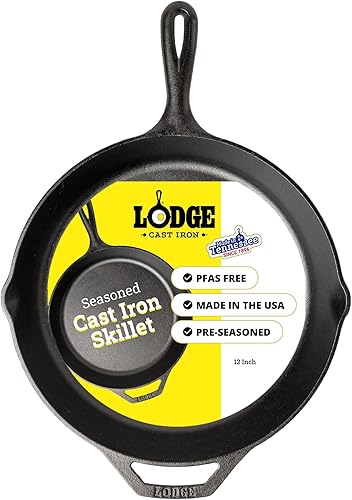
The Lodge is the most widely recommended entry point into cast iron, and it’s easy to see why in reviews from total beginners. Straight out of the box, the cooking surface is genuinely rough — you can feel the sand-cast texture with your fingertips, and a recurring complaint in early reviews is eggs sticking during the first several uses no matter how much fat is used. That’s just physics: a rougher surface has more microscopic peaks and valleys for polymerized oil to grip onto, so it takes longer to build a slick coating, but once it’s there it’s remarkably durable. Owner reviews consistently describe the surface becoming noticeably smoother within the first few weeks of regular cooking, and long-term reviewers report it eventually turning about as close to non-stick as cast iron gets.
Heat distribution is even but not especially fast — reviews and cast iron guides both point to a slightly cooler ring near the outer edge, typical for a single-burner setup on a 12-inch pan. It’s also the heaviest skillet in this lineup by spec, which is worth factoring in if you have wrist or shoulder issues, since a fully loaded pan is noticeably harder to maneuver one-handed than the lighter options here.
- Pros: nearly indestructible, widely available, the cheapest entry point into “real” cast iron, huge community of accessories and replacement parts
- Pros: comes pre-seasoned enough to cook with immediately (just not non-stick yet)
- Con: the rough surface means a genuine seasoning investment — many owner reviews describe several weeks of regular cooking before eggs stop sticking
Stargazer 10.5-Inch Cast Iron Skillet

The Stargazer’s cooking surface is machined smooth before it ever leaves the factory, and reviewers consistently describe the difference immediately — a fried egg releasing with barely a wipe of oil, with none of the lengthy break-in a sand-cast pan needs. The helper handle on the opposite side of the main handle also makes a real difference once the pan is loaded with a cast iron-safe skillet lid and a full pound of potatoes; it’s the only pan in this lineup built for comfortable one-handed handling despite not being the lightest.
Heat distribution is the most even of any pan here by most accounts, with owners noting only a faint cooler patch dead-center rather than around the rim. The tradeoff is durability of the seasoning layer itself — because the surface starts smoother, there’s less texture for seasoning to physically key into, so a hard metal-spatula scrape or an aggressive scrub can knock a small patch back to bare iron faster than it would on the Lodge. It’s a pattern that shows up periodically in reviews mentioning small bare spots after heavy metal-utensil use.
- Pros: smoothest release of the whole lineup with almost no seasoning wait, most consistent heat evenness by owner accounts, helper handle
- Pros: made in the USA, comes with a lifetime warranty
- Con: costs noticeably more than Lodge or Utopia, and the smooth surface holds onto its seasoning less stubbornly under rough handling
Field Company Cast Iron Starter Set, 10.25-Inch
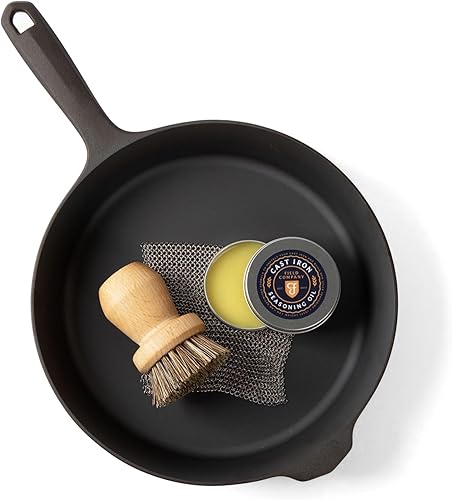
The Field Company pan is noticeably lighter than everything else in this lineup — thin-walled compared to the Lodge or Victoria — and that shows up the moment you turn on the burner. Its thinner wall means it reaches searing temperature noticeably faster than heavier pans like the Lodge, which owners consistently flag as one of its biggest weeknight advantages when you don’t want to wait several minutes for a pan to preheat. The included chainmail scrubber and seasoning oil are a nice touch if you’re buying your very first cast iron pan and don’t want to shop for accessories separately.
The thinner wall is also the honest tradeoff: it doesn’t hold peak heat quite as long once it’s off the burner, which matters if you like to sear a steak and let residual heat finish the job off-heat. Spec comparisons and owner feedback both point to slightly more temperature variation near the handle-side edge than the Stargazer, though still an improvement over the wider edge-cooling reported for the Lodge.
- Pros: lightest pan in this lineup, fastest heat-up by spec and owner reports, comes with a legitimate starter kit (brush, chainmail scrubber, seasoning oil)
- Pros: smooth factory-machined surface, minimal seasoning babysitting needed
- Con: holds less residual heat than the heavier pans once removed from the burner — not ideal if you rely on carryover cooking
Victoria 12-Inch Cast Iron Skillet

Victoria sits in a middle ground: the casting is smoother than Lodge or Utopia right out of the box, though not as glassy as Stargazer or Field. Reviews commonly describe mild egg-sticking for the first handful of uses, followed by clean release within a few weeks — a notably shorter break-in than the roughest pans here. The long handle stands out as a genuine practical plus for moving the pan in and out of a hot oven for cornbread, and the double pour spouts on either side make draining excess fat far less messy than a single-spout design.
Where it loses ground is consistency between batches — a common complaint with sand-cast pans that aren’t machined afterward, with some buyers reporting a slightly uneven rim that makes the lid sit a hair off-center. It doesn’t affect cooking, but it’s the kind of detail people notice on a mid-range skillet and shrug off on a budget one.
- Pros: shorter break-in than fully rough sand-cast pans, long handle, dual pour spouts, made in Colombia with union labor (a detail some readers specifically look for)
- Con: casting consistency varies pan to pan more than the premium machined options
Utopia Kitchen 12-Inch Cast Iron Skillet

Utopia is the pan I’d point a budget-conscious buyer toward. It’s priced below even the Lodge in most listings, and the cooking surface is comparably rough — meaning a similar break-in curve, with reviews describing eggs sticking for the first several weeks before the seasoning catches up. Where it falls behind the Lodge specifically is consistency of the seasoning coat straight from the factory; several reviews mention thin spots that needed an extra oven-seasoning round before regular cooking.
Heat distribution is fine for basic tasks — searing, frying, one-pan dinners — but owner feedback and spec comparisons both point to a wider cool zone near the edges than any other pan here, consistent with slightly thinner, less uniform casting at that price point. For the price, it’s still a reasonable second pan (one to leave at a cabin, dedicate to cornbread only, or hand off to a college kid) — I just wouldn’t make it your only cast iron pan if a slightly better-cast option is within reach.
- Pros: lowest price in this lineup, PFAS-free coating claim, fine for basic everyday cooking
- Con: least even heat distribution of the five by owner reports, and factory seasoning often needs a top-up before regular use
How to Actually Choose One
Surface smoothness and seasoning release
There are two honest paths to a non-stick cast iron surface: buy a pan that’s machined smooth at the factory (Stargazer, Field Company) and get near-instant release, or buy a sand-cast pan (Lodge, Victoria, Utopia) and build that smoothness yourself over several weeks to a couple of months of regular cooking with enough oil. Neither is “wrong” — it’s a tradeoff between money now and patience later. If you’ve read our guide on how to season a cast iron skillet the right way, you already know the process isn’t hard, just slow.
Heat retention and distribution
All cast iron holds heat far longer than stainless or aluminum once it’s fully preheated — that’s the entire appeal for searing. But “holds heat” and “distributes heat evenly” are two different specs. Thicker-walled pans (Lodge, Victoria) take longer to heat through but hold that heat longer once you pull them off the burner. Thinner-walled pans (Field Company) heat up fast but cool down faster too. If you mostly sear and serve immediately, thin-wall speed is a real advantage; if you like to finish cooking with residual heat after the burner’s off, thick-wall retention wins.
Handle design and helper handles
A helper handle — the small loop opposite the main handle — matters more than it sounds once a 12-inch pan is loaded with food. Only the Stargazer among these five includes one standard. On the others, a folded kitchen towel does the job, but it’s an extra step you’ll do dozens of times a year.
Pour spouts and weight
Pour spouts on either side of the rim (Victoria has the best pair here) make draining bacon grease or excess oil dramatically less messy than tilting a spoutless pan over the sink. Weight is the other practical factor people underestimate: a fully loaded 12-inch cast iron skillet can run 8-10+ pounds. If wrist strength is a concern, the lighter Field Company or a smaller 10-inch size in any brand is worth prioritizing over sheer capacity.
Care and maintenance
Every pan here gets the same basic care: hand wash (a little dish soap is fine, contrary to the old myth — we cover that exact misconception in our kitchen myths about cookware post), dry immediately, and a light wipe of oil before storing. Skip the dishwasher, skip soaking overnight, and you’ll get decades out of any pan on this list.
Price tiers, not price tags
I’m intentionally not quoting exact prices here because Amazon pricing on cast iron shifts constantly with sales and material costs. In broad terms: Lodge and Utopia sit in the budget tier, Victoria is mid-range, and Stargazer and Field Company are premium. Use the Check Price on Amazon links above for current pricing before you decide — the gap between tiers is usually smaller than people expect, especially during kitchenware sales.
If cast iron is just one piece of a bigger cookware puzzle for you, our best cookware sets guide covers full sets by material and budget, and if you’re torn between cast iron and its lighter cousin, we broke that down directly in cast iron vs. carbon steel skillet. For outdoor and stovetop searing specifically, our best cast iron grill pans under $40 roundup is the more specialized pick.
FAQ
Do I need to season a cast iron skillet before first use?
Most modern cast iron, including every pan covered here, ships pre-seasoned enough to cook with immediately. That factory layer is thin, though — it’s a starting point, not the finished non-stick surface you’ll have after weeks to a couple of months of regular oil-based cooking.
Is a smoother cast iron skillet always better?
Not automatically. A machined-smooth pan releases food faster with less break-in, but reviews consistently note that the seasoning layer on smoother pans also chips or scrapes off more easily under a metal utensil. A rougher sand-cast surface takes longer to season but holds onto that seasoning more stubbornly once it’s built up.
Why does my cast iron skillet cook unevenly?
Usually it’s a burner-size mismatch — a 12-inch pan on an 8-inch burner will always run hotter in the center and cooler at the rim. Thinner-walled pans also show more temperature variation across the surface than thick-walled ones. Preheating longer at a lower setting, rather than blasting high heat for a short time, evens things out on any pan.
Can I use metal utensils on cast iron?
Yes — that’s one of the real advantages over non-stick cookware. Just know that aggressive scraping, especially on a smoother-finished pan, can remove small patches of built-up seasoning that you’ll need to re-oil and re-heat to restore.
How much should I expect to spend on a good cast iron skillet?
You can get a genuinely good pan at the budget tier (Lodge, Utopia) or pay roughly triple that for a premium machined pan (Stargazer, Field Company) that skips most of the seasoning wait. Both routes land you at a pan that lasts decades — the premium tier is buying convenience and finish, not durability, since sand-cast budget pans are just as tough long-term.
My Final Pick
If I had to recommend just one of these five, it’s still the Lodge — not because it wins on any single spec, but because it’s the most forgiving of mistakes and the cheapest to replace if something goes wrong. But if you want the smoothest cooking experience from the first fried egg onward and don’t mind paying more, the Stargazer earns its premium price based on how consistently owners praise its factory finish. The Field Company is the one I’d recommend for anyone prioritizing quick heat-up and portability, and the Victoria and Utopia both make sense as second pans or lower-risk starter options depending on your budget. Whichever you pick, the honest truth about cast iron is that time and use matter more than the brand name on the box — reviewers across the board describe every pan here getting noticeably better with regular cooking over the following weeks and months.