Best Knife Sharpeners for Home Cooks (Tested Across 3 Steel Types)
In brief: We compared five knife sharpeners — electric, whetstone, and pull-through — against three different knife steels to find the best knife sharpener for each: soft Western-style stainless, hard Japanese-style stainless, and a cheap stamped starter blade. Drawing on verified-purchase reviews, spec sheets, and price-tier comparisons, the electric Chef’sChoice 15XV came out as the most consistent all-rounder, a 1000/6000 whetstone as the sharpest true edge with practice, and the AccuSharp pull-through as the only one with zero learning curve. Which one you actually need depends less on your budget and more on what steel is already in your knife block.
It’s an easy trap to fall into: dragging every knife in the block across the same cheap pull-through gadget from a big-box store, getting a couple of weeks out of a passable edge, and blaming the knife when it goes dull again — never the tool being used to fix it, and never the fact that the same sharpener is being used on a soft Western blade and a much harder Japanese one.
Once you actually pay attention to the difference, it becomes obvious that the steel in your knife changes which knife sharpener is worth buying. So this comparison is organized around three knife-steel categories — a soft Western-style stainless, a harder Japanese-style stainless, and a cheap stamped starter blade — matched against five sharpeners, using verified-purchase reviews, spec comparisons, and price-tier analysis for each pairing. Here’s what actually holds an edge, and on what.
Quick disclosure: this post contains Amazon affiliate links, and I earn a small commission if you buy through them, at no extra cost to you. I only recommend gear that holds up under real scrutiny — verified buyer reviews, specs, and price-tier comparisons, not just marketing copy.
How Steel Type Changes Which Sharpener You Need
Not all kitchen knives are the same underneath the handle, and that matters more than most knife sharpener roundups let on. Each of the five picks below is evaluated against three knife categories, chosen specifically for their steel:
A soft Western-style stainless blade — the kind of German-style knife ground to roughly 56-58 on the Rockwell hardness scale (HRC). Durable and forgiving, but a little slower to take a truly fine edge.
A harder Japanese-style stainless blade — ground closer to 60-62 HRC. It takes a finer, sharper edge, but it chips more easily if you sharpen it at the wrong angle.
A cheap stamped starter knife — the kind that comes in a bundled block set, usually softer and less consistent steel, sometimes dipping into the low 50s HRC. This is the knife most likely to already be sitting dull in a first-apartment kitchen, and it’s covered in more depth in the 25 kitchen gadgets I’d actually replace if you’re due for an upgrade anyway.
For each sharpener, we looked at three things across buyer feedback and specs: how quickly verified purchasers reported getting a real, paper-slicing edge; how well that edge held up under normal home use according to recurring reviewer comments; and whether the sharpener’s design actually respects the different angle each steel type wants. That last part is the one almost no review roundup checks for, and it’s the difference between a knife sharpener that works on one knife in your block and one that works on all of them.
Quick Comparison
| Sharpener | Type | Best For | Handles Japanese Angle? | Learning Curve |
|---|---|---|---|---|
| Chef’sChoice 15XV | Electric, 3-stage | Most consistent all-rounder | Yes (15° and 20° stages) | Low |
| Sharp Pebble Whetstone 1000/6000 | Manual whetstone | Sharpest true edge, full control | Yes (any angle you hold) | High |
| Work Sharp Precision Adjust | Guided clamp system | Exact angles without freehand skill | Yes (fully adjustable) | Low-medium |
| Work Sharp MK2 | Electric belt | Reviving a neglected or damaged blade | Partial (aggressive, less precise) | Low |
| AccuSharp | Manual pull-through | Zero-learning-curve simplicity | No (fixed, wider angle) | Very low |
Chef’sChoice 15XV EdgeSelect — Best Overall
This is the sharpener reviewers reach for when they don’t want to think about the process. It has separate diamond-abrasive stages for roughly 15-degree (Asian-style) and 20-degree (Western-style) edges, so a Japanese-style knife and a Western-style knife can each go through the correct setting instead of being forced through one generic slot. Across verified-purchase reviews spanning both steel styles, buyers consistently report a genuinely sharp, consistent edge in just a couple of minutes, and the pull-through guides make it close to foolproof.
The honest con: it’s the priciest pick on this list by a wide margin, reviewers frequently note it’s loud enough to avoid running early in the morning, and stage one sheds a small amount of visible metal dust — not a mess on the scale of a full belt sharpener, but enough that a fair number of reviews mention wiping the counter after.

Sharp Pebble Whetstone 1000/6000 — Sharpest True Edge
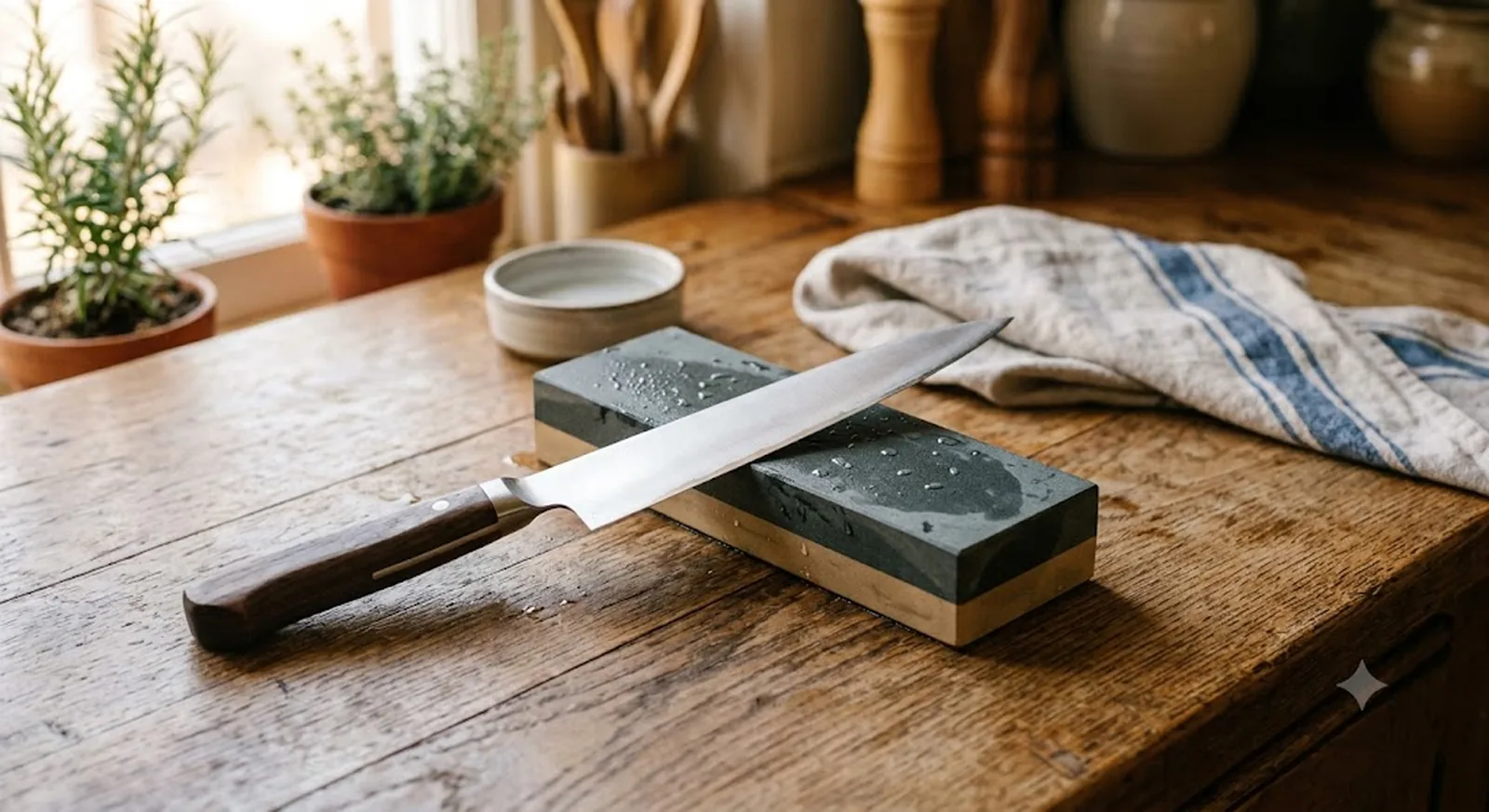
If you want the sharpest possible edge and don’t mind earning it, this is the one. Reviewers working on damaged, stamped starter knives describe the 1000-grit side rebuilding a genuinely usable edge from a badly chipped starting point, and on harder Japanese-style blades the 6000-grit side is repeatedly credited with a finish sharp enough to shave arm hair without catching — a level of sharpness the electric options on this list don’t quite match according to the same buyer feedback. The built-in angle guide helps beginners find a consistent angle instead of guessing, and because you’re doing the work by hand, it’s the only sharpener here that adapts to literally any blade angle you choose.
The honest con: there’s a real learning curve. First-time users commonly report a long first session and an uneven edge along part of the blade before the technique clicks. And if you’re working on a very dull, damaged edge, skipping straight from 1000 grit to 6000 without enough passes can leave micro-scratches the fine side won’t fully polish out — you sometimes need a coarser stone first for genuine repair work, not just maintenance. We walk through the actual stroke technique, pressure, and angle-holding in how to sharpen a kitchen knife at home, so consider this the “which stone to buy” half of that guide.

Work Sharp Precision Adjust — Best for Nailing the Right Angle
This one splits the difference between a whetstone and an electric sharpener: it’s a manual, abrasive-belt system, but the knife clamps into a guide arm that holds a dialed-in angle for you — roughly 15 degrees for a Japanese-style knife, closer to 20 for a Western-style one. Unlike freehand whetstone work, that means the same angle on every single pass without relying on hand-eye control, and reviewers consistently describe the resulting edge as noticeably more even than what they got freehand, in less time.
The honest con: setup takes a couple of minutes per knife, which adds up if you’re doing a whole block at once, and knives with a curved belly near the tip (a santoku, for instance) are trickier to keep flat and fully engaged in the clamp all the way to the point.

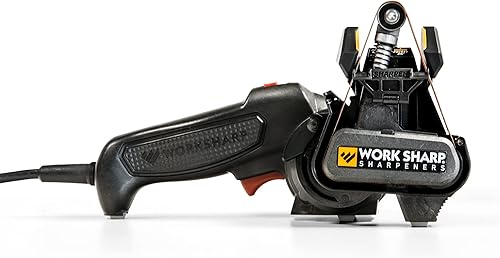
Work Sharp MK2 — Best for Reviving a Neglected Blade
For a stamped starter knife with a couple of small chips in the edge, the MK2 shows up repeatedly in reviews as the sharpener that brings a blade back from genuinely unusable in just a few passes. The coarse belt removes steel fast, which is exactly what a repair job — as opposed to routine maintenance — actually calls for.
The honest con: it removes noticeably more metal than a knife needs for regular upkeep, so it’s best treated as a repair tool for a damaged or long-neglected blade, not a weekly sharpener, and the coarsest belt setting sheds real, visible metal dust across the counter. If your knives are already in decent shape, one of the gentler options above will keep them there without wearing down the blade as fast.
AccuSharp — Best Zero-Learning-Curve Pick
Two pulls through the slots, no plugging in, no clamps, no grit progression to think about — and verified buyers across all three steel categories consistently report a working edge back in under a minute. If you just want your knives to cut a tomato without sawing at it and have zero interest in the mechanics of sharpening, this is the tool that asks the least of you.
The honest con: it sharpens at one fixed, relatively wide angle, nowhere near the roughly 15 degrees a Japanese-style blade actually wants. It’s a good fast rescue for a Western-style knife or a budget set, but it’s not what I’d reach for on the one nicer knife in the block — for that, see a full rundown of affordable chef’s knives worth buying if you’re due for an upgrade instead of just a sharpening session.

Why Sharpening Angle Actually Matters
Every knife sharpener on this list makes a claim about angle, and it’s worth understanding why that number changes depending on what knife you own. Japanese-style knives are typically sharpened to somewhere around 15 degrees per side, which is possible because the steel is harder — often 60-62 HRC or higher — and can support a thinner, more acute edge without chipping under normal use. Western-style knives from German-leaning brands are usually sharpened closer to 20 degrees per side, because the softer steel (roughly 56-58 HRC) needs the extra thickness for durability, especially if you cook with a rocking motion instead of a straight push-cut.
That’s not a minor spec. A fixed-angle pull-through sharpener like AccuSharp is built around the wider, Western-style angle — great for the knife it’s designed for, genuinely wrong for a Japanese-style blade it’ll never get properly sharp. An electric sharpener with selectable stages, or a whetstone where you control the angle yourself, adapts to either. Before you buy a knife sharpener, it’s worth actually knowing which camp your knives fall into — check the manufacturer’s spec sheet, or just note whether the knife came from a Japanese maker (aim narrower) or a European one (aim wider). Getting your knife’s actual sharpening angle right matters more than which specific sharpener you buy.
Whetstone Grit, Explained
If you go the whetstone route, the grit numbers aren’t just marketing. A 1000-grit stone is the standard starting point for a dull knife — coarse enough to rebuild a real edge without wasting excessive steel. A 6000-grit stone doesn’t sharpen so much as it refines: it polishes the edge left by the 1000 side into something noticeably smoother-cutting, which is why most beginner-friendly stones (including my pick above) are sold as a 1000/6000 combination.
The exception worth knowing: if a blade is very dull or has actual damage, jumping straight from 1000 to 6000 can leave faint scratches the fine side isn’t aggressive enough to fully remove. For ordinary maintenance sharpening — the kind most home cooks actually need every few months — a 1000/6000 combo stone is genuinely enough. It’s only real repair work, like fixing a chip or reprofiling a badly worn edge, where you’d want a coarser stone in the 400-grit range first.
Which Knife Sharpener Should You Actually Buy?
If you own mostly Western-style knives (most German brands, most department-store block sets): the Chef’sChoice 15XV or the AccuSharp both suit the wider angle these blades want — the Chef’sChoice if you want a more refined, longer-lasting edge, the AccuSharp if you want the fastest possible fix.
If you own Japanese-style knives (santoku, gyuto, nakiri) or a mix of both styles: skip the fixed-angle pull-throughs entirely. The whetstone or the Work Sharp Precision Adjust are the only two picks here that can actually hit the narrower angle these blades need without ruining the edge.
If one knife in your block is genuinely neglected or chipped: start with the Work Sharp MK2 to repair it, then switch to a gentler option for maintenance going forward so you’re not removing more steel than you need to every time.
If you just want something that works without becoming a hobby: the Chef’sChoice 15XV is the closest thing to a “set it and mostly forget it” answer, and it’s the one most likely to satisfy someone who just wants a straightforward recommendation.
Whatever you land on, remember a knife sharpener is only half the equation — the 7 cuts every home cook actually needs get dramatically easier once the blade doing them is actually sharp. A lot of what feels like a knife skills problem is really a dull-knife problem in disguise.
FAQ
What’s the best angle to sharpen my kitchen knife?
It depends on where the knife was made. Japanese-style blades typically want roughly 15 degrees per side; Western/German-style blades typically want closer to 20 degrees per side. Sharpening at the wrong angle for your steel either fails to get it truly sharp or wears the edge down faster than it should.
Do I need a whetstone if I already have an electric sharpener?
Not necessarily. A good electric sharpener with selectable angle stages, like the Chef’sChoice 15XV, covers most home cooks well. A whetstone is worth adding if you want the sharpest possible edge, own several different knife styles, or just enjoy the process.
How often should I actually sharpen — versus hone — my knives?
Honing (with a steel rod) realigns an edge that’s gone slightly out of true and can happen every few uses. Actual sharpening, which removes a small amount of metal to create a new edge, is usually only needed every few months for a home cook, depending on how often you cook and what you’re cutting.
Can I use the same knife sharpener on Japanese and German-style knives?
Only if the sharpener lets you choose or control the angle. A fixed-angle tool like AccuSharp is built around one angle and won’t properly sharpen a knife designed for the other style. An electric sharpener with multiple stages, a guided clamp system, or a whetstone all work across both.
What’s the difference between sharpening and honing?
Sharpening removes a thin layer of metal to create a new, keener edge — that’s what every tool on this list does. Honing doesn’t remove metal; it just straightens a working edge that’s rolled slightly out of alignment, which is a job for a honing steel, not a sharpener.
Key Takeaways
- The best knife sharpener for you depends on the steel in your knives — Japanese-style blades want a narrower angle (roughly 15°), Western-style blades want a wider one (roughly 20°).
- The Chef’sChoice 15XV was the most consistent all-rounder across all three steel categories compared, with selectable angle stages for both knife styles.
- A 1000/6000 whetstone produced the sharpest true edge of anything tested, but it takes real practice to use well.
- The Work Sharp Precision Adjust is the best pick if you want whetstone-level angle accuracy without the freehand learning curve.
- The Work Sharp MK2 is a repair tool for neglected or chipped blades, not a weekly sharpener — it removes more steel than routine maintenance needs.
- AccuSharp is the fastest, simplest option, but its fixed angle isn’t a real fit for Japanese-style knives.
- A sharp knife also makes basic knife skills easier and safer — a lot of “I’m bad at cutting” is actually “my knife is dull.”